

SpaceX continues to refine its first-generation (Gen1) Starlink constellation through detailed FCC modification filings. This installment covers the technical parameters of the upgraded Gen1 system — beam configurations, spectrum usage, and spectrum sharing frameworks with both GSO and NGSO operators.
Upgraded Gen1 System Overview
SpaceX’s upgraded Gen1 system consists of 4,408 satellites operating in low Earth orbit. The modification application seeks authority to operate with flexible technical parameters across both Ku-band and Ka-band spectrum, including the ability to transmit or receive any number of co-frequency beams (Nco) at a given location — consistent with the modernized sharing frameworks adopted by the Commission for NGSO system inter-sharing.
SpaceX submitted a detailed interference analysis (Appendix B) demonstrating its ability to protect space-to-Earth GSO systems within U.S. territory. For Earth-to-space GSO protection, SpaceX continues to comply with ITU Radio Regulations Article 22 EPFD (Equivalent Power Flux-Density) limits.
Ku-Band Operations
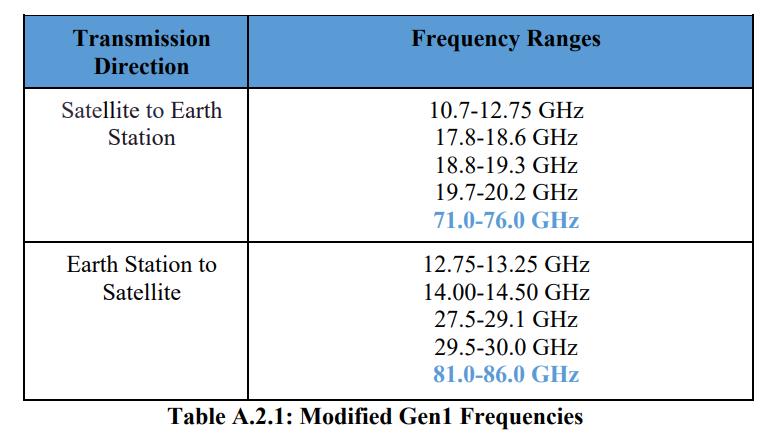
The Gen1 satellites use Ku-band antennas for both uplink and downlink communications. The system is designed to maintain constant power flux density (PFD) on the Earth’s surface — as a satellite steers its transmit beam, it adjusts power to stay within applicable PFD limits. This adaptive power management ensures compliance with international and domestic regulations while maximizing link performance.

Key Ku-band design principles:
- Co-frequency beam flexibility: The system can transmit/receive any number of co-frequency beams at a given location, consistent with modernized NGSO-NGSO sharing criteria
- Adaptive PFD management: Power adjusts dynamically based on beam steering angle to maintain regulatory compliance
- GSO protection: Short-term and long-term protection criteria are met for both space-to-Earth and Earth-to-space GSO systems
- NGSO protection: The upgraded 4,408-satellite system complies with modernized inter-system sharing guidelines adopted by the Commission
Ka-Band Beam Parameters
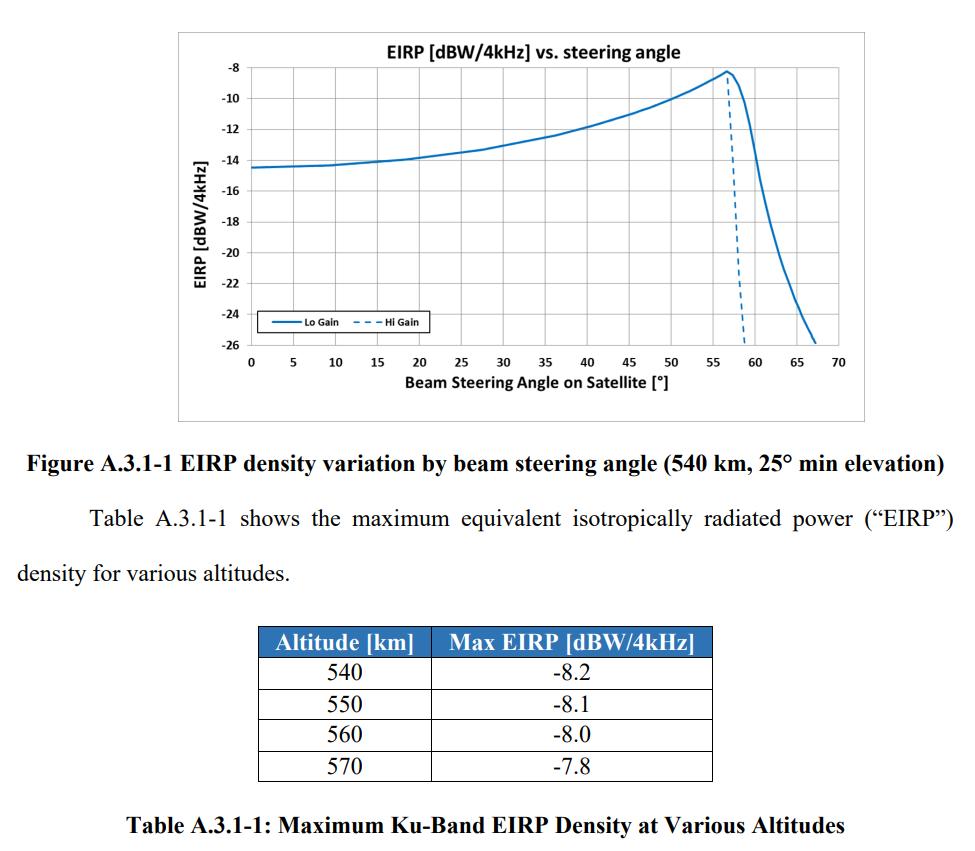
SpaceX proposes to operate modified Gen1 space stations using Ka-band antennas with the following characteristics:
- Minimum gain at boresight: 34.5 dBi
- Maximum gain: 48 dBi
- Polarization: Right-Hand Circular Polarization (RHCP) and Left-Hand Circular Polarization (LHCP) on the same frequencies
- Parabolic antenna receive G/T: 12.9–26.4 dB/K (constant, dependent on antenna gain and frequency, independent of altitude and steering angle)
- Phased array receive G/T: Maximum at nadir (12.9–26.4 dB/K), decreasing at maximum slant range due to antenna gain reduction off-boresight
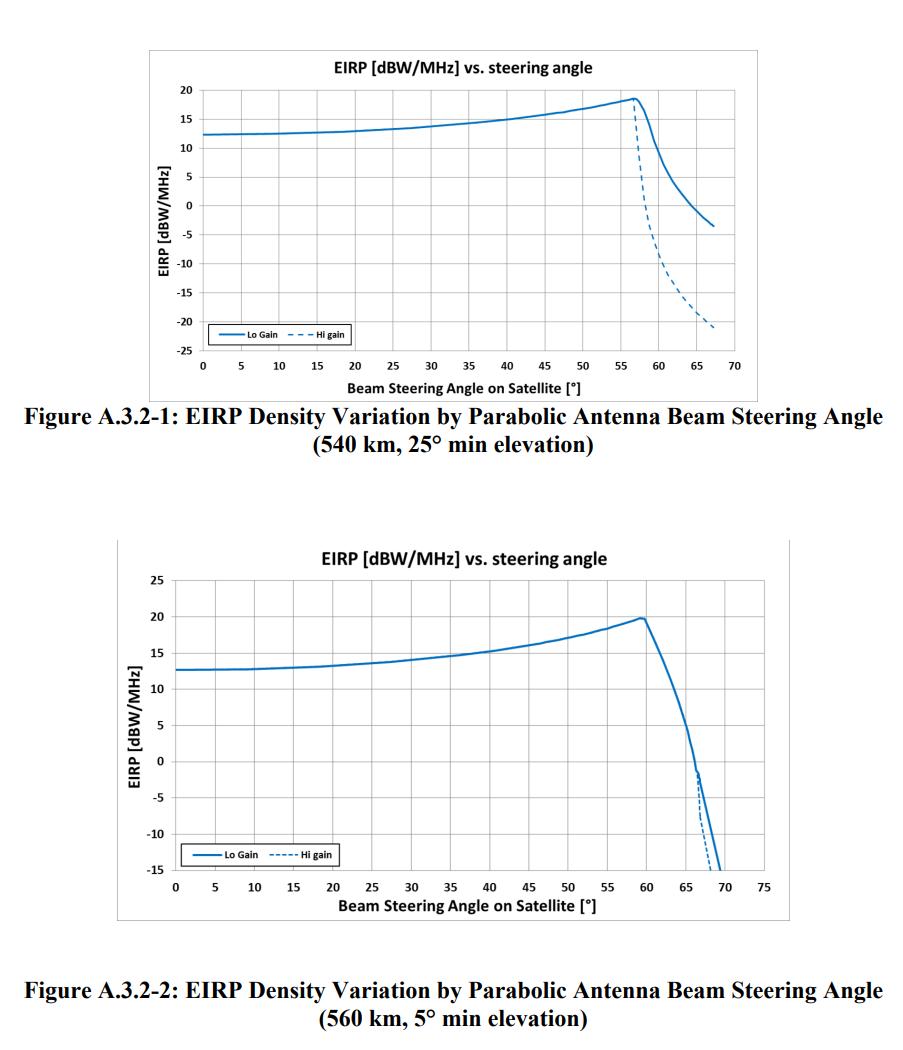
The antenna beam patterns provided in Schedule S cover operations at 540 km altitude at nadir, 25° off-nadir, 45° off-nadir, and maximum slant range — representing the full range of proposed operating altitudes and elevation angles. Additional beam patterns are provided for 560 km altitude at 5° minimum elevation angle for satellites operating at higher inclinations connecting with parabolic earth stations above 62° North latitude.
Adaptive Power Management
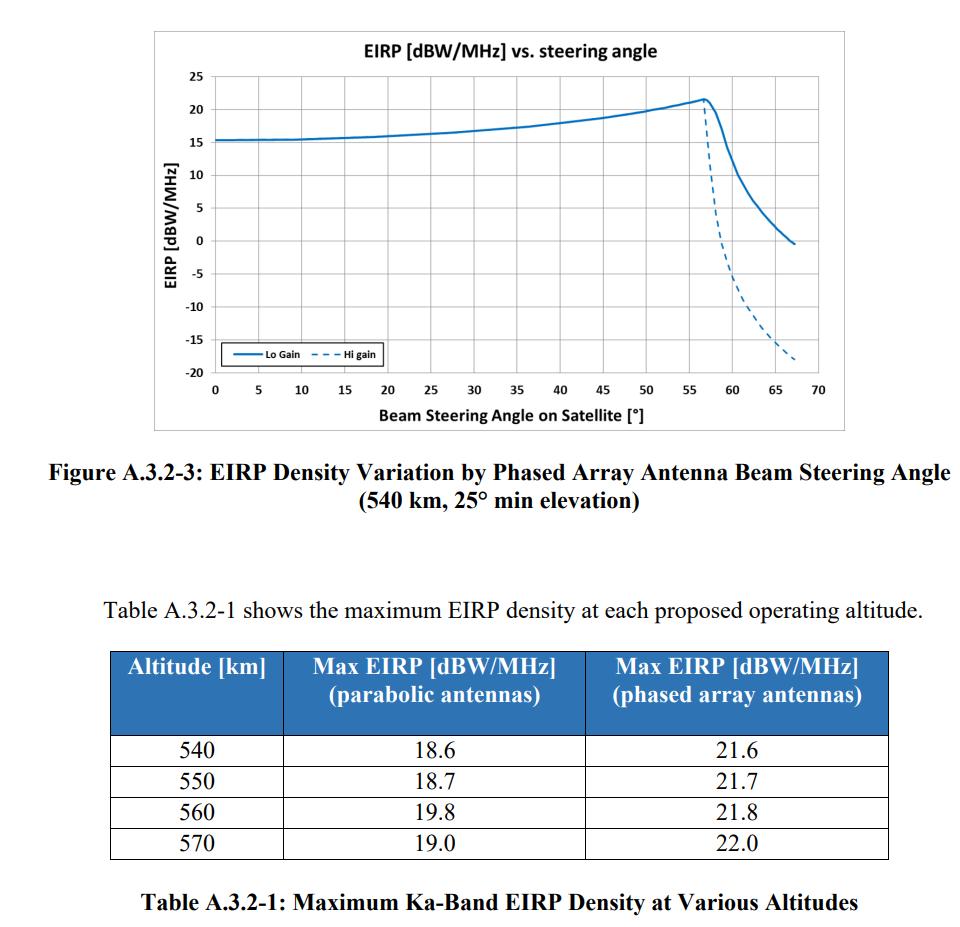
As shown in Figures A.3.2-1 through A.3.2-3 (illustrating operations at nominal 540 km and 560 km orbital shells), when a satellite steers its transmit beam, it adjusts power to maintain constant PFD on the Earth’s surface within applicable limits. This dynamic power management is critical for:
- Regulatory compliance: Ensuring PFD remains within ITU and FCC limits at all beam steering angles
- Interference management: Preventing harmful interference to GSO and other NGSO systems
- Link optimization: Maintaining consistent service quality across the coverage area regardless of satellite geometry
Aomway’s satellite communications engineering team notes that this adaptive PFD approach is becoming standard practice for modern NGSO constellations — it represents a significant evolution from the fixed-beam, fixed-power architectures of earlier satellite systems. The ability to dynamically adjust power per-beam based on geometry is one of the key technical advantages of phased array antennas over traditional parabolic designs.
Spectrum Sharing Framework
SpaceX requests authority to operate with flexible parameters across all authorized spectrum bands in the modification application, including the ability to transmit or receive any number of co-frequency beams (Nco) across all 4,408 Gen1 satellites. This flexibility is consistent with:
- The modernized sharing framework for NGSO-NGSO systems (Appendix A analysis)
- GSO protection requirements including EPFD limits per ITU Article 22 (Appendix B analysis)
- Section 22.5CA operation: “In any country whose administration has indicated its consent, the limits given in Tables 22-1A to 22-1E may be exceeded (see also Resolution 140 (WRC-23))”
SpaceX will adjust operational parameters as necessary to comply with applicable rules, subject to the Commission’s action on any waiver requests in this application. This application does not trigger ITU-R Radiocommunication Bureau re-examination of EPFD compliance.
Technical Significance
This modification filing represents SpaceX’s ongoing effort to maximize the utility of its Gen1 spectrum authorizations through:
- Beam flexibility: Nco operation enables dynamic capacity allocation based on demand
- Multi-band operation: Coordinated Ku-band and Ka-band usage optimizes overall system throughput
- Sharing compliance: Modernized frameworks enable coexistence with GSO and other NGSO systems
- Adaptive power control: PFD-based power management ensures regulatory compliance across all operating geometries
For satellite communication system designers and spectrum managers, this filing provides valuable insight into the technical parameters and sharing methodologies that enable large-scale NGSO constellation operations. Aomway’s engineering team monitors these filings closely as they establish technical precedents that influence satellite system design across the industry.
Have questions about satellite spectrum sharing, NGSO system design, or FCC technical filing requirements? Contact Aomway at [email protected] — our satellite communications team provides regulatory consulting, interference analysis, and system design services.
Frequently Asked Questions
1. What is EPFD and why does it matter for NGSO-GSO spectrum sharing?
EPFD (Equivalent Power Flux-Density) is a regulatory metric defined in ITU Radio Regulations Article 22 that limits the aggregate power flux-density that NGSO satellite systems can produce into GSO satellite receiving earth stations. Because NGSO satellites move relative to GSO satellites, a single NGSO satellite’s transmissions could potentially interfere with GSO earth stations as it passes through the GSO arc. EPFD limits ensure that the statistically aggregated interference from all NGSO satellites in a constellation remains below harmful levels. SpaceX complies with both short-term (single-event) and long-term (aggregate) EPFD limits by dynamically adjusting satellite beam pointing, power levels, and in some cases ceasing transmission when beams approach the GSO arc.
2. What does “Nco” (co-frequency beams) flexibility mean in practice?
Nco flexibility means a satellite can simultaneously transmit multiple beams using the same frequency to different locations. This is a significant departure from traditional satellite systems where each frequency is typically assigned to one beam per satellite at a time. With phased array antennas, SpaceX can reuse the same frequency across multiple beams — effectively multiplying spectral efficiency. For example, if a satellite serves 10 locations within its footprint, Nco operation allows it to use the same Ku-band frequency for all 10 beams simultaneously, provided the beams are spatially separated enough to avoid self-interference. This capability is critical for maximizing the throughput of a high-capacity NGSO constellation.
3. How does adaptive PFD management work?
Power Flux-Density (PFD) is the power per unit area arriving at the Earth’s surface from a satellite transmitter. Regulatory limits cap PFD to prevent interference with terrestrial services sharing the same band. As a satellite steers its beam away from nadir (straight down), the path length to the ground increases, the beam spreads over a larger area, and the geometry changes. Without adaptive management, a fixed-power beam would produce different PFD values at different steering angles — potentially exceeding limits at some angles and wasting power at others. SpaceX’s system continuously adjusts transmit power based on beam steering angle to maintain PFD within regulatory limits across all operating geometries. This is implemented through the satellite’s phased array antenna control system, which calculates the required power reduction for each beam based on its current steering angle and altitude.
4. Why does SpaceX need both Ku-band and Ka-band for Gen1?
Ku-band (12-18 GHz) and Ka-band (26-40 GHz) serve complementary purposes. Ku-band offers better rain-fade resistance and wider geographic coverage per beam, making it suitable for consumer terminal service. Ka-band offers significantly more bandwidth (enabling multi-Gbps throughput per beam) but is more susceptible to rain attenuation, making it better suited for gateway links between satellites and high-performance ground stations with large antennas. By operating in both bands, Starlink can use Ku-band for user links (where moderate throughput and weather resilience matter) and Ka-band for high-capacity gateway backhaul (where maximum throughput is critical and gateway antenna gain compensates for rain fade). This dual-band architecture is a key factor in Starlink’s ability to deliver high-speed service to consumer terminals with relatively small, affordable dishes.
5. How do modernized NGSO-NGSO sharing frameworks differ from older approaches?
Earlier NGSO sharing frameworks (pre-2020) were based primarily on static frequency division — each NGSO system operated in its own allocated spectrum, preventing interference but wasting capacity. Modernized frameworks, adopted by the FCC in recent rulemakings, enable dynamic spectrum sharing between NGSO systems through: (1) Time-domain sharing — systems coordinate to avoid transmitting on the same frequency at the same time toward the same area. (2) Power-based sharing — systems operate at power levels low enough that mutual interference remains below harmful thresholds. (3) Angle-based exclusion — systems avoid transmitting when their beams align with another system’s satellites. (4) Database-assisted coordination — real-time spectrum databases track satellite positions and beam directions to enable dynamic conflict resolution. SpaceX’s filing demonstrates how these principles enable multiple large NGSO constellations (Starlink, OneWeb, Kuiper) to coexist in shared spectrum. Aomway’s regulatory team tracks these frameworks as they directly impact satellite system design requirements and market entry strategies for new constellations.
Need satellite spectrum analysis, FCC compliance consulting, or NGSO system design support? Contact Aomway at [email protected] — our team provides end-to-end satellite communications engineering and regulatory services.
