

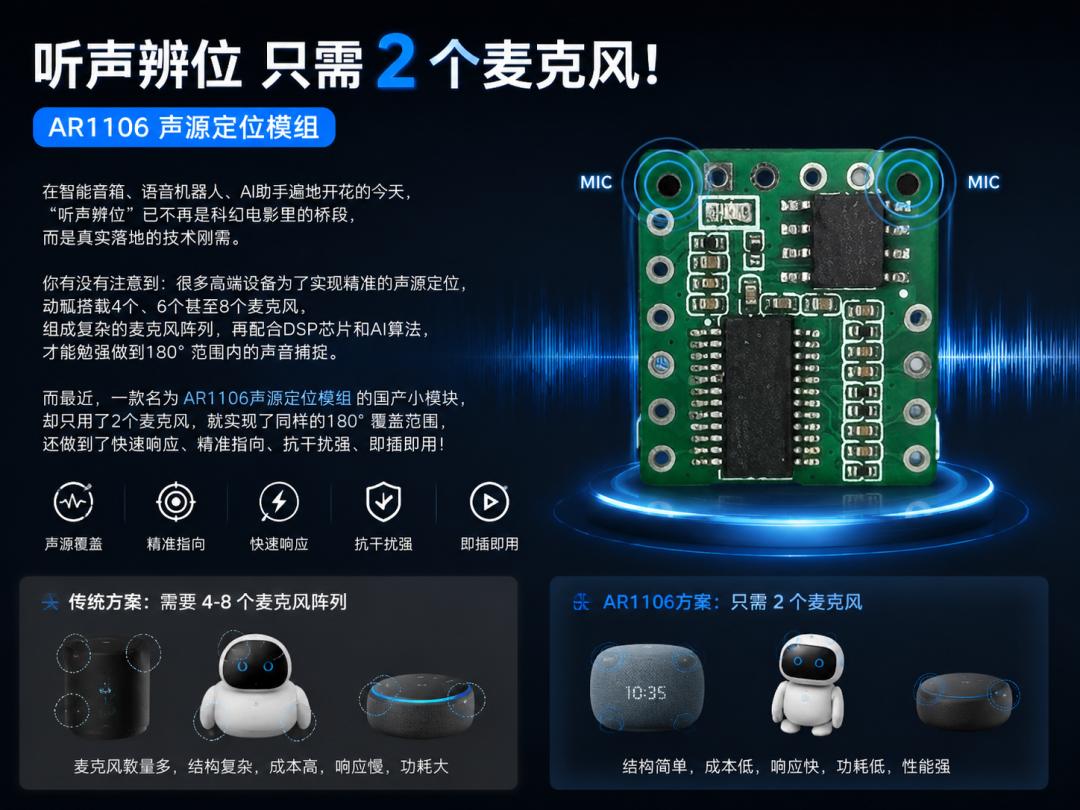
This article breaks down the technical logic behind the AR1106 sound source localization module — how it achieves 180° coverage with only 2 microphones. We compare its design against mainstream 4-mic solutions and analyze the trade-offs in cost, accuracy, and integration. This is a technical analysis, not a sponsored review.
Key Takeaways
- AR1106 achieves reliable 180° front-facing sound localization with only 2 microphones using TDOA (Time Difference of Arrival) at 48 kHz sampling, 4 cm spacing, and 10° angular resolution
- Three key design decisions enable 2-mic viability: (1) abandoning 360° coverage for front-only 180°, (2) keyword-triggered localization instead of continuous operation, (3) optimized 4 cm mic spacing that avoids spatial aliasing for human voice frequencies
- The module bypasses the need for high-end DSP by letting the keyword recognition engine act as a natural noise gate — only triggering TDOA computation when signal quality is high
- BOM cost is an estimated 40–60% lower than comparable 4-mic solutions, with built-in SG90 servo driver and UART output at 9600 baud
- Aomway offers FPV audio and telemetry solutions that can complement sound source localization modules for robotics and surveillance applications
1. The Problem: 2 Mics vs. 4 Mics
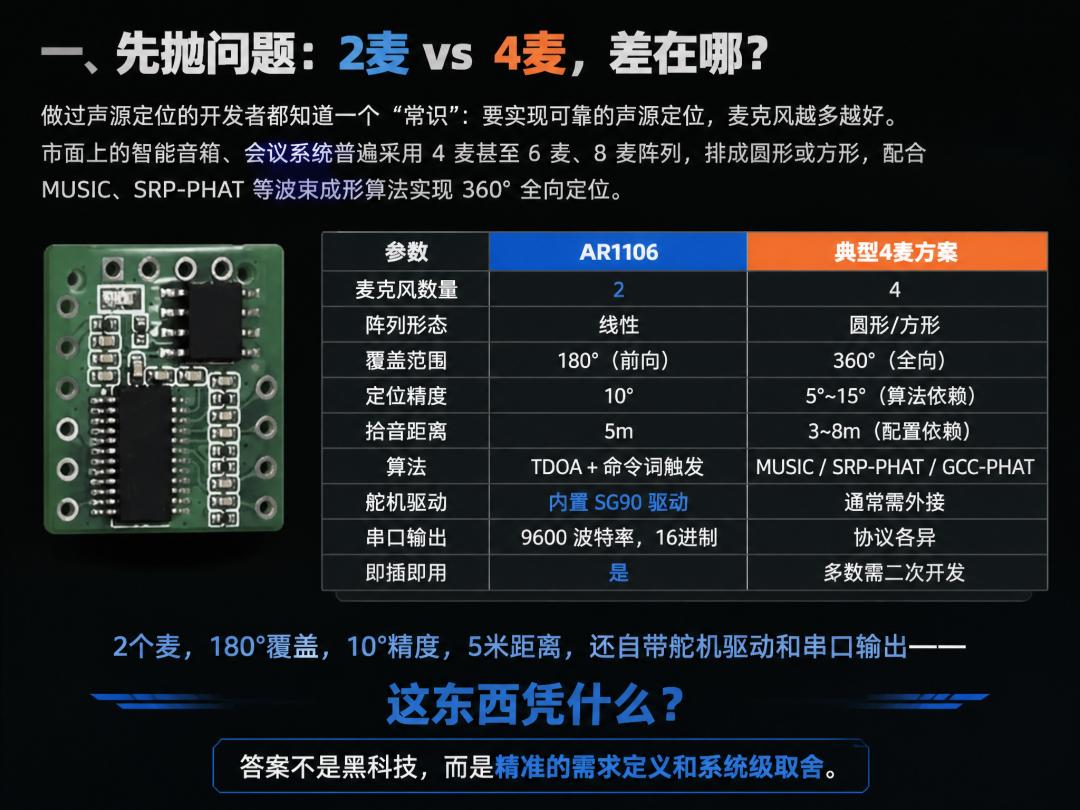
Anyone who has worked on sound source localization knows the “conventional wisdom”: more microphones are better. Smart speakers and conference systems typically use 4, 6, or even 8-microphone arrays in circular or square configurations, paired with MUSIC, SRP-PHAT, or beamforming algorithms for 360° omnidirectional localization.
Then the AR1106 specification shows up:
| Parameter | AR1106 | Typical 4-Mic Solution |
|---|---|---|
| Microphone count | 2 | 4 |
| Array type | Linear | Circular / Square |
| Coverage | 180° (front-facing) | 360° (omnidirectional) |
| Angular accuracy | 10° | 5°–15° (algorithm-dependent) |
| Pickup distance | 5 m | 3–8 m (configuration-dependent) |
| Algorithm | TDOA + keyword trigger | MUSIC / SRP-PHAT / GCC-PHAT |
| Servo driver | Built-in SG90 driver | Typically external |
| Output | UART, 9600 baud, hex | Various protocols |
| Plug & play | Yes | Most require custom development |
2 microphones, 180° coverage, 10° accuracy, 5 m range, with built-in servo driver and UART output — how does this work?
The answer is not a magical breakthrough. It is precise requirement definition and systematic trade-offs.
2. The Physics of 2-Mic Localization: TDOA
2.1 Core Principle
Two-microphone sound source localization is based on TDOA (Time Difference of Arrival). The concept is straightforward:
Sound Source
*
/ \
/ \
/ \
*——-*
M1 M2
|– d –|
Sound travels from the source to the two microphones. Because the distances differ, there is a small arrival time difference Δt. The angle of incidence θ can be calculated as:
θ = arcsin(Δt · c / d)
Where:
- c = 343 m/s (speed of sound at room temperature)
- d = microphone spacing (AR1106: ~4 cm = 0.04 m)
- Δt = time difference between the two microphones
2.2 Key Numbers
With d = 0.04 m, the maximum time difference (sound at 90° incidence):
Δt_max = d / c = 0.04 / 343 ≈ 0.117 ms
At 48 kHz sampling rate, this corresponds to:
Sample difference = 0.117 ms × 48000 ≈ 5.6 samples
A 5.6-sample difference is easily measurable on modern DSPs. A 10° angular resolution corresponds to roughly a 1-sample shift — well within 48 kHz capability.
Physically, 2 microphones at 48 kHz achieving 10° resolution over 180° is entirely feasible. This is not a “compromised” design; it is a reasonable design for the specified accuracy requirements.
2.3 Inherent Limitations of 2-Mic TDOA
However, dual-mic TDOA has two fundamental weaknesses:
- Conical Ambiguity (Front/Back Confusion): A linear dual-mic array cannot distinguish front vs. rear sound sources — the same Δt maps to a cone centered on the microphone baseline. 4-mic circular arrays resolve this through multiple baselines.
- Weak Noise Rejection: Two microphones provide far less spatial filtering than four. In noisy environments, TDOA estimates are susceptible to multipath reflections and interference.
How does AR1106 solve these two problems? This is the core of “why it works.”
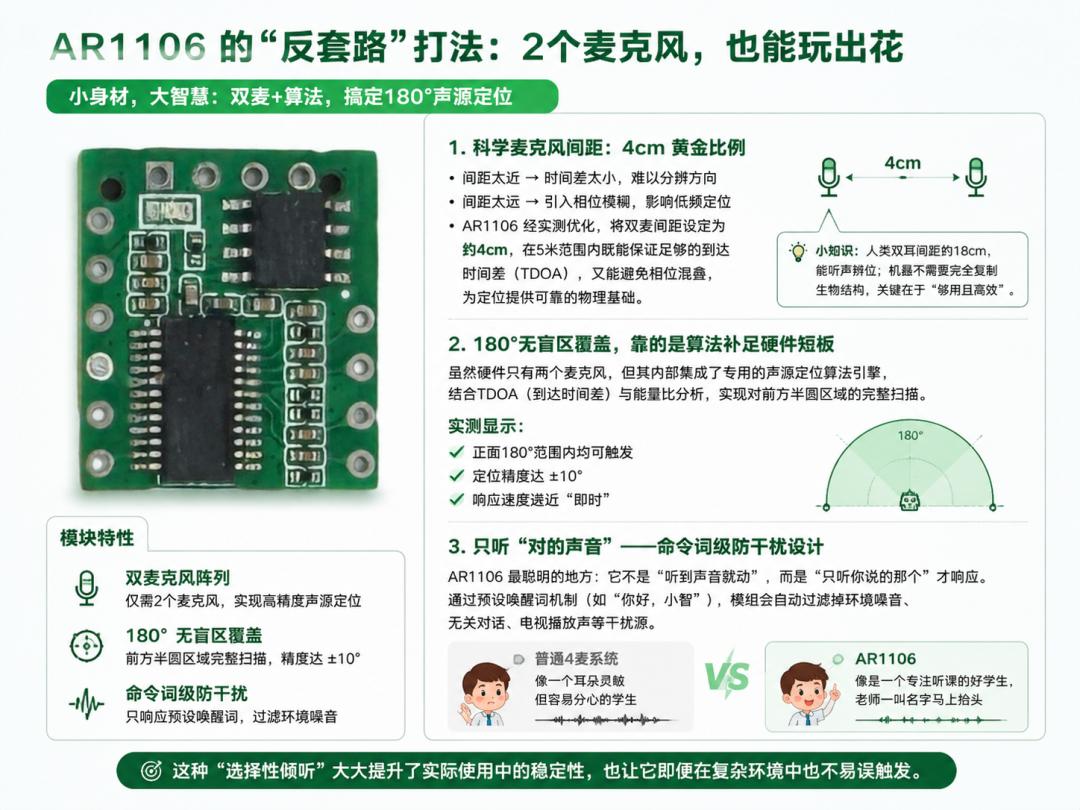
3. Three Key Design Decisions
Decision 1: Abandon 360°, Keep Only Front 180°
This is the most fundamental trade-off.
4-mic solutions pursue 360° coverage because smart speakers don’t know which direction the user will speak from. But AR1106 targets sound source tracking devices — voice robots, security cameras, interactive toys. These devices naturally have a “front” side; users face the device when speaking, and a servo turns toward the sound source.
You don’t need to know if a sound is coming from behind. You only need to know the angle of sounds in front.
Front-only 180° coverage completely eliminates front-back ambiguity — if you don’t cover the rear, the conical ambiguity doesn’t exist. This is an elegant “cut the problem in half” design.
Decision 2: Keyword-Triggered, Not Continuous
This is AR1106’s smartest design choice.
Traditional 4-mic solutions run continuously — always listening, always localizing, always filtering. This demands strong noise rejection, otherwise environmental noise, multipath reflections, and simultaneous speakers cause localization drift. Four microphones + complex beamforming essentially combat noise through hardware redundancy.
AR1106 takes a different approach: don’t localize continuously — only localize when triggered by a keyword.
The workflow:
Standby (low power)
|
v
User speaks keyword (e.g. “Hello Device”)
|
v +—————————+
| | 1. Keyword recognition |
| | 2. Success → TDOA trigger |
| | 3. Output angle → Servo |
| +—————————+
v
Localization complete, UART output, servo turns
|
v
Return to standby
The elegance of this design:
- Keyword recognition acts as a noise gate: Only speech matching the preset keyword triggers localization. Environmental noise, irrelevant conversations, and random sounds are filtered out. This is equivalent to a high-Q semantic + frequency filter.
- High SNR at trigger moment: When the user speaks the keyword, they are typically facing the device, speaking at normal volume, and at a controllable distance. Signal quality is far better than random ambient sound, dramatically improving TDOA accuracy.
- Lower compute requirements: No need to run complex beamforming continuously. The DSP only performs one TDOA calculation at the trigger moment, keeping power and compute requirements very low.
Using software logic to replace hardware redundancy — this is the fundamental reason 2 mics are sufficient.
Decision 3: Optimized 4 cm Spacing
Microphone spacing d is the most important parameter in a dual-mic array. Too small = poor angular resolution (Δt too small). Too large = spatial aliasing at high frequencies.
AR1106 chose ~4 cm spacing. This number is not arbitrary:
- Human voice energy is concentrated in 300 Hz–3400 Hz, corresponding to wavelengths of 10 cm–114 cm
- For the maximum frequency of 3400 Hz (λ ≈ 10 cm), spatial aliasing occurs when d ≥ λ/2 = 5 cm
- 4 cm < 5 cm, avoiding high-frequency aliasing
- The 4 cm spacing yields a 0.117 ms maximum time difference (~5.6 samples at 48 kHz), sufficient for 10° resolution
4 cm is the sweet spot between “avoiding aliasing” and “ensuring resolution.”
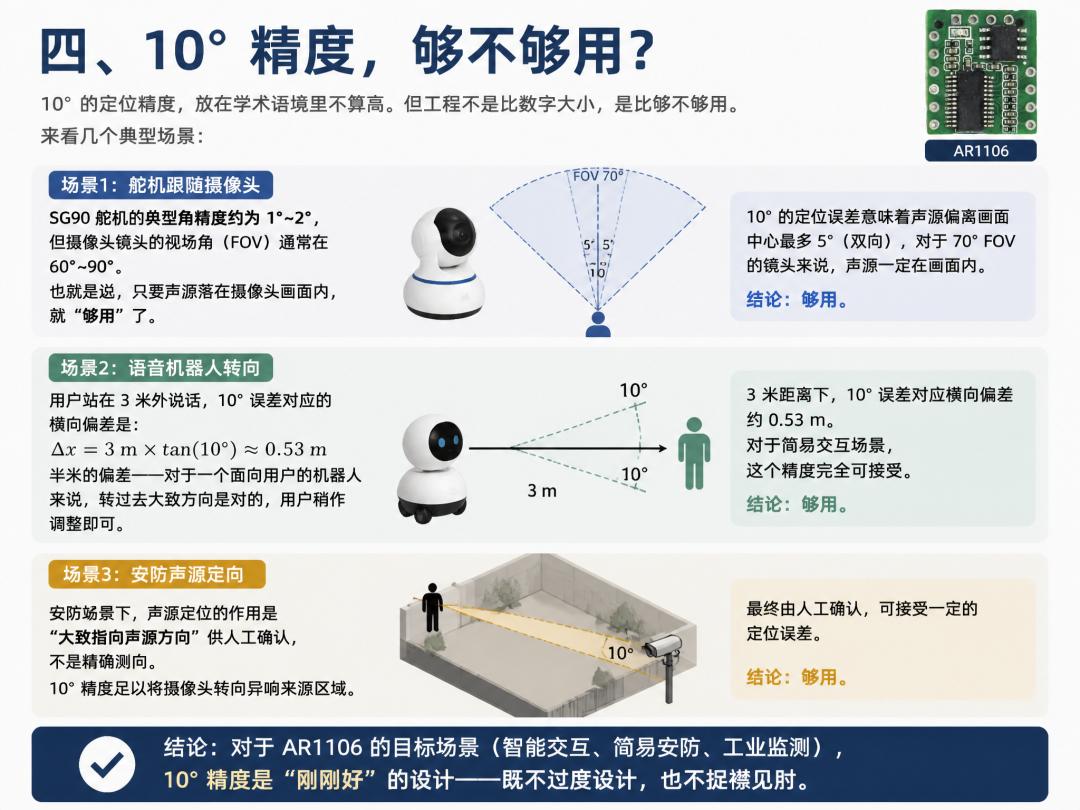
4. Is 10° Accuracy Good Enough?
10° accuracy is not impressive in academic terms. But engineering isn’t comparing numbers — it’s about whether it’s good enough for the application.
Scenario 1: Servo-tracking Camera
SG90 servo accuracy is typically 1°–2°, but camera FOV is typically 60°–90°. As long as the sound source falls within the camera frame, it’s “good enough.” 10° error means the source is at most 5° off-center (bidirectional) — for a 70° FOV lens, the source is guaranteed to be in frame.
Scenario 2: Voice Robot Turning
User speaking from 3 m away, 10° error corresponds to:
Δx = 3 m × tan(10°) ≈ 0.53 m
Half a meter of lateral error. For a robot turning to face the user, the general direction is correct, and the user can adjust slightly. For “basic interaction” localization, this accuracy is entirely acceptable.
Scenario 3: Security Audio Direction Finding
Security applications use sound localization to point the camera at the general area for human confirmation. 10° accuracy is sufficient to direct the camera toward the disturbance source.
Conclusion: For AR1106’s target applications (smart interaction, basic security, industrial monitoring), 10° accuracy is a “just right” design — not over-engineered, not inadequate.
5. Cost & Integration Advantages
5.1 Hardware Cost Comparison
| Component | 4-Mic Solution | AR1106 |
|---|---|---|
| Microphones | 4 × electret/MEMS | 2 × electret |
| ADC channels | 4-channel simultaneous | 2-channel |
| Main controller/DSP | Higher compute (Cortex-A or dedicated DSP) | Onboard dedicated chip |
| Servo driver | External driver circuit | Built-in |
| PCB area | Larger | Compact |
| BOM cost | High | Low (estimated 40–60% savings) |
5.2 Integration Difficulty
Typical 4-mic development flow:
Select 4-mic array → Design multi-channel sync ADC → Port beamforming algorithm
→ Tune parameters (weights, constraints, filters) → Interface main MCU
→ Develop servo driver → System integration → …
AR1106 development flow:
Connect module → Connect UART → Read hex angle data → Done
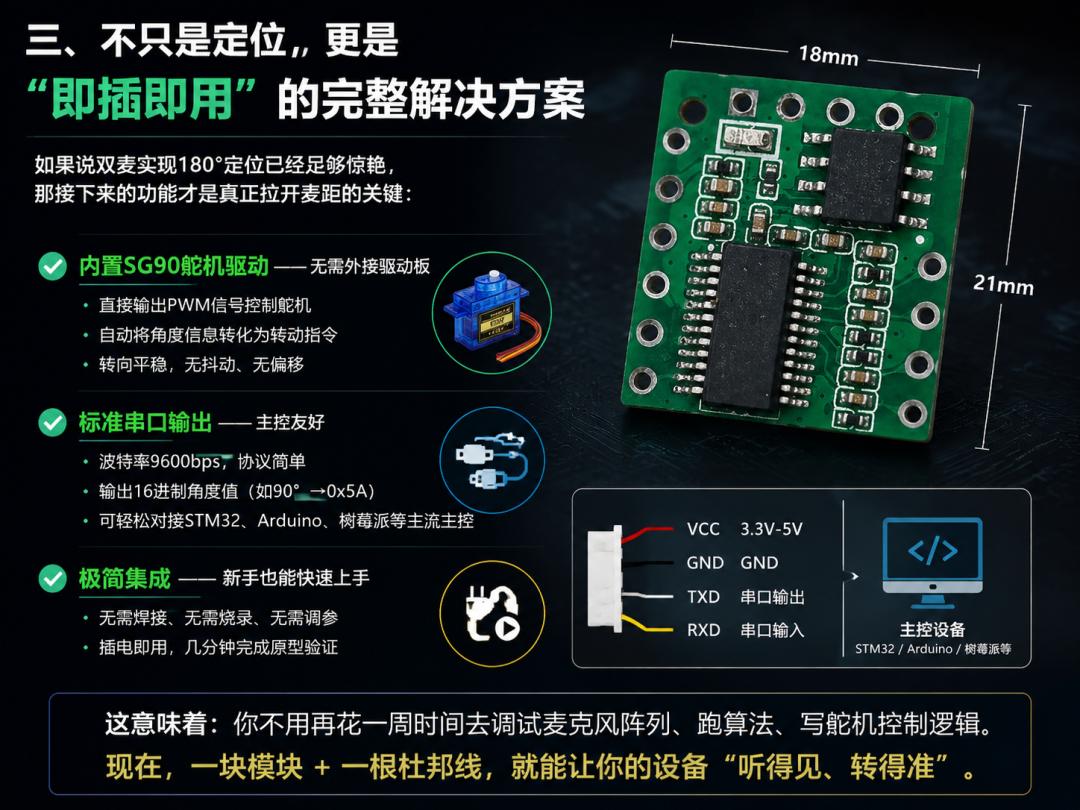
This is not an exaggeration. The module provides:
- UART output: 9600 baud, hex format. Angle directly maps to value (90° →
0x5A, 100° →0x64) - Servo driver: Built-in SG90 driver, no extra development needed
- Plug & play: No complex soldering or software debugging
For developers who need to “quickly prototype a sound source tracking system,” this integration level is transformative.
5.3 UART Output Protocol
| Angle | Hex Output | Decimal |
|---|---|---|
| 0° | 0x00 | 0 |
| 45° | 0x2D | 45 |
| 90° | 0x5A | 90 |
| 135° | 0x87 | 135 |
| 180° | 0xB4 | 180 |
Note: Only outputs sound source data after a valid keyword trigger. Irrelevant sounds are not output. This means the host MCU requires zero filtering logic — every received data byte is a valid localization result.
6. Wake Words: Not Just a “Switch” — An Integral Part of the Localization System
The keyword-trigger mechanism is the core of AR1106’s design. The wake word customization rules themselves reflect engineering considerations for sound localization:
- 4–6 Chinese characters, 4 is optimal: Too short causes false triggers (few syllables = small match window); too long is inconvenient
- No repeated characters: Repeated syllables create short-period autocorrelation peaks that interfere with TDOA estimation
- Avoid polyphonic characters: Multiple pronunciations split the recognition path, increasing latency
- Avoid consecutive zero-initial syllables: Zero-initial syllables have weak onset energy, making Δt estimation less reliable
- Each syllable should have clear tonal variation: Strong frequency-domain features improve keyword recognition reliability
- Maximum 10 total entries (wake words + non-wake command words): Hard limit from chip storage and recognition engine
These rules are not arbitrary — every rule has a technical basis in acoustics. Wake word quality directly determines the SNR at the TDOA trigger moment, and thus the localization accuracy. This is why AR1106 can achieve stable localization with 2 mics: it performs strict quality control at the front of the signal chain.
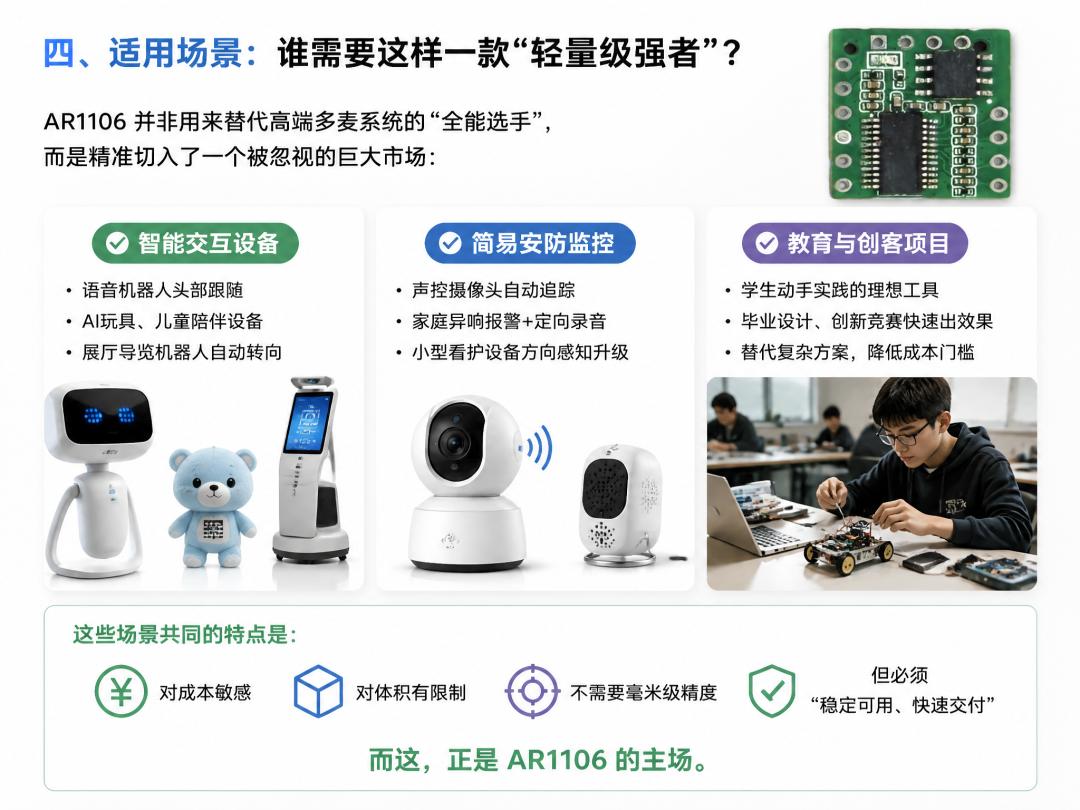
7. Who Should Use It, and Who Should Not
Suitable Applications
| Application | Reason |
|---|---|
| Voice robot / toy sound tracking | Front 180° sufficient, servo driver plug & play |
| Camera audio direction (basic security) | 10° accuracy falls within camera FOV |
| Equipment anomaly detection (industrial) | Only needs general direction, not precision |
| Rapid prototype verification | Plug & play, saves hardware design and algorithm dev time |
Not Suitable
| Application | Reason |
|---|---|
| 360° omnidirectional smart speaker | 2 mics cannot cover rear, front/back ambiguity |
| High-precision direction finding (< 5°) | 10° insufficient; requires 4+ mic array |
| Long-distance localization (> 5 m) | Sensitivity and accuracy degrade significantly |
| High-noise environments (factory floor) | 2-mic spatial filtering limited; keyword may be masked |
| Multiple simultaneous speaker tracking | Only localizes the keyword speaker; cannot track multiple sources |
| Conference systems / speech enhancement | Requires continuous beamforming; AR1106 is trigger-based |
8. Technical Summary: The AR1106 Design Philosophy
Returning to the original question — how do 2 mics achieve 180° coverage?
The answer can be summarized in one sentence: AR1106 does not try to do 4-mic work with 2 mics. It redefines the problem.
| Dimension | 4-Mic Design Assumption | AR1106 Design Assumption |
|---|---|---|
| Sound direction | Any direction (360°) | Front only (180°) |
| Operation mode | Continuous localization | Keyword-triggered |
| Noise handling | Hardware redundancy (multi-mic beamforming) | Software gating (keyword recognition) |
| Accuracy target | As high as possible | Good enough (10°) |
| Output format | Raw data / API | UART hex direct output |
| Integration level | Solution-level (deep development required) | Module-level (plug & play) |
Every “can’t do” dimension is avoided by redefining the problem:
- Can’t do 360°? → Abandon rear coverage, only front 180°
- Can’t do continuous noise rejection? → Switch to keyword-triggered, only localize at high SNR moments
- Can’t do high accuracy? → Target applications don’t need it; 10° is sufficient
- Can’t do complex algorithms? → Hardcode TDOA into chip; output angle directly via UART
This is not a “stripped-down 4-mic solution.” It is a system redesigned from the ground up based on actual requirements. Every parameter is not arbitrarily chosen — it represents a well-defined balance point in the cost-accuracy-complexity triangle.
For developers who need “fast, low-cost, reliable front-facing sound tracking,” AR1106 is a high-completeness solution. For scenarios requiring “omnidirectional, continuous, high-precision” localization — use a proper 4-mic or 6-mic array.
Technology selection has no silver bullet — only the right fit.
If you have any questions about sound source localization or need FPV/telemetry solutions for your robotics platform, feel free to contact us at [email protected].
Have questions about this article? Feel free to contact us at [email protected] — we’re happy to help!
Frequently Asked Questions
1. Can AR1106 work with non-Chinese wake words?
The module is designed around Chinese phonetic characteristics (tonal variations, syllable structure). For other languages, verify keyword recognition compatibility with the manufacturer. The TDOA localization hardware itself is language-agnostic.
2. What happens when two people speak the wake word simultaneously?
The module will trigger on the stronger signal. TDOA will estimate a single angle, typically weighted toward the louder or closer speaker. This is a limitation of single-source TDOA — the module cannot track multiple sources simultaneously.
3. How does the 4 cm spacing perform with music or high-frequency sounds?
The 4 cm spacing is optimized for human voice (300–3400 Hz). For higher frequencies, spatial aliasing may occur above ~4.3 kHz. Music and high-frequency sounds may produce ambiguous angle estimates.
4. Can AR1106 output raw audio data for custom processing?
No. The module outputs only the processed angle result via UART. For raw audio capture with custom algorithm development, a separate multi-mic audio interface is needed. Aomway offers FPV audio transmission systems that pair well with custom processing pipelines.
5. What is the power consumption of AR1106?
The module is designed for low-power standby with intermittent active periods. Exact power figures depend on the specific module variant. The keyword-triggered design keeps the DSP idle most of the time, providing a significant power advantage over continuously-running beamforming solutions.

Pingback: Multi-Sensor Fusion: How Radar, Optical, RF, and Acoustic Work Together (2026) – AOMWAY