
Key Takeaways
- Radar detection of a drone reduces to four steps: transmit, reflect, receive, process. Everything else is refinement of step four.
- Six parameters describe a drone echo: range, radial velocity, azimuth and elevation, radar cross section (RCS), micro-Doppler from the rotors, and track behaviour over time.
- Plain Doppler radar measures radial velocity first — not the drone’s full flight speed. That distinction causes most of the confusion in detection-range claims.
- Micro-Doppler is the signature that separates a quadcopter from a bird: rotor blades chop the echo into a periodic comb of sidebands around the body return.
- Nine processing steps turn raw I/Q samples into a track, and the order matters: filter, range, Doppler, range–Doppler, clutter suppression, CFAR, STFT, beamforming, RCS estimation.
In one line: a drone is a small, slow, low-flying target with a tiny radar cross section, which is exactly the target class classical radar was never optimized for. What makes it detectable is not raw power but the structure of the echo — the periodic micro-Doppler comb from spinning rotors, the track that behaves nothing like a bird’s, and a processing chain that suppresses ground clutter before it drowns the return. Aomway breaks down the physics, the six characterizing parameters and the nine processing steps in the order they actually run.
How Radar Detects a Drone
- Transmit. The radar antenna radiates electromagnetic waves into the air.
- Reflect. The waves strike the drone’s body, wings and rotors and scatter back.
- Receive. The receive antenna collects the returning echo.
- Process. The radar analyses the echo’s time, frequency, amplitude and phase to characterize the target.
The Six Parameters That Characterize a Drone
1. Range
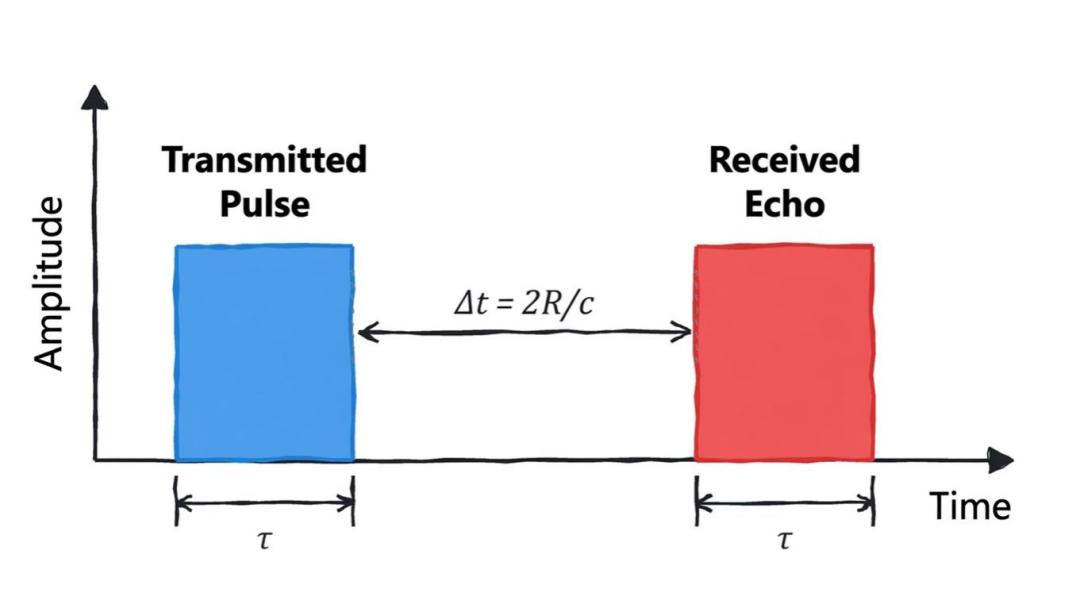
Range tells you how far the drone is. The principle is a time-of-flight measurement: how long the signal took to travel out and back.
R = c · Δt / 2, where R is range, c is the speed of light and Δt is the round-trip time.
2. Velocity
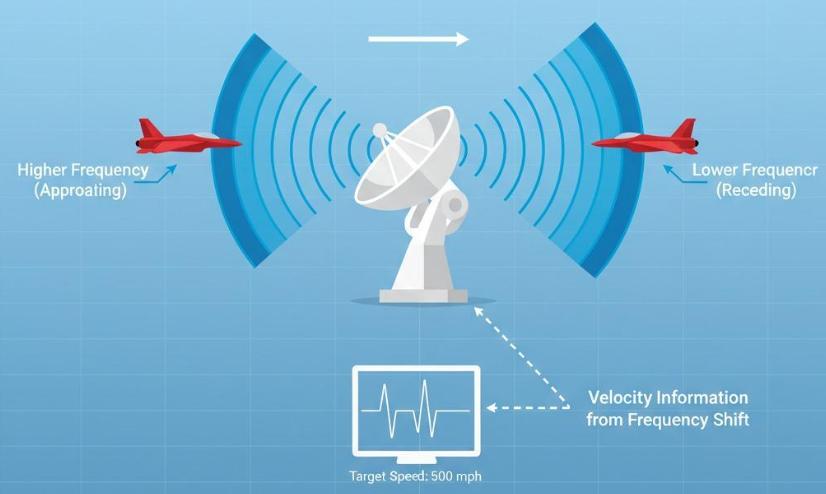
Velocity describes the drone’s motion relative to the radar, and it comes from the Doppler effect: motion shifts the frequency of the returned echo. A drone flying toward the radar and one flying away produce Doppler shifts of opposite sign.
Important caveat: a conventional Doppler radar measures radial velocity first, which is not necessarily the drone’s full flight velocity. A drone crossing the radar’s line of sight at speed can show a small radial component, and a hovering drone shows almost none.
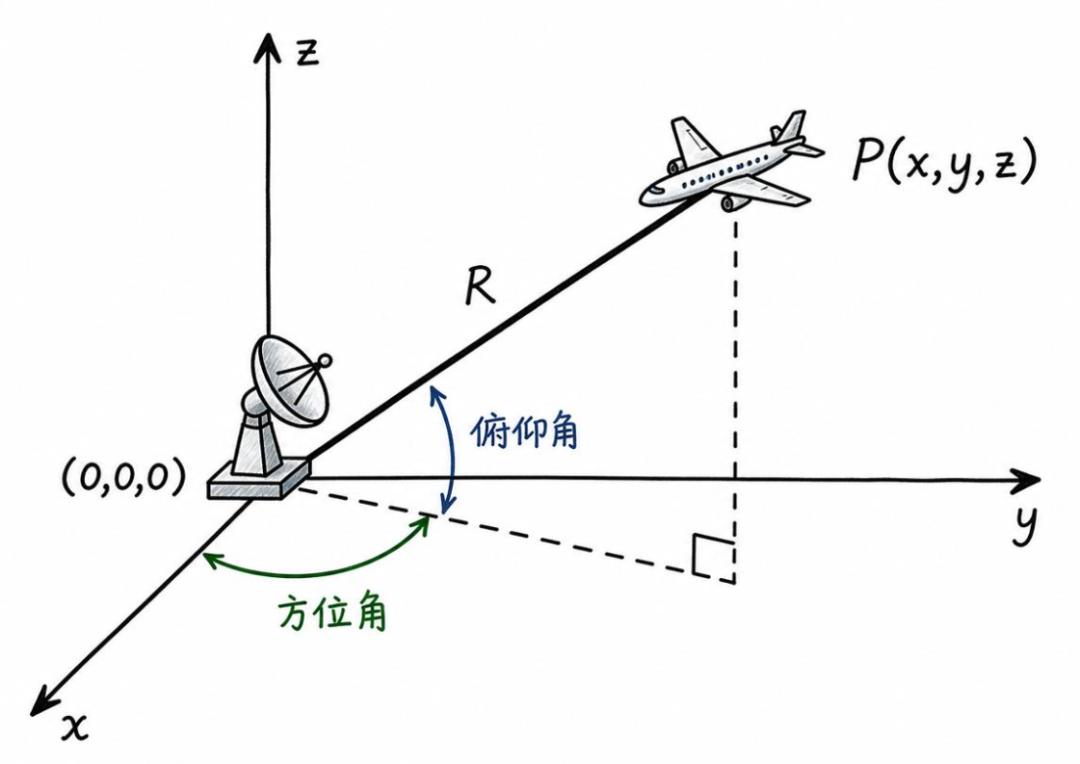
3. Angle: Azimuth and Elevation
Angle tells you which direction the drone is in. Azimuth is its horizontal bearing relative to the radar; elevation is its vertical angle. Combined with range, the two angles fix the drone’s position in space (longitude, latitude, altitude).
4. Radar Cross Section (RCS)
RCS is one of the most important radar signatures of a drone. In plain terms, it expresses how strongly the drone scatters the radar’s electromagnetic energy. The unit is usually square meters (m²) or dBsm.
RCS = limr→∞ 4πr² · |Es|² / |Ei|², where Es is the scattered field, Ei the incident field and r the range.
A larger RCS usually means a stronger echo, but the value also depends on range, target attitude and frequency. RCS is not the drone’s physical area — a small plastic quadcopter can present a larger RCS from one aspect angle than from another, because of how its surfaces and rotors happen to reflect.
5. Micro-Doppler
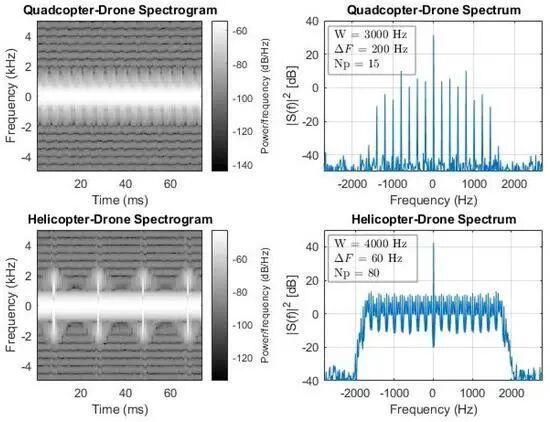
This is the signature most worth studying in drone detection. Rotors spin at high speed and add small extra Doppler shifts on top of the body’s motion. From those shifts a radar can extract:
- rotor rotation characteristics
- rotor rotation frequency
- the periodic modulation the rotors impose on the echo
- the difference between a drone echo and a bird echo
The spectrograms below show why this works: a quadcopter produces a fairly regular comb of sidebands around the body return, while a helicopter drone produces a much denser, wider comb because of its different blade count and rotation rate.
6. Track Features
Track features describe the drone’s motion over a period of time: flight path, direction of travel, speed changes, altitude changes, and manoeuvres such as turns or hovering. These help classify what the target is doing — and a track that stops, hovers and reorients is a strong indicator of a multirotor rather than a bird.
The Radar Signal Processing Pipeline
Take a drone flying in the air. Once the radar has captured raw data, the processing chain runs in six stages:
- Raw echo data — ADC sampling, I/Q complex signal.
- Signal preprocessing — filtering, denoising, DC correction.
- Range and Doppler processing — FFT, pulse compression, range–Doppler map.
- Clutter suppression and detection — MTI, MTD, CFAR.
- Angle estimation and feature analysis — beamforming, STFT, RCS estimation.
- Output — range, velocity, direction, scattering features and detection results.
The Nine Processing Methods
1. Signal Preprocessing and Filtering
What it does: removes unwanted interference so the echo is easier to analyse.
- FIR filters — digital filtering with easily controlled phase response.
- IIR filters — frequency selectivity with a lower filter order.
- Low-pass and band-pass filters — keep only the band of interest.
- Wavelet denoising — suppress noise while preserving some local structure.
- DC removal — reduce the DC offset of the receive chain.
2. Range Processing
What it does: determines how far away the drone is.
- Range FFT — the standard approach in FMCW radar.
- Matched filtering — improves detection of a known waveform’s echo.
- Pulse compression — for pulse-compression radar.
- High-resolution range profile (HRRP) — analyses the target’s scattering distribution along the range axis.
3. Doppler Processing
What it does: determines whether the drone is moving, and how fast along the radar’s line of sight.
4. Range–Doppler Processing
What it does: puts range and velocity on a single map, so a target appears as a localized blob in the range–Doppler plane instead of two separate one-dimensional peaks.
5. Clutter Suppression (MTI / MTD)
What it does: reduces the influence of ground, buildings and other irrelevant reflections.
- MTI — moving target indication; suppresses stationary or slowly varying clutter.
- MTD — moving target detection using a bank of Doppler filters.
- Clutter map — records the background clutter distribution and uses it during detection.
- Adaptive filtering — adjusts the filter according to measured clutter characteristics.
6. CFAR Detection
What it does: decides which peaks in the echo are probably real targets. Constant false alarm rate detection sets the threshold adaptively from the local background level, so the false-alarm rate stays roughly constant whether the radar is looking at empty sky or a cluttered horizon.
7. STFT Time–Frequency Analysis and Micro-Doppler Extraction
What it does: shows how the echo’s frequency changes over time — the tool that makes rotor signatures visible.
8. Beamforming and Angle Estimation
What it does: determines which direction the drone is in, by combining the signals from an antenna array.
9. RCS Estimation and Echo Feature Extraction
What it does: analyses the drone’s own electromagnetic scattering characteristics, which vary with aspect angle and can be used as a classification feature.
Nine Methods at a Glance
| Method | Problem it solves | Typical output |
|---|---|---|
| Filtering / preprocessing | What if the echo is noisy? | Filtered waveform |
| Range FFT | How far away is the drone? | Range profile |
| Doppler FFT | How fast is it moving? | Velocity spectrum |
| Range–Doppler processing | Where is it, and how fast? | 2D heat map |
| MTI / MTD | What if ground clutter is too strong? | Clutter-suppressed data |
| CFAR | Where might a real target be? | Detection points |
| STFT | What do the rotors look like? | Time–frequency plot |
| Beamforming | Which direction is it in? | Angle spectrum |
| RCS estimation | How strongly does it scatter? | RCS curve |
For a sense of scale, the demonstration plots in the original article show two synthetic targets at about 25 m and 54 m on the range profile, a radial velocity peak near 1.5 m/s on the Doppler spectrum, and a clearly periodic ridge in the STFT plot once the rotor modulation is present. Those are illustrative values from a demo figure, not measured drone data.
Have questions about this article? Feel free to contact us at [email protected] — we’re happy to help!
Frequently Asked Questions
Why is a drone hard to detect with radar?
Because it is small, slow and low. A plastic multirotor has a tiny radar cross section, it flies in the clutter band near the ground, and its radial velocity is often low enough to be filtered out as stationary clutter. Detection depends more on processing than on transmit power.
Does Doppler radar measure the drone’s actual speed?
No, not directly. It measures radial velocity — the component along the radar’s line of sight. A drone flying tangentially can show almost no Doppler shift even at high speed, and a hovering drone shows none. Full velocity requires tracking over multiple measurements.
How can radar tell a drone from a bird?
Mainly through micro-Doppler and track behaviour. Spinning rotors modulate the echo into a periodic comb of sidebands at the blade-passage frequency, which a bird’s flapping does not produce. Tracks also differ: birds glide and flap irregularly, while multirotors hover, stop and reorient.
What is RCS and is it the drone’s physical size?
RCS is a measure of how strongly the target scatters radar energy back, in square meters or dBsm. It is not the physical area. A small quadcopter can present a larger RCS from one aspect angle than another because of how its body, arms and rotors reflect at that geometry.
Why does CFAR matter so much in drone detection?
Because a fixed threshold either misses small targets or floods the tracker with false alarms. CFAR sets the detection threshold from the local background level, keeping the false-alarm rate roughly constant across empty sky, ground clutter and urban clutter — which is what makes a small, low-RCS target usable.
Source: original Chinese explainer on radar drone detection (WeChat). Original: mp.weixin.qq.com.
About Aomway
Aomway designs and manufactures FPV video transmitters, antennas, cameras and goggle systems for drone pilots worldwide, with more than fifteen years in the UAV industry. Its hardware serves racing, long-range and professional aerial platforms where low-latency video and reliable RF links matter most.