

Key Takeaways
- APM (ArduPilot) and PX4 are two completely different firmware stacks that both run on the same Pixhawk hardware the “APM vs PX4” debate is about software, not hardware
- ArduPilot offers faster onboarding (2 weeks vs 3-4 weeks) due to Chinese-language resources, mature AutoTune, intuitive parameters, and hobbyist-friendly community ideal for agriculture, education, and standard industrial drones
- PX4’s modular uORB architecture, BSD-3 license (allows closed-source), and modern control approach make it the default choice for R&D, algorithm integration, VTOL projects, and commercial mass production
- The deciding factor for commercial teams is often licensing: GPLv3 (ArduPilot) requires open-sourcing modifications, while BSD-3 (PX4) allows fully proprietary commercial use
- For industrial-grade clients, the optimal path is Route B (deep PX4 customization), not Route C (custom firmware from scratch) months vs. years in development, with mature certification pathways
1. Reader Comments That Shifted the Direction
The first 15 articles in this series covered industrial-grade system design IMU selection, multi-sensor fusion, PID tuning, environmental adaptation, OTA updates, and production testing. After publishing them, several reader comments made me stop and think.
On Article #8, A Field Engineer’s PID Tuning Notes, a reader left three consecutive comments:
I’m getting high-frequency vibration with two-blade props. I’ve done dynamic balancing and swapped to soft isolation, but the vibration values in the log keep jumping around. Is this a firmware parameter issue?
My compass errors out as soon as I take off, and GPS keeps losing satellites intermittently. Is this a hardware problem or a firmware fault-tolerance strategy issue?
Your last article talked about log analysis, but when I open my logs I can’t make sense of anything. I’ve tried both Mission Planner and QGC. Can you write a systematic guide on reading logs?
I stared at these comments for a long timeand realized they all pointed tothe same underlying question
I know I need to tune my flight controller, but which platform should I use? And once I’ve chosen, how do I read logs, tune parameters, and start doing secondary development?
Looking further back in the conversation history 05 almost every article after #5 had similar commentsThis was no coincidence 15 articles focused onhow to design a complete systemteams with in-house flight controller developmentfound it very useful, but fordoing secondary developmentreadersbuilding an industrial-grade flight controller from scratchwas not realistictheir starting point wasopen-source flight controllers
So I’ve decided to shift the series into its second phase starting with this article
how to design a complete system open-source flight controllershow to use them
Here we must be upfront about one thing:open-source flight controllers including hardware supplyfirmware customizationand tuning/training services15 The first 15 articles did not emphasize this identitybecause the content leaned towardgeneral engineering experience 16 Starting from this article, we will discusshow to choose specific firmware and how to approach secondary developmentThese are questions weget asked by clients every dayNot being clear about our identitywould appear as false neutrality
With that clarifiedthe content will be more direct
- Among the clients we have servedPhD studentsstartup CTOs CTOand technical leads transitioning into the low-altitude economyall tend to get stuck on the same set of issuesThese are issues we have encountered over years of practiceand we will share what we can
- In our fieldAPM PX4an eternal debateB GitHub Issues 10from the front-line perspective of an industrial mass-production teamthere is not much content that clearly explains thisThis perspectiveis exactly what we can provide
- The upcoming articles will progress fromchoosing firmware first flight checklist log analysis will all be answered in subsequent articles
With that context established, let’s dive in.
2. Clearing Up the Terminology: APM, ArduPilot, Pixhawk, and PX4
Before the comparison, let’s clarify the four most commonly confused terms.
90% of beginners mix these terms up APM Pixhawk PX4They all sound correctbut may refer to completely different things
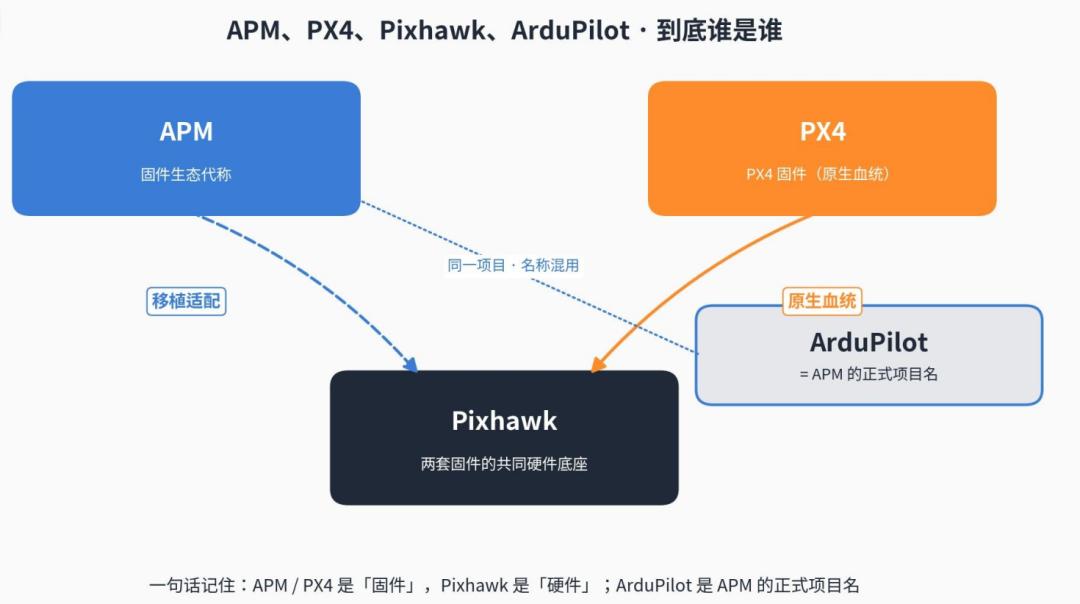
Current Industry Usage (Use This Reference):
- APM in modern usage, refers to ArduPilot a shorthand for the ArduPilot firmware ecosystemWhen you hear in forums B APM APM APMit meansArduPilot open-source flight controllersnot a hardware board
- ArduPilot APMThe official project nameopen-source flight controllersa firmware project maintained by the ArduPilot Foundationwith thousands of contributors worldwide
- Pixhawk open-source flight controllers Pixhawk 12.4.8Cube Pixhawk 5X/6X STM32 F4/F7/H7 MCU
- PX4 a firmware projectled by ETH ZurichETH Zurich DroneCode hosted by the DroneCode Foundationit is the mainstream firmware for industrial-gradeand certification-oriented applications
Key relationship
APM (ArduPilot) and PX4 are two completely different firmware stacks that both run on the same Pixhawk hardware family.
So the APM vs PX4 comparison is not about comparing two hardware boards it’s about comparing two different firmware stacks running on the same hardware.
This is the fundamental premise for everycomparison in this articleUnderstanding this is essentialto understanding whyhardware does not matterfirmware is the variable
Historical evolutionin one sentenceArduPilot the early ArduPilot team built a board called ArduPilotMega old hardwareabbreviated as APMhardware has long been discontinuedArduPilot firmware was later ported to Pixhawk APMthe term evolved froma piece of hardwareintoArduPilot the firmware ecosystem Some old tutorials still refer to APM as hardwarethat is historical baggagedo not let it confuse youModern usage follows the definitions above 4
In the rest of this articlefor brevityI will also use APM ArduPilot PX4 PX4 hardware defaults to Pixhawk / Cube APM PX4 This is what these terms mean here
3. Six-Dimension Comparison: A Ready-to-Use Matrix
Firmware-level differencesfrom a developer perspective6 Dimension each dimension is followed bywhat this difference means in engineering practice
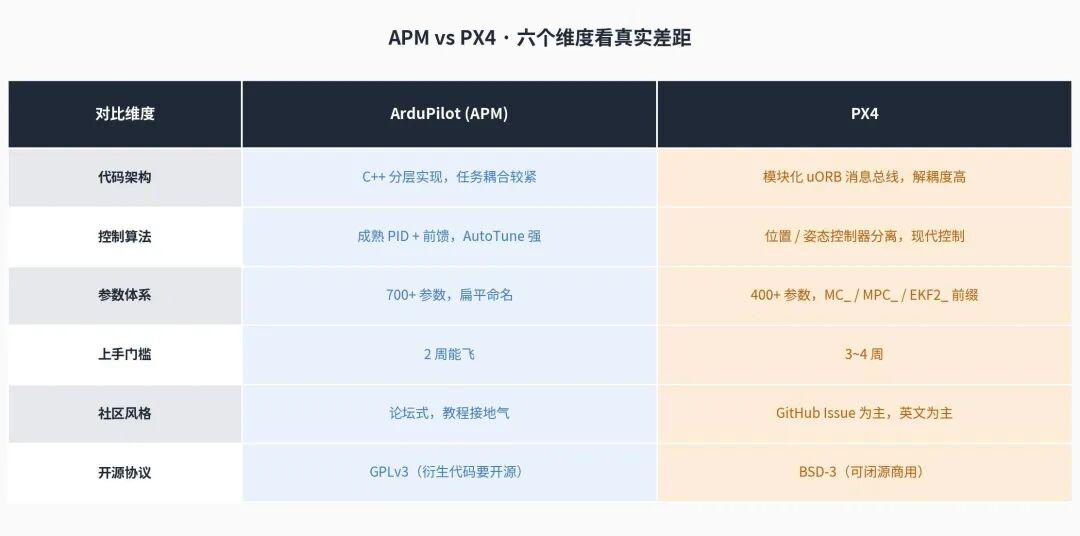
| Dimension | ArduPilot (APM) | PX4 |
|---|---|---|
| Code Architecture | Traditional C++ layered, tighter coupling | Modular uORB message bus, high decoupling |
| Control Algorithm | Mature and stable, PID + feedforward, strong AutoTune | Modern control, separate MC position/attitude controllers |
| Parameter System | 700+ parameters, flat naming | 400+ parameters, prefixed groups (MC_/MPC_/EKF2_) |
| Learning Curve | ~2 weeks to fly (rich community tutorials) | ~3-4 weeks (mostly English docs, unfamiliar structure) |
| Community Style | Forum-based, veteran pilots, beginner-friendly tutorials | GitHub Issue style, developer-focused, primarily English |
| License | GPLv3 (derivative works must be open-source) | BSD-3 (allows closed-source commercial use) |
Below: detailed breakdown of each dimension.
3.1 Code ArchitectureA Monolithic Whole vs vs. a Bunch of Modules
ArduPilot C++ layered architectureFlight control functions organized through class inheritance and virtual functionswith moderate coupling between modulesEarly optimizations for 8 -bit microcontrollers left traces in the codehistorical traces remain in the codeAdvantage: a coherent codebasereads like a bookDisadvantage: replacing any modulerequires changes that propagate across multiple locations
PX4 NuttX RTOS + uORB messaging middlewareEach function is an independent moduleessentially independent tasks or processes/ communicating only through uORB publish-subscribe messagingnaturally decoupledWant to swap the attitude estimatorJust point the subscribed topic to a new modulenothing else needs to change
Aomway Insight: Our development team has worked with both architectures extensively. PX4 modular design typically reduces custom algorithm integration time by 40-60% compared to ArduPilot, a critical factor when your product timeline matters.
Engineering impactIf you just want toget a flight controller flyingarchitecture differences do not matterIf you aredoing secondary developmentreplacing algorithm modulesYang Wenhao VIOPX4 modular architecture saves you at least half the development time
3.2 Control Algorithm PID vs Modern control
ArduPilot PIDMulti-rotor uses angular rate loop + + and three-stage cascade position loop PIDwith intuitive parameter namingATC_RAT_RLL_P = Attitude Controller___PAutoTune AutoTune is very maturethe aircraft flies one pattern and tunes the rate loop P/I/D ArduPilot the most comfortable aspect of this camp
PX4 PID +attitude uses quaternionsposition uses trajectory trackingmulti-sensor fusion uses EKF2MCposition and attitude controllers are completely separate modulesMPC_ MC_ with their own parameter groupsTheoretically better performancebut tuning requires understanding position setpointsattitude setpointsand how rate setpoints cascade through the system
Engineering impactRC hobbyists on ArduPilot ArduPilotcan be flying in one evening with AutoTune PX4 on PX4 requires spending time understanding MPC/MC first month flights are typically conservative.
Aomway Note: For teams who want faster PX4 onboarding, Aomway offers structured tuning training that compresses the learning curve from weeks to days.
3.3 Parameter SystemHuge Flat List vs Prefixed Grouping
ArduPilot total main firmware parameters 700+naming conventionmodule_item_ a flat listMission Planner scrolling takes a long timekeyword search worksmany parameters but each is documented
PX4 total main firmware parameters 400+Prefixed Grouping
MC_*Multi-rotorMPC_*Multi-rotor position controlEKF2_*Kalman filterCOM_*Generic flight controller behaviorNAV_*Navigation and missions
QGC Prefixed Grouping more structured browsingbut physical meaning is more abstract MPC_XY_P it represents the entire position loop feedback ratio
Engineering impactBeginners find ArduPilot parameter list feelsmany but understandable PX4 few but confusingArduPilotparameter template copyingthe community has parameter templates for nearly every airframecopy and tweak, ready to fly
3.4 Learning Curve2 vs 3-4
ArduPilotMission Planner Chinese interface + abundant Chinese tutorials + B + domestic forums + Wikihighest density of getting-started resourcesnearly any problem can be found by keyword searchTeams we have trained consistently reportfrom zero to completing a waypoint mission2
PX4QGroundControlQGChas both Chinese and English UIbut official documentation is primarily Englishdeep issues require searching GitHub Issues Discuss.px4.ioChinese tutorials are significantly fewer than ArduPilot far fewer in numberfrom zero to completing a waypoint mission3-4 weeks is typicalif not comfortable with English documentation 6
Engineering impactThis gap is not about capabilityit is about resource densityArduPilot RC hobbyist-friendly PX4 English technical documentation-friendly whether your team has someone comfortable reading English technical docsdirectly determines PX4 onboarding speed.
Aomway Tip: Not sure which team structure fits your project? Contact Aomway for a free consultation on your firmware strategy.
3.5 Community StyleForum Veterans vs GitHub
ArduPilotdiscuss.ardupilot.org primarily forum-basedaverage daily new posts 20+very fast responsesCore users are veteran pilots + and commercial drone manufacturersmany have been in the field for 10 +before you have fully described your problemsomeone has already posted a log analysistutorials are practical and groundedhow to tune parameters for a specific airframetypically have ready answers
PX4discuss.px4.io + GitHub Issuesaverage daily new posts 5-10core users are developers + research institutions + and commercial firmware engineerswhether this module EKF2 update rate should be adjustedwhy this topic latency is so highhigher technical depthbut less beginner-friendly
Engineering impacthow to tune parametershow to fly an airframe ArduPilot community is more helpful whether this module bugcan I fix it and submit a PR PX4 community is a better fit
3.6 LicenseGPLv3 vs BSD-3
This is often the deciding factor for commercial teams
ArduPilot GPLv3if you modify firmware for commercial productsyou must theoretically open-source your changesincluding any proprietary algorithmsproprietary sensor driversand proprietary communication protocolsin practice many companies push boundariesbut compliance risk always exists
PX4 BSD-3you can modify and sell commerciallyas long as you retain the copyright noticethis is whyand commercial drone manufacturers PX4from both legal risk and trade secretDimension
Engineering impact
- Hobby use, research papers, open-source development → both licenses are fine.
- → PX4 ArduPilot
- Already 6 months into ArduPilot development before considering licensing? Switching firmware could cost you half a year’s development budget.
4. Scenario Selection Matrix: Which Platform for Which Use Case
Comparison completeA Ready-to-Use Scenario Selection Matrix
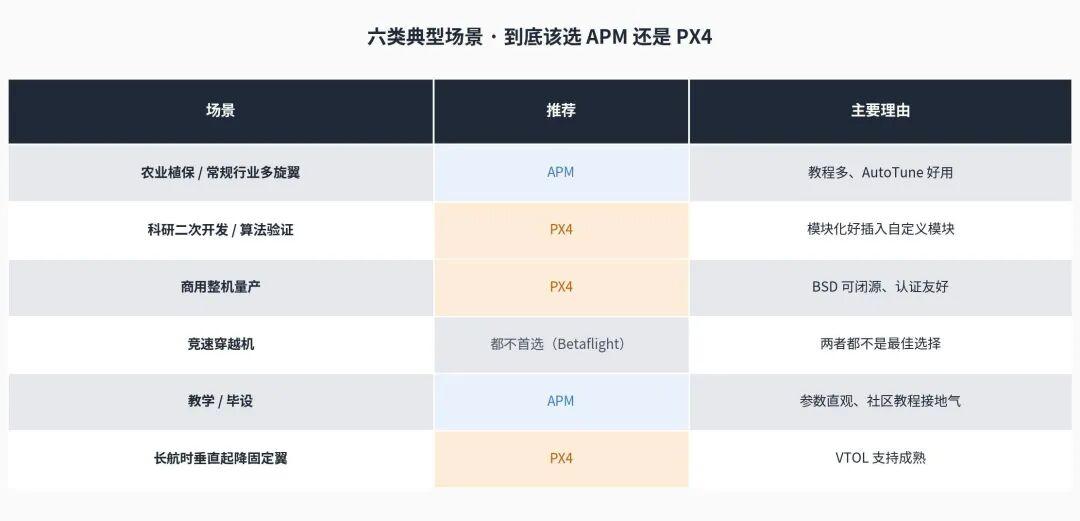
| Recommended | Reason | |
|---|---|---|
| Agriculture spraying, standard multi-rotor industrial drones | APM (ArduPilot) | Rich community tutorials, mature AutoTune, easy parameter templates |
| R&D secondary development, algorithm validation | PX4 | Modular architecture easy to integrate custom modules |
| Commercial mass production | PX4 | BSD license allows closed-source, certification-friendly |
| Racing / freestyle drones (FPV) | Neither Betaflight is more suitable | |
| Teaching, university projects | Faster to get started | Intuitive parameters, good visualization |
| Long-endurance VTOL fixed-wing | PX4 | Mature VTOL support, stable state machine |
Each recommendation is expanded below for context.
4.1 Agriculture spraying / standard industrial drones → APM
Agriculture spraying and standard multi-rotor industrial scenariosthe core needs areeasy parameter templatesaccessible tutorialsflyable out of the boxand community backup
ArduPilot has been deeply rooted in these industries for over a decade+whether you are flying 8 13 inch props or 30 the community has similar airframeparameter templatesAutoTune one-click parameter tuningpost a problem in the forum and get replies within hoursfor these scenarios, choose APMis the path of least resistance
4.2 R&D secondary development / algorithm validation → PX4
this directly answersYang Wenhaoquestionyou want to integrate your VIO / / SLAM modules into the flight controller PX4
the reason is straightforwardPX4 modular architecture makesreplacing an estimatorclean and well-definedwrite a new module vehicle_local_position other modulessuch as the position controllersubscribe to this topic, doneArduPilot ArduPilot can also do itbut touches more codemodifying one module may affect EKFlogMavlink multiple interfaces
Research teams get a hidden benefitPX4 ROS/ROS2 mavros / micro-XRCE-DDS integration is very matureyour algorithm nodes can run directly on onboard Linux PX4 uORBfor multi-vehicle coordinationAI SLAM integration teams PX4 is the default answer
4.3 Commercial mass production → PX4
3.6GPLv3 ArduPilot unsuitable for closed-source commercializationfor mass productionindustry solutions CE/FCC/and civil aviation certificationand trade secret protectionPX4 only one path
PX4 with its modular architecturehigh code qualityand a mature DO-178C reference processit is the first choice for civil aviation certificationeVTOLmedical delivery dronesand power grid inspection applicationsall start from PX4 fork
4.4 Racing / freestyle drones (FPV) → neither is first choice Betaflight
to be clearAPM PX4 neither is designed forRacing / freestyle drones (FPV)
Racing / freestyle drones (FPV) the core needs areextreme responsiveness and agilityrequiring control loops at 8kHz / 16kHz high-frequency operationparameters closely coupled to motor characteristicsthe open-source firmware for this domain is BetaflightiNavEmuFlight F4/F7/H7compact flight controllersPixhawk a separate hardware ecosystem from Pixhawk
If your friend says they use Pixhawk for racing dronesit is likely recreationalnot how the racing community does it
4.5 / → Faster to get started
University teachingundergraduate projectsand graduate student onboardingthe core needs areresults within two weeks
ArduPilot Mission Planner Chinese interfaceAutoTune one-click tuningintuitive parametersB and abundant tutorialsa student with zero flight controller experiencerealistically completes a waypoint mission in two weeksPX4 takes one to two weeks longer in teaching scenariosmainly due to documentation language and parameter abstraction
if the project focuses onControl Algorithm/or sensor fusionthat is a different storyPX4 is better as a secondary development basebut if the goal isbuild a flying drone + that completes a specific taskAPM save time
4.6 VTOL → PX4
VTOL fixed-wingVTOLthe fastest-growing airframe categoryrotor lift-offfixed-wing cruiserotor landingthe core challenge isthe state transition logic
PX4 VTOL has a very mature VTOL state machinefour main configurationsTailsitterTiltrotorStandard VTOLQuadplaneall with official reference supportstable transitionsArduPilot VTOLless maturity and documentation density compared to PX4
for long-endurance VTOL PX4 is the more stable choice.
Aomway Project Reference: We recently delivered a VTOL-based long-range inspection solution for a utility client, built entirely on PX4 with custom sensor integration. The project went from specification to flight-ready in under 6 months.
5. One-Sentence Decision Rule + Three Implementation Roadmaps
80% 20%
Building a flying system / already in production / no embedded team → APM
Building a product that needs closed-source / certification / modular development → PX4
both apply → PX4PX4 has a higher ceilingthe learning cost is a one-time investment with long-term returns
choosing is only step onewhat truly determines project successis your implementation roadmapHere are three mainstream implementation routes from engineering practice
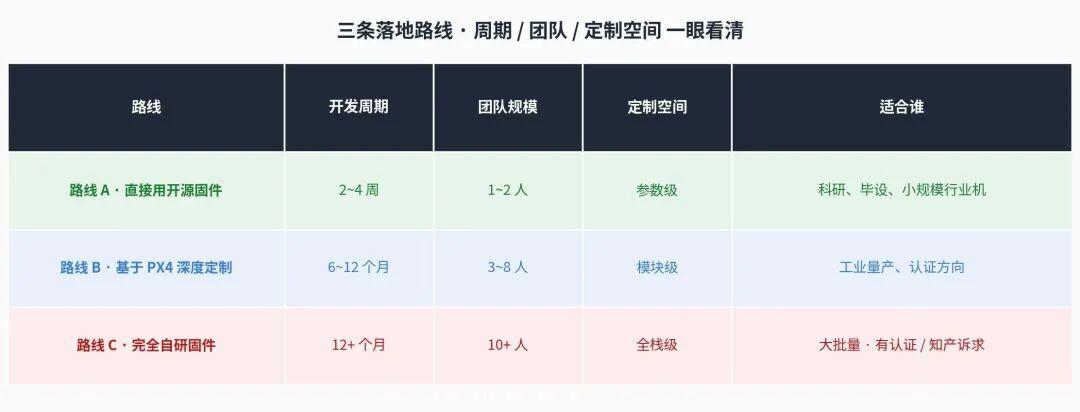
5.1 ADirect Use of Open-Source FirmwareArduPilot PX4
Pixhawk / Cube + stock firmware parameter templates Lua ArduPilot launch PX4without modifying firmware code
Cost magnitude
- Development cycleperson-daysa few to a dozen person-daysmostly spent on parameter tuning and flight testing
- Team: 1 engineer who can read documentation and tune parameters
- Hardware cost: Off-the-shelf Pixhawk/Cube module purchase cost
- License risk: ArduPilot OK if no closed-source mods; PX4 risk-free
- Certification costbasic type approval onlynot civil airworthiness
- Research, university projects, prototype validation
- Small-batch industrial applications (<10 units)
- No embedded firmware engineer on team
Limited customizationyou can only tweak parametersnot change any algorithm logicIf a client requestsadd our own gesture control modulethat kind of requirementyou either work around itusing an external onboard computer via Mavlink or upgrade to Route B
5.2 B PX4 Deep CustomizationBSD Allows Closed-Source
Fork PX4 forkclosed-source modificationscustom estimatorcustom position controllercustom sensor drivers and proprietary communication protocolsand industry-specific featureshardware typically usesPCBPixhawk reference design with modifications
Cost magnitude
- Development cyclesix to eighteen monthsdepending on customization depth
- Team: 1 HW + 2 FW (including 1 with NuttX/RTOS experience) + 1 application + 1 test
- Hardware cost: Custom PCB prototyping + mass production amortization
- License riskBSD-3 Allows Closed-Sourceessentially risk-free
- Certification costCE/FCC type approval achievablecivil airworthiness requires a longer compliance cycle
- Industrial-grade production teams (100+ units)
- Teams needing closed-source core algorithms
- Teams with certification requirements
- Teams delivering industry solutions (agriculture, surveying, law enforcement, power utilities)
This is the mainstream path for industrializationmost eventually go to Route BA for prototypingthen inevitably migrate to Route B
5.3 CCustom Firmware from Scratch
writing flight controller firmware from scratchfully custom hardwareRTOS NuttX / FreeRTOS / RT-Thread / or even bare metalfully custom driversControl Algorithm fully custom ground station
Cost magnitude
- Development cyclemulti-month to multi-year1-2 for industrial-grade stability, typically 2-3
- Team compositioncomplete flight controller R and D team Control Algorithm SDKtypically requires 10
- Hardware cost: Custom PCB
- License risk: Fully proprietary
- Certification: Building from scratch regardless of certification path
- Large-scale production (1000+ units) requiring exclusive technical advantage
- Military, law enforcement, or other special certification requirements
- Teams with sufficient R&D budget and long-term commitment
most teams claiming Route C end up back at Route Bthe reason is simplebuilding an industrial-grade flight controller from scratch number less than a dozen worldwidemost teams overestimate their firmware engineering capabilityand underestimate the industrial stability threshold 1000 units flying for a year in harsh environments without failure)
5.4 Core Insight Across All Three Routes
I’ve compared these three routes many times and consistently reach the same conclusion:
for the vast majority of industrial clientsthe optimal path is not C B Deep Customization PX4
Reason
- Development cycleB is months C is yearsmarket windows do not wait
- The certification path is establishedPX4 reference processcustom firmware starts from zero
- Low long-term maintenance costPX4 upstream continuously iterates fork your fork can regularly merge upstream fixes bug you own every bug
wanting to build custom firmware needing to build custom firmwareare two different thingsThis may offend some teamsbut it needs to be said
Choosing the right flight controller platform is a critical decision that affects your entire development timeline, certification path, and long-term maintenance costs.
Aomway specializes in helping teams make and execute this decision — from hardware supply and firmware customization to training and mass production. We have delivered over 100+ flight controller solutions across agriculture, surveying, public safety, and industrial inspection.
Contact us at [email protected] — tell us your project requirements, and we will recommend the optimal platform and implementation route within 48 hours.
Aomway provides open-source flight controller hardware, firmware customization, and tuning/training services from Pixhawk-compatible boards to deep PX4 customization for mass production. Contact us at[email protected]for a consultation.
Have questions about this article? Feel free to contact us at [email protected] — we’re happy to help!
Frequently Asked Questions
Can I run ArduPilot on PX4 hardware?
Yes. Both ArduPilot and PX4 run on the same Pixhawk/Cube hardware family (STM32 F4/F7/H7 based). You can flash either firmware onto the same board — but you must use the correct hardware target during compilation.
Do I need to know C++ to use open-source flight controllers?
No, not for basic use. Both ArduPilot and PX4 can be configured entirely through their ground station software (Mission Planner or QGC) using parameters. C++ knowledge is only needed for secondary development and deep customization.
Which firmware has better support for custom sensors?
PX4’s modular uORB architecture makes it easier to add custom sensor drivers without touching the core codebase. On ArduPilot, adding a new sensor typically requires deeper changes across multiple modules.
Can I switch from ArduPilot to PX4 mid-project?
Technically yes, but the migration cost can be significant — different parameter systems, different log formats, different tuning methodology. As covered in the Route B analysis, switching firmware mid-project could cost you months of development time. Plan ahead.
Is PX4 harder to learn than ArduPilot?
For beginners, ArduPilot is faster to get started (about 2 weeks vs 3-4 weeks for PX4), mainly due to abundant Chinese-language resources, more intuitive parameter naming, and mature AutoTune. However, PX4’s learning curve pays off if you need modular development, certification, or closed-source commercialization.
What about Aomway’s flight controller solutions?
Aomway provides both ArduPilot and PX4-based solutions — from off-the-shelf Pixhawk-compatible hardware to deep PX4 customization for mass production. Contact us at [email protected] to discuss which platform fits your project best.
6. What’s Next in This Series
This article covers The next articles will coverhow to use them
The roadmap:
- 17 APM Getting Started from Zero Mission Planner + Pixhawk first flight checklistfrom unboxing to first hoverincluding firmware flashingsensor calibration sequenceRC mappingfailsafe setupAutoTune AutoTune prerequisitesfirst flight These are questions we every pitfall is documented here
- 18 PX4 Getting Started from ZeroQGC the same pathQGroundControl PX4 parameter grouping logicMC_/MPC_/EKF2_QGC tuning interfaceparameter import and exportand first entry into offboard mode preparation
- 19log analysisparameter optimizationand diving into secondary developmentSongshuangvibration and log Yang Wenhao VIO integration issueswill all be addressed one by one
