

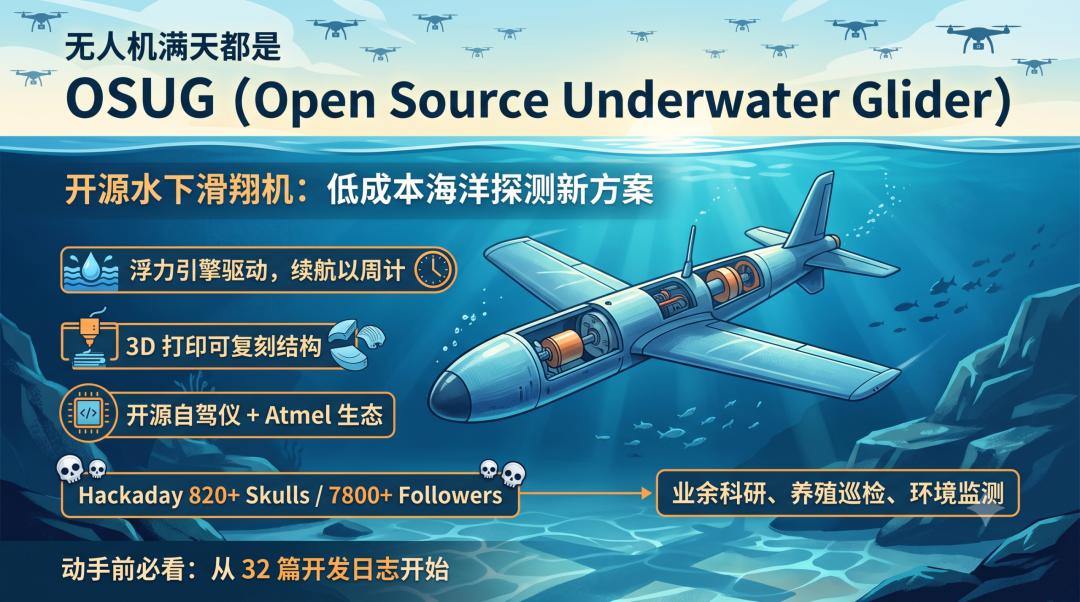
Drones fill the skies, but almost nobody plays underwater — because long-endurance underwater exploration platforms are prohibitively expensive. This Hackaday project with 820 skulls and nearly 7,900 followers aims to build a glider that can autonomously navigate for weeks underwater using commodity hardware, a 3D-printed hull, and a homemade buoyancy engine. Amateur research, aquaculture, and environmental monitoring are the scenarios it targets. For makers who enjoy underwater robotics, this is one of the few open-source solutions that can actually be replicated.
What It Is in One Sentence
OSUG (Open Source Underwater Glider): an autonomous underwater glider driven by a buoyancy engine and running an open-source autopilot, with the goal of driving down the cost of long-endurance underwater exploration.
Why It’s Worth Your Attention
- Hard data from Hackaday.io: 820 skulls, 7,881 followers, 175K views, 32 development logs — this is not a flash-in-the-pan project; the author keeps updating it.
- A rare niche: open-source “surface” USVs are everywhere, but open-source underwater gliders are extremely rare. The README states clearly: there is currently no affordable long-endurance underwater exploration platform — this project targets exactly that gap.
- A civilian approach: commodity hardware + 3D-printed parts + open-source autopilot. It is designed for individual hobbyists and small teams, not military-grade pricing.
The 3 Most Interesting Features
- Buoyancy engine instead of spinning propellers
The glider ascends/descends by changing its own buoyancy, converting gravitational potential energy into forward motion without constantly burning motor power. That is the basis for its “weeks of endurance” claim — although the README only says “up to weeks at a time,” so real numbers depend on implementation. - Open-source autopilot + Atmel ecosystem
The project’s tags clearly includeatmel, following the path familiar to embedded developers. Combined with the open-source autopilot, people who know ArduPilot/PX4 can theoretically pick up the code and start modifying quickly. - 3D-printable, replicable structure
The pressure hull, wings, and internal structure all lean toward 3D printing, meaning you do not need a CNC shop to build it — a rare attribute for underwater projects, where most designs die at the machining stage.
Getting Hands-On: Where to Start
Honest note: this project lives on Hackaday.io rather than as a traditional GitHub repo. The README does not provide a one-click git clone && make pipeline; the main material is published as project logs (32 posts). So the right way to “quickly start” is to read the logs, not copy commands.
Recommended order:
- 1. Open the project page → read the Description, confirm the target scenario
- 2. Go through the 32 logs in chronological order:
– Early logs: buoyancy engine prototype, sealing approach
– Mid logs: electronics bay, Atmel main controller, sensors
– Late logs: full assembly / testing - 3. Replication priority: build the buoyancy engine test rig first (testable in a bucket)
- 4. Then print the pressure hull → do a static water leak test
- 5. Only then worry about autopilot and launching
What you should be able to answer: after reading the logs, you should be able to answer three questions — how does the buoyancy engine drive it? How is it sealed? How is attitude controlled? If you cannot answer these, do not buy parts yet.
Pitfall reminders:
– This is an ongoing project (the README’s own tag), not a finished kit — do not expect to pull the BOM and start soldering.
– The biggest pitfalls in underwater projects are always sealing and losing the vehicle. For the first launch, use a tether, shallow water, and daylight.
– The Atmel controller means limited resources; if you want to run complex SLAM or vision, you will need to add a coprocessor.
What You Can Do With It
- Amateur marine science: mount a CTD (conductivity-temperature-depth) or dissolved-oxygen sensor for long profiling transects near shore.
- Aquaculture inspection: the README explicitly lists
seafood farmersas a target user — for example, checking water quality beneath net pens. - Environmental monitoring: long-term dissolved-oxygen / turbidity observation in estuaries and reservoirs.
- Teaching / competitions: as an open-source platform for underwater robotics courses, far cheaper than buying commercial AUVs.
Who It’s For
- Makers / embedded hobbyists who want underwater robots but are put off by commercial AUV prices;
- Drone veterans with a 3D printer and ArduPilot/PX4 experience looking to go underwater;
- Ocean / environmental students who want a replicable thesis or competition platform;
- Not for: people who want plug-and-play, people who lack patience for reading logs, and people doing their very first embedded project.
Project Links
https://hackaday.io/project/20458-osug-open-source-underwater-glider
If you have any questions about this topic, feel free to contact us at [email protected]
Have questions about this article? Feel free to contact us at [email protected] — we’re happy to help!
