
Key Takeaways
- Transfer learning plus a deep neural network surrogate cuts high-fidelity training samples by about 70% while improving accuracy 35%.
- An end-to-end urban noise pipeline processes over 2,000 audio segments per second on an RTX 3060 and trains one fold in under six hours.
- Psychoacoustic heatmap models cut mean absolute error by 31% against classical regression, reaching an adjusted R² of 0.61 versus 0.32.
- A motor-noise classifier trained on 2,640 FEA-labelled samples reaches 95.68% accuracy from MFCC features.
- AI does not replace simulation software — it wraps it, handling fast design sweeps while the standard method does the physics.
Acoustic simulation is the practice of predicting how sound will propagate before anything is built, and as of 2026 it is being rebuilt around machine learning. Empirical formulas and brute-force numerical solvers are giving way to surrogate models that compute in seconds what used to take hours, while keeping prediction error under 2 dB.
Where Classical Noise Prediction Stalls
Both legs of the traditional approach have reached their limits.
Analytical propagation models such as ISO 9613-2 lose accuracy in cities with complex geometry, dynamic traffic and variable meteorology. Numerical methods — finite-difference time-domain (FDTD), boundary element method (BEM) — are accurate but computationally intractable at scale. Empirical regression models cannot represent the nonlinearity of real sound propagation at all.
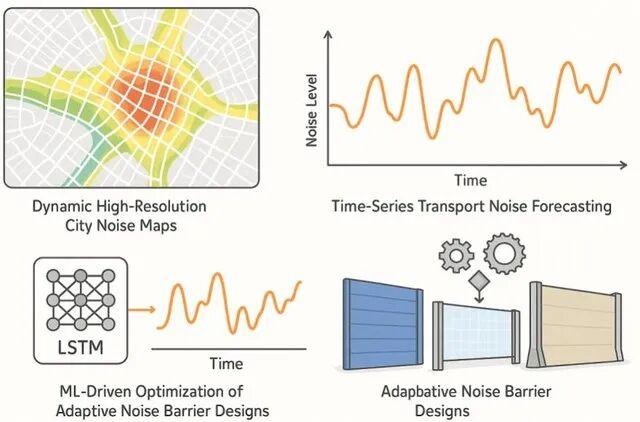
Engineering has already produced a transitional answer: low-cost IoT sensors collect continuously, GIS produces the map, and an LSTM extrapolates future noise levels from historical data. Sensing, mapping and forecasting are decoupled into three layers, and the visualisation is light enough to no longer depend on desktop GIS, giving city managers a forward-looking input rather than a retrospective one.
AI-Accelerated Acoustic Simulation
Surrogate models are the first lever
Transfer learning combined with a deep neural network lets low-fidelity simulation data act as pre-training material: high-fidelity training samples drop by roughly 70%, accuracy rises 35%, the coefficient of determination for the main physical quantities exceeds 0.98, and mean relative error stays below 2%.
The monitoring pipeline is already closed-loop
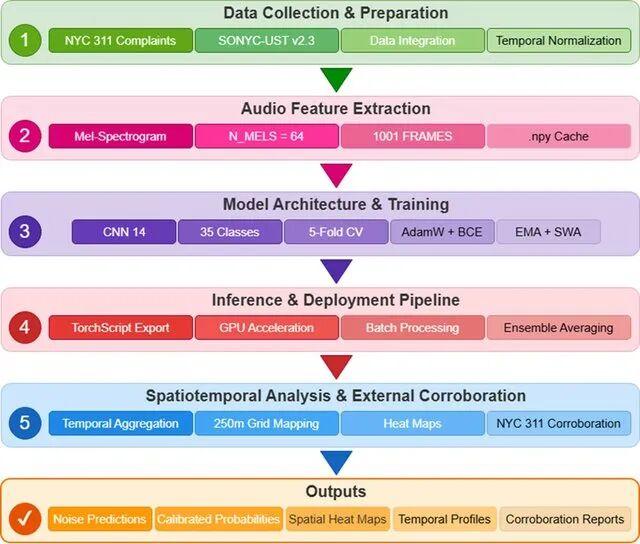
On the noise-monitoring side, an end-to-end deep learning pipeline runs the whole engineering loop: raw sensor data to multi-label model training, to 250 m grid mapping, to hourly and daily aggregation. After probability calibration the model is delivered as TorchScript and processes more than 2,000 audio segments per second on an RTX 3060, with a single fold training in under six hours.
Teaching a machine to listen like a person
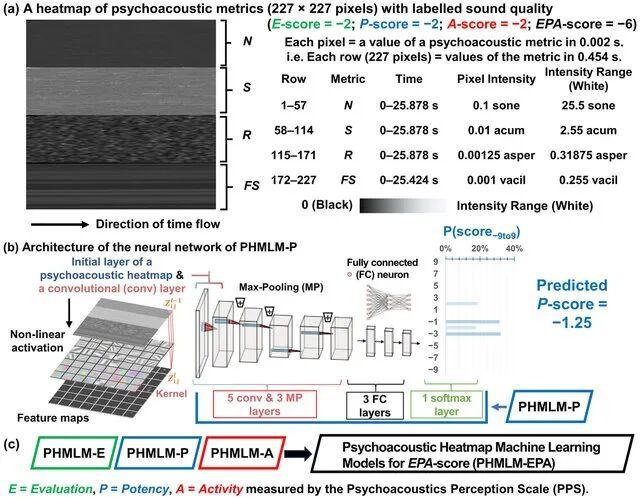
Loudness, sharpness, roughness and fluctuation strength are converted into 227×227 heatmaps and fed to a model. The psychoacoustic heatmap machine learning model predicts negative noise impact with mean absolute error 31% lower than classical regression. Across 432 multi-dimensional sound quality evaluations it reached an adjusted R² of 0.61 for EPA perceptual scores, against 0.32 for traditional regression.
Four Case Files
| Case | Method | Result |
|---|---|---|
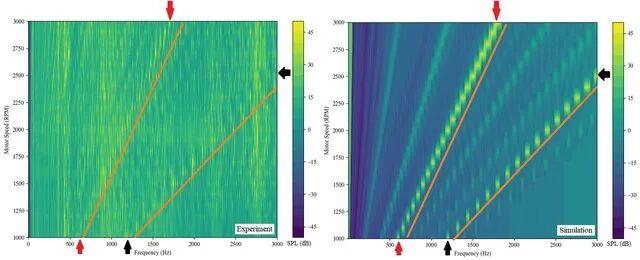
| Motor acoustic design | Multiphysics FEA generating 2,640 labelled samples over 470 hours across four motor states; MFCC features into a neural classifier | 95.68% classification accuracy; design deviations such as magnet size and air-gap adjustment can be inferred from noise features; experimental and simulated waterfall plots agree closely |
| Vehicle interior annoyance | Multi-order differential MFCC plus multiple auditory attention modules (MAA-SAE) | 98.4% overall recognition accuracy, ahead of feeding raw spectrograms or time-series data |
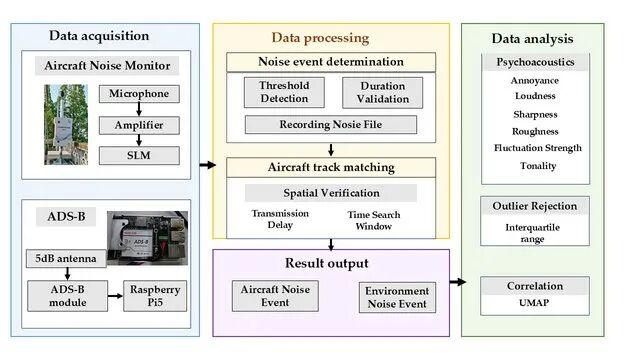
| Airport noise monitoring | Cascaded spatio-temporal fusion linking noise events to flight tracks, layered IQR cleaning, loudness/sharpness/roughness/fluctuation strength/tonality extraction, UMAP embedding | New-generation and legacy aircraft separate cleanly in psychoacoustic feature space, while overlapping badly on energy metrics alone |
| Road traffic sensing | Gradient Boosting on 1,200 vehicle pass-by events with acoustic and psychoacoustic indicators | R² = 0.63 and MAE = 0.122 for LAeq and FS50, enabling perception-oriented real-time monitoring |
Where AI Actually Sits in the Workflow
None of this replaces the simulation software. It orbits it. With SoundPLAN as the platform, the standard method performs the forward calculation of source and propagation, AI surrogate models perform the fast sweep across design options, and measured data closes the calibration loop. That combination raises engineering efficiency and confidence at the same time, and it is the most realistic form of AI deployment in acoustic simulation today.
When compute stands watch in place of the ear, noise control finally gets ahead of the complaint instead of following it.
Have questions about this article? Feel free to contact us at [email protected] — we’re happy to help!
Frequently Asked Questions
How much faster is AI acoustic simulation than numerical methods?
About 90% less computation time. A surrogate model returns a prediction in seconds where FDTD or BEM would run for hours, because the expensive physics has been pre-computed into the training set.
How accurate are AI noise-prediction models?
Mean relative error below 2% and coefficient of determination above 0.98 for the main physical quantities, with prediction error held under 2 dB — accurate enough for design decisions, not a replacement for final verification.
Why is psychoacoustic data better than plain sound pressure level?
Because annoyance is not loudness alone. Heatmap models built on loudness, sharpness, roughness and fluctuation strength cut mean absolute error 31% and lifted adjusted R² from 0.32 to 0.61 for perceived impact.
Can AI separate aircraft types from noise recordings?
Yes. Airport monitoring that maps noise events to flight tracks and extracts psychoacoustic features separates new-generation from legacy aircraft clearly in UMAP space, where energy-only metrics show severe overlap.
Do I still need simulation software like SoundPLAN?
Yes. The standard solver still does the forward physics; AI handles design sweeps and measured data closes the loop. The realistic deployment is a hybrid, not a replacement.
About Aomway
Aomway has been developing and manufacturing video transmission and UAV radio hardware for over 15 years, producing equipment for any frequency band from 1 GHz to 9 GHz at power levels from 3W to 15W. We build high-power FPV video transmitters, directional and circularly polarised antennas, digital links, fiber-optic tether systems and detection hardware for pilots, integrators and commercial operators worldwide.