
Key Takeaways
- Small drones are low, slow and small: X-band radar cross sections often sit below 0.01 square metres, close to a bird’s return.
- Air-to-air detection adds three coupled problems: the interceptor’s own manoeuvring, targets that scale from a few pixels to full frame, and millisecond latency budgets.
- YOLOMG reached about 89.4 percent AP50 at 42 FPS on ARD100 by fusing pixel-level motion with RGB, roughly 25 points above its baseline.
- Unregistered multimodal fusion, which abandons pixel alignment for feature-level attention, is the current direction for infrared and visible pairing.
Air-to-air drone detection is what lets an interceptor aircraft find another drone from the air, and it exists because ground-based radar struggles with small low-altitude targets. A 2026 review by Wang Ji and Peng Yueping of the Engineering University of the People’s Armed Police, published in Electronics Optics and Control, traces the field from early hand-crafted vision to unregistered multimodal fusion. As of 2026 the consensus is that detection from above is a different problem from detection from the ground, not a dataset swap.
Why ground radar is not enough
In 2018 Gatwick Airport halted flights because of drone incursions, and in recent conflicts loitering munitions have appeared in formation. The instinctive answer is to sweep with radar, but the physics does not cooperate.
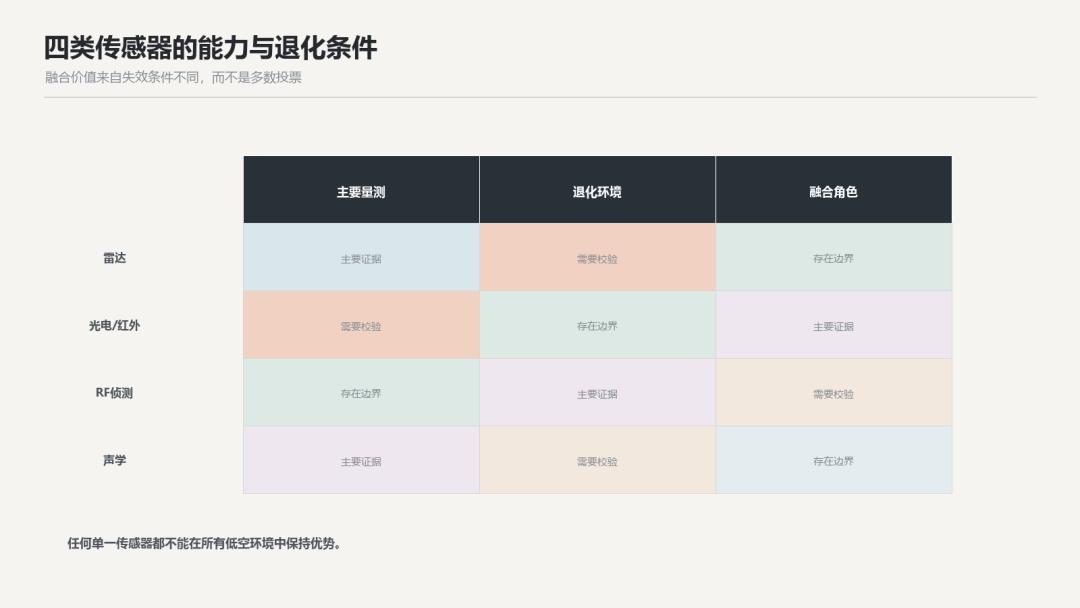
Small drones are usually described as low, slow and small. They fly low, so they slip between buildings and into terrain folds that long-range early-warning radar cannot see. They fly slowly, so their Doppler signature is weak and radar filters them out as clutter. Their airframes are largely composite, so the X-band radar cross section is often below 0.01 square metres, which puts them in the same return band as birds and produces both false alarms and missed detections. Ground systems also suffer terrain masking and the curvature of the earth.
Since about 2020, research attention has shifted to air-to-air: let the interceptor fly into the target’s airspace, escort and observe it, or intercept it directly.
Why looking down is harder than looking up
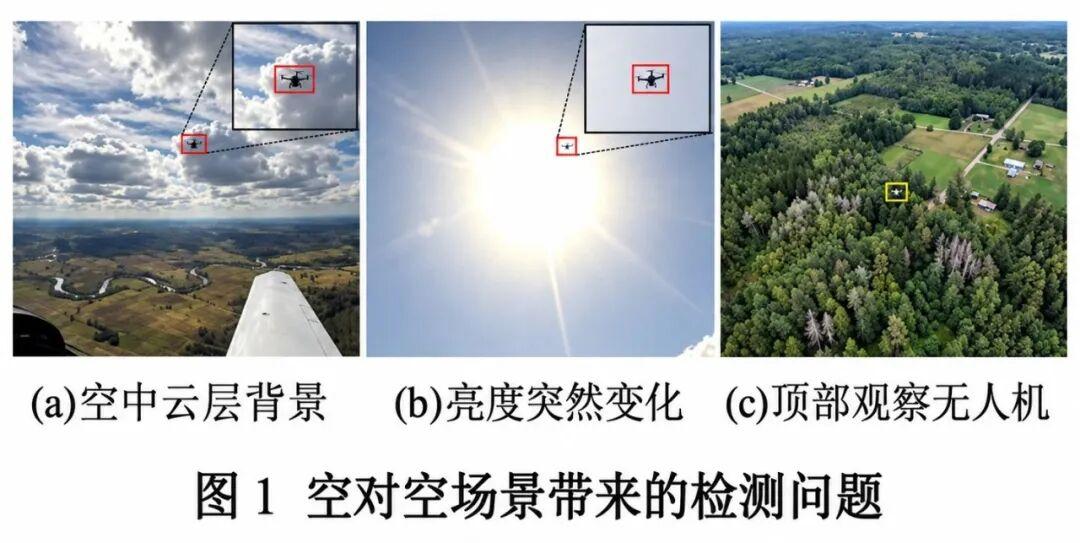
Ground-to-air systems at least stand still. Air-to-air is different: a cloud can hide the target one moment and reveal it the next, the onboard camera’s brightness can blow out suddenly, and looking down from above or from the side puts a fragmented city or field behind the target.
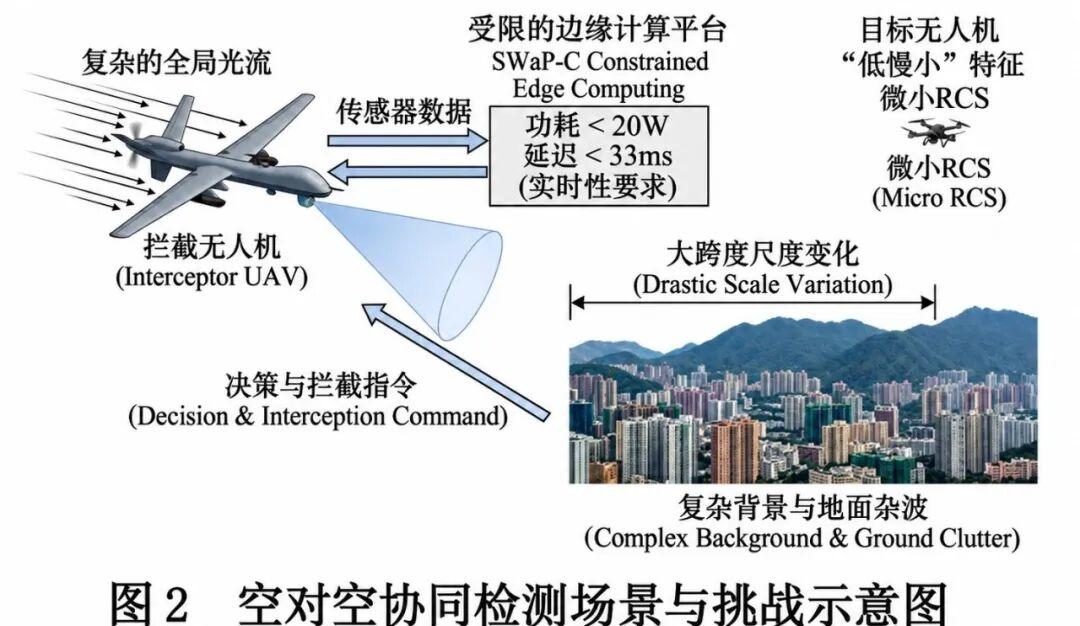
Three difficulties then stack on top of each other. First, the interceptor is manoeuvring hard, so the whole frame carries global optical flow and any algorithm that assumed a static background collapses. Second, the target alternates between a few pixels and a full-frame close-up, so small-target recall and large-target localisation have to be solved at the same time. Third, onboard compute is tight and results are needed in milliseconds, because jitter in latency translates directly into degraded guidance accuracy.
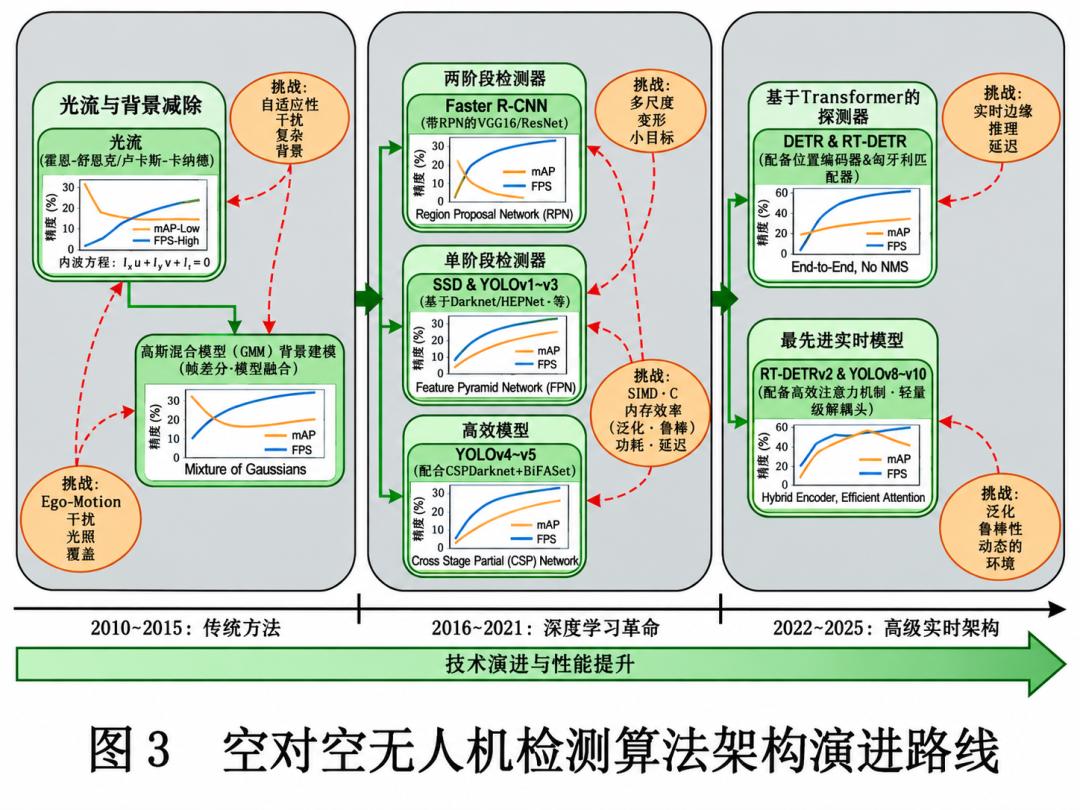
The field therefore falls into three periods: early hand-crafted vision, a deep-learning mainstream dominated by YOLO and RT-DETR, and the current move toward three-dimensional perception, event cameras and unregistered multimodal fusion.
The old approach: subtract the camera’s own motion first
Before deep learning spread, the problem was treated as moving-target segmentation. Optical flow was the common tool, but once the platform itself moves, the motion signal of a small dim target is swamped.
The answer was global motion compensation, or GMC: estimate camera motion, align consecutive frames, then difference them. With good alignment, static clutter is suppressed and a moving drone shows up in the residual. It sounds elegant, but it is slow on embedded hardware and degrades when lighting shifts, so it is not stable in dynamic air-to-air use.
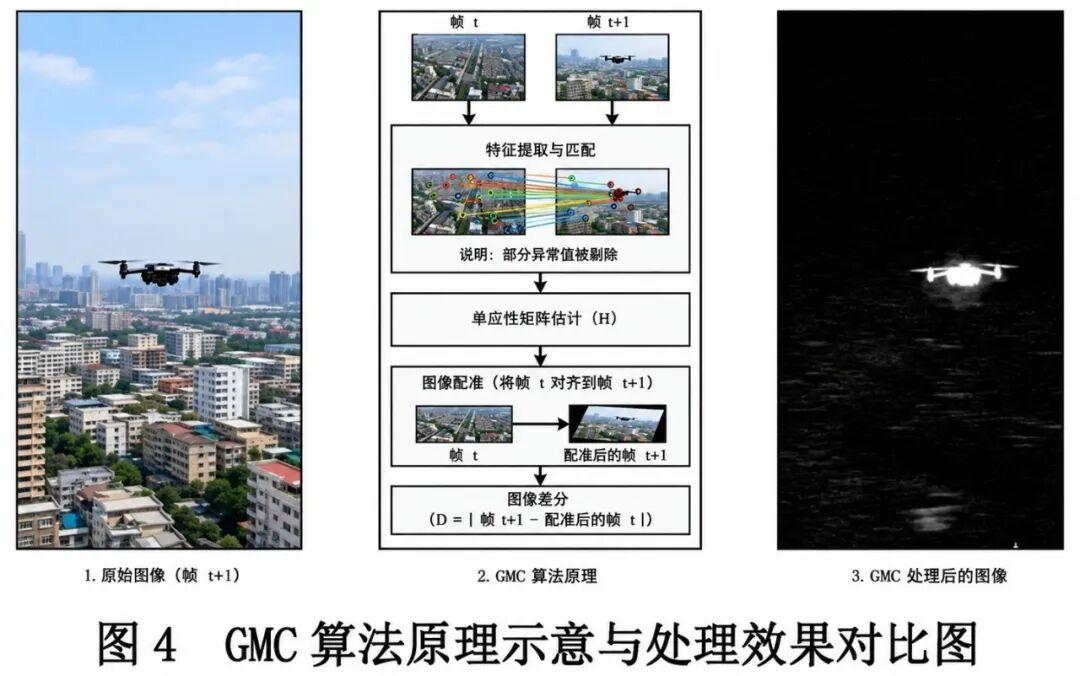
Distant drones often blur into textureless blobs. Morphological methods such as Top-Hat can lift a small target out of a uniform sky, but false alarms rise as soon as the ground texture gets complicated. Gaussian mixture background modelling works well in static surveillance, yet in air-to-air the background never stops moving, so the temporal stationarity assumption fails and false detections pile up.
These methods clarified the problem but could not survive high dynamics and hard real-time constraints. Deep learning is what actually took over.
Datasets: fix the data before fixing the algorithm
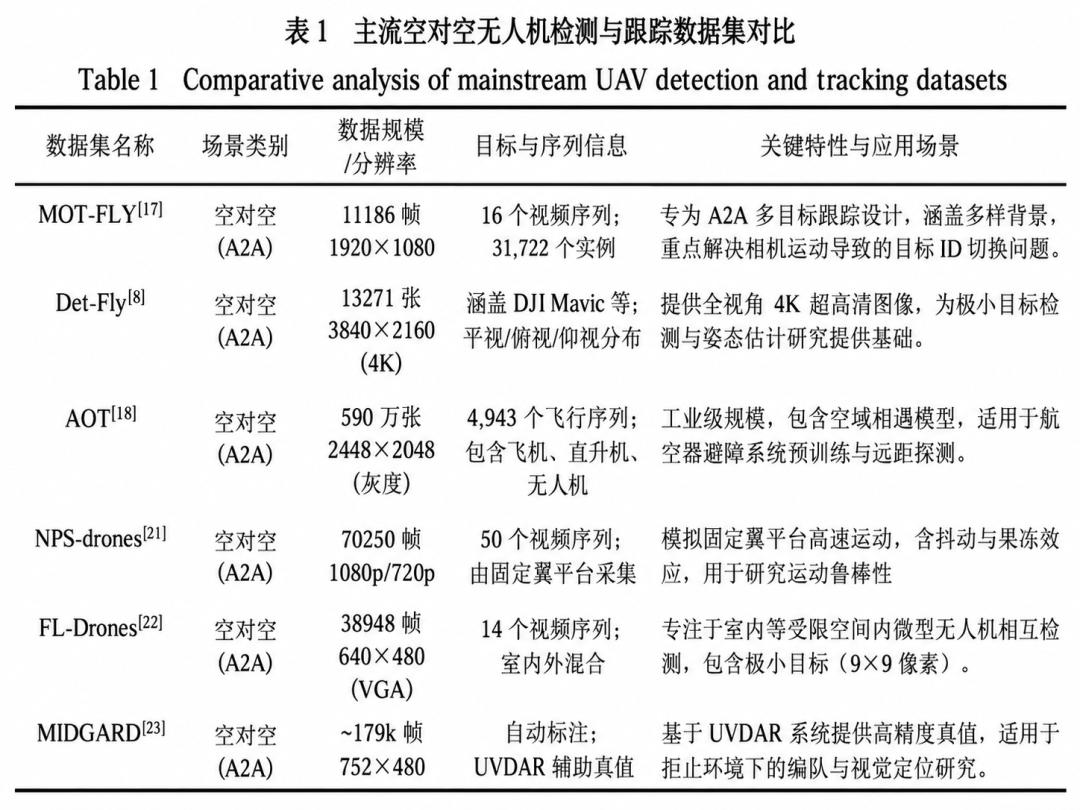
Several air-to-air datasets exist, each with a different purpose. Getting the dataset right matters more than the model choice, because the failure modes they stress are different.
| Dataset | Scale | Use | Characteristics |
|---|---|---|---|
| MOT-FLY | 11,186 frames, 13,222 instances | Multi-object tracking | Designed to stress identity switching when the camera shakes |
| Det-Fly | 13,271 frames, 8,641 instances (4K) | Detection | Covers look-down and level flight, suited to very small targets and pose variation |
| AOT | 590 sequences, 4,943 flight segments, 2,448 x 2,048 | Detection and tracking | Includes aircraft, helicopters and drones, aimed at obstacle-avoidance pretraining |
| NPS-drones | 70,250 frames, 1080p/720p | Detection | Captured from fixed-wing platforms, carries shake and rolling-shutter artefacts |
| FL-Drones | 38,467 frames, 640 x 480 | Detection | Indoor and outdoor, includes nine-pixel-scale small targets |
| MIDGARD | About 179 sequences, 752 x 480 | Detection and tracking | Ground truth from UVDAR, for formation localisation in GNSS-denied environments |
Evaluation does not stop at mAP. In an interception scenario, FPS and latency are often the sharper constraints, because a delay of tens of milliseconds propagates through the whole downstream chain.
Deep learning: YOLO carries the load, Transformers push in
Two-stage detectors such as Faster R-CNN are accurate enough but their serial structure is slow, which does not suit high-dynamics interception. Single-stage detectors such as YOLO and SSD treat detection as regression, and pairing them with FPN or BiFPN improves small-target performance. DETR is end-to-end and needs fewer anchors and less NMS, but it is expensive to compute; RT-DETR was tuned for real time and is used in air-to-air work as well.
The YOLO line keeps changing too: from anchors to anchor-free, decoupled heads that separate classification from localisation, YOLOv9 with programmable gradient information and GELAN to preserve deep detail, YOLOv10 removing NMS to cut latency, and then attention and lightweight modules pushed into onboard deployment. Swarm-level dense occlusion and extreme CPU speed have each received dedicated variants.
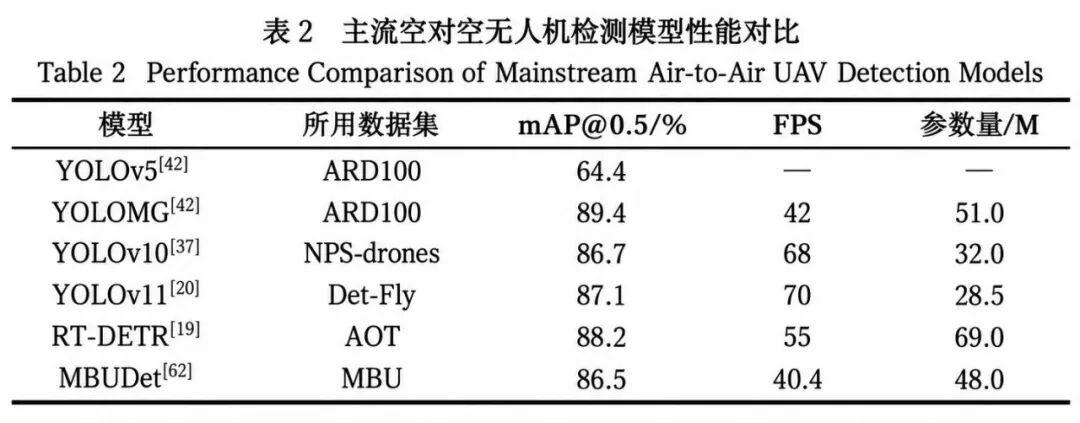
One of the more striking works is YOLOMG, which does not rely on appearance alone but fuses pixel-level motion features with RGB to separate drones from birds and pedestrians. Built on YOLOv5, it beat its baseline by roughly 25 AP50 points on ARD100 and also outperformed a group of contemporary methods on NPS-Drones.
| Model | Dataset | [email protected] (%) | FPS | Parameters (M) |
|---|---|---|---|---|
| YOLOv5 | ARD100 | 64.4 | – | – |
| YOLOMG | ARD100 | 89.4 | 42 | 51.0 |
| YOLOv10 | NPS-drones | 86.7 | 68 | 32.0 |
| YOLOv11 | Det-Fly | 87.1 | 70 | 28.5 |
| RT-DETR | AOT | 88.2 | 55 | 69.0 |
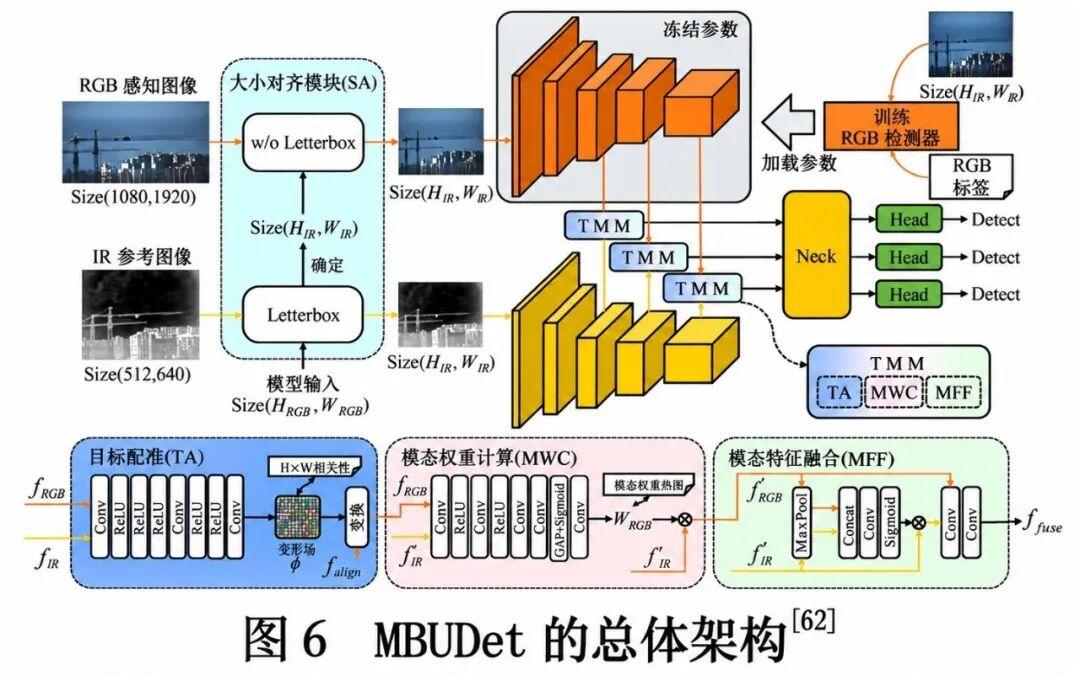
| MBUDet | MBU | 86.5 | 40.4 | 48.0 |
Note that these results come from different datasets, so the ranking is not a direct comparison. What they do show is that real-time speed and accuracy are being chased at the same time.
When 2D is not enough: monocular ranging and event cameras
Interception needs decisions, and a bounding box alone does not say how far away the target is. Lidar is heavy and power-hungry, which rules it out for small interceptors. Works such as Mono-UAV use intrinsics plus a ground-plane constraint to estimate three-dimensional position, size and orientation from a single RGB image. MASt3R and Aerial Mega Depth use large-scale synthetic data for pretraining and extract a scaled pseudo-lidar point cloud from monocular or stereo streams, reducing reliance on continuous SLAM trajectories and on prior calibration.
Frame cameras tend to fail under fast motion blur and strong backlight. Event cameras emit spikes only when brightness changes exceed a threshold, giving microsecond time resolution and wide dynamic range, so the signature of a fast-spinning propeller survives and direct sunlight does not blind the sensor. Paired with spiking neural networks and neuromorphic chips, power consumption can drop very low: one virtual tripwire design reports static power around 7.13 mW. Methods such as PropellerSpikes capture the rotational fingerprint of propellers, which separates a drone from a bird physically rather than statistically and cuts false alarms.
Multimodal: when hard registration fails, go soft
At night, in fog or in rain, visible light alone is weak. Radar micro-Doppler, RF fingerprinting, microphone arrays and infrared have all been added. Millimetre wave can observe hovering state and payload; RF exploits transmitter hardware differences for individual identification; acoustics adds another vote at low signal-to-noise ratios.
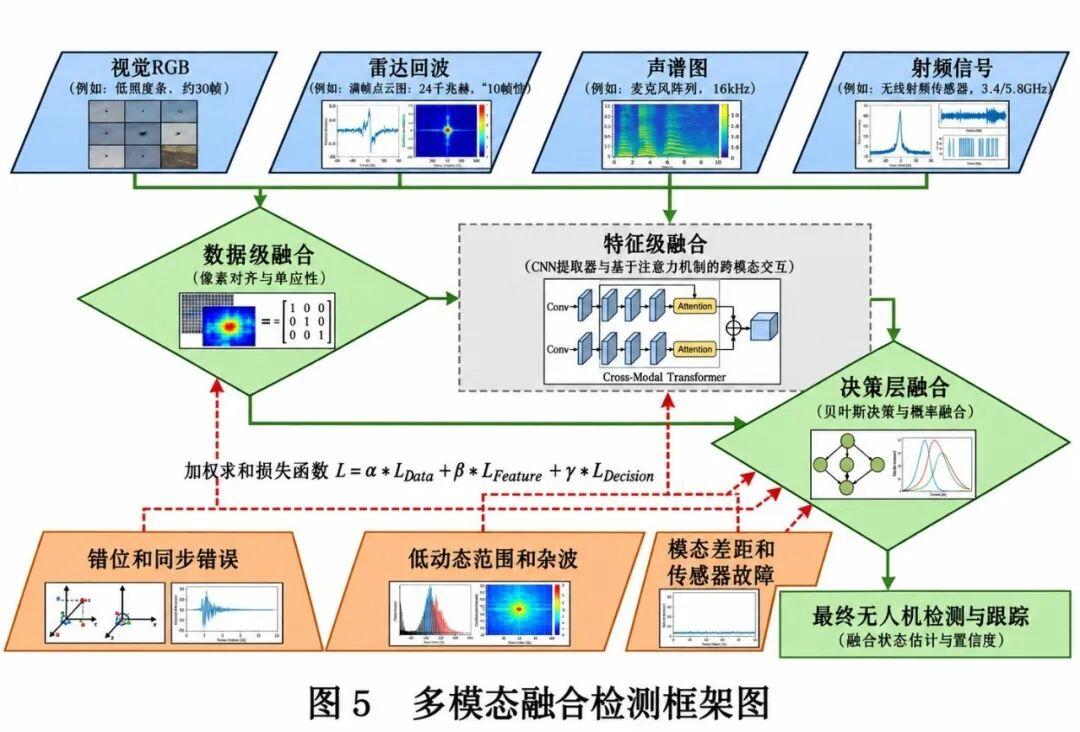
Air-to-air has one hard defect: both the platform and the target are moving, so infrared and visible images frequently fail to align. Hard registration is compute-expensive and fails on weak texture or overexposure, and forcing it can be worse than using a single modality.
Unregistered fusion is therefore the breakthrough point. Instead of forcing pixel alignment, it uses heat-source masks to guide saliency, or Transformer cross-attention to align the two modalities logically at the feature level. MBUDet folds registration thinking and detection into a single stage, using target offset learning and dynamic modality weights to handle mosaic augmentation interference and cases where one modality cannot see the target. The direction is clear: from “align first, then fuse” to “let the algorithm absorb the misalignment”.
What still has to be solved
The review is candid about the open problems: platform-induced optical flow, cross-scale targets, swarm occlusion and identity switching, night and strong backlight, and the tension between edge compute and millisecond response.
The next steps are likely along the same lines: fuse IMU and vision for motion compensation; use high-resolution pyramids, occlusion completion and long-range context to stabilise small targets and dense scenes; move multimodal work from hard alignment to semantic-level soft cooperation; and use quantisation, pruning and neuromorphic chips to fit the algorithms onto real aircraft so the system works around the clock rather than only looking good in a paper table.
Air-to-air detection is not a matter of taking the ground-based YOLO stack and swapping the dataset. The camera shakes, the background explodes with detail, the target goes from a speck to a close-up, and there is never enough power. Whoever can lock onto the target accurately and quickly inside that constraint set is the one who can talk about countermeasures.
Have questions about this article? Feel free to contact us at [email protected] — we’re happy to help!
Frequently Asked Questions
Why can’t ground radar detect small drones reliably?
Because small drones are low, slow and small. Terrain masks them, weak Doppler returns get filtered as clutter, and composite airframes give X-band radar cross sections often below 0.01 square metres, close to a bird.
What makes air-to-air drone detection harder than ground-based detection?
The interceptor manoeuvres, so the whole frame carries global optical flow; the target alternates between a few pixels and a full-frame close-up; and onboard compute is tight while latency must stay in the millisecond range.
How accurate are current air-to-air detection models?
On their own datasets, YOLOMG reports about 89.4 percent [email protected] on ARD100 at 42 FPS, RT-DETR about 88.2 percent on AOT at 55 FPS, and YOLOv11 about 87.1 percent on Det-Fly at 70 FPS. These are not directly comparable across datasets.
What is unregistered multimodal fusion?
It fuses infrared, visible or radar data without forcing pixel-level alignment, using heat-source masks or cross-attention at the feature level instead. This avoids the cost and failure modes of hard registration when both platform and target are moving.
Why use event cameras for drone detection?
Event cameras respond only to brightness changes, with microsecond resolution and wide dynamic range. That preserves the propeller’s rotational signature under motion blur and keeps working in strong backlight, while neuromorphic processing can hold power in the milliwatt range.
About Aomway
Aomway is a radio-frequency engineering company that designs and manufactures long-range FPV video transmitters, antennas, goggles and UAV communication links, and it publishes technical notes on detection, perception and embedded control. Its hardware is built for builders who need dependable links at range, and its documentation aims to explain the engineering behind each product.