

AOMWAY
Why Did the Shahed-136 “Flying Moped” Become an Internet Sensation in Modern Conflicts?
Its extreme range is determined by five design factors working together: aerodynamic layout, fuel-efficient propulsion, lightweight construction, one-way mission profile, and radical simplification with minimal redundancy. It is not that the engine is particularly powerful — rather, the entire design is optimized for maximum fuel efficiency and maximum fuel carriage over the full flight.
1. Powerplant: Ultra-Low-Fuel-Consumption Piston Engine — Optimal Choice for Long-Range Cruise
Powered by the MD-550 two-stroke gasoline piston engine (reverse-engineered from the German Limbach L550E aero engine), approximately 50 hp, in a rear-mounted pusher-propeller configuration.
Compared to turbojet or rocket engines commonly used in cruise missiles: gasoline piston engines offer several times higher fuel efficiency, extremely low fuel consumption per 100 km at low-speed cruise, and endurance that far surpasses jet propulsion.
Cruise speed is locked at approximately 180 km/h low subsonic — deliberately avoiding high-speed flight, significantly reducing aerodynamic drag and fuel consumption. Endurance can reach 6–8 hours.
2. Delta-Wing Aerodynamic Design: High Lift, Low Drag, Ample Internal Fuel Volume
Clipped delta wing + blended wing-body configuration, wingspan 2.5 m, length 3.5 m. Excellent subsonic glide efficiency, very high lift-to-drag ratio at low altitude, gliding fuel-efficiently.
The wing and fuselage are integrally formed as a single unit. The broad wing roots are used entirely as integral fuel tanks. At a total takeoff weight of 200 kg, this design squeezes out a very large fuel volume; the warhead occupies only a small forward fuselage section (40–50 kg warhead), while the vast majority of the fuselage carries fuel.
No separate horizontal stabilizer — simpler structure, lower aerodynamic drag, further fuel savings.
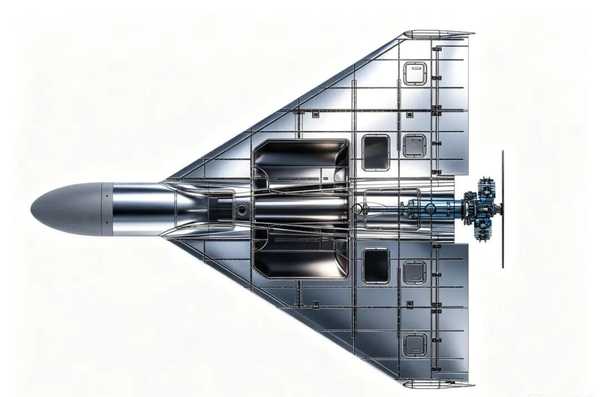
2.1 Structural and Spatial Efficiency
The delta wing layout eliminates the traditional horizontal tail, removing a major structural component and its associated control system. At the same time, the large-area, long-chord wing interior can be fully utilized.
This directly yields two benefits: first, it significantly reduces structural weight, improving the thrust-to-weight ratio; second, it provides extremely generous internal volume, easily accommodating large-capacity fuel tanks and a sizable payload bay, greatly enhancing both endurance and mission flexibility.
2.2 Excellent Stall Safety
Unlike conventional-layout aircraft that experience dangerous nose-up pitch divergence at stall, the delta wing’s center of lift shifts relatively gently with angle of attack. After reaching maximum lift coefficient, lift decreases gradually and smoothly.
This characteristic gives delta-wing aircraft better controllability and safety during low-speed, high-angle-of-attack flight (such as takeoff and landing phases). Combined with modern flight control system angle-of-attack limiting functions, the risk of stall-induced loss of control is fundamentally eliminated.

2.3 Exceptional Cruise Efficiency
Delta wings typically employ a high sweep angle, which helps delay shock wave formation at transonic speeds and raises the critical Mach number. Combined with wingtip devices, this effectively reduces induced drag.
Lower drag means flying farther and faster on the same fuel consumption. The measured cruise lift-to-drag ratio of 13.5 is an excellent figure, directly proving the massive advantage in cruise efficiency, far surpassing conventional-layout aircraft of the same weight class.
2.4 Good Manufacturing Economy
The delta wing’s relatively simple planar shape, free of horizontal stabilizers and complex connection structures, makes it highly suitable for advanced composite integral molding processes.
Integral molding not only further reduces weight but also decreases part count and assembly steps, significantly lowering manufacturing cost and maintenance difficulty. It is well-suited for mass production — a critical advantage for platforms like drones that require large-scale deployment.

3. Ultra-Lightweight Airframe: Weight Reduction = Effective Range Extension
The airframe makes extensive use of fiberglass, foam sandwich, and balsa wood composite materials, resulting in extremely low empty weight. No high-strength aviation aluminum is required. Exceptional empty weight control means the same fuel load flies farther.
Completely eliminated landing gear: as a one-way suicide loitering munition, no landing structure is needed, saving tens of kilograms — all weight budget goes to fuel. Takeoff relies on an external rocket booster (RATO), which is jettisoned after launch.

4. Stripping All Non-Essential Equipment — Every Gram Goes to Fuel
No electro-optical camera, no real-time remote-control datalink, no complex electronic warfare countermeasure suite, no radar seeker. Only inertial navigation + civilian GPS/GLONASS minimal guidance — the circuit board occupies negligible volume and weight.
Target coordinates are pre-loaded before launch; the entire flight is autonomous, requiring no continuous radio transmission or reception. This saves power, weight, and frees up enormous internal space for fuel.
5. One-Way Design: Inherent Advantage
Conventional reconnaissance or round-trip drones must reserve fuel for the return journey plus contingency margins. The Shahed-136 is a one-way suicide munition: all takeoff fuel is expended on the single outbound leg to the target, with no return consumption. For the same fuel load, range is effectively doubled.
6. Russian Geran-2 (Improved Variant)
The modified variant increases the warhead to 90 kg, encroaching on fuel tank volume, with range shrinking to approximately 650 km.
Analysis of why the Russian Geran-2 (Witness-136) 90 kg heavy-warhead variant’s range collapses
6.1 Baseline Comparison of Original Specifications
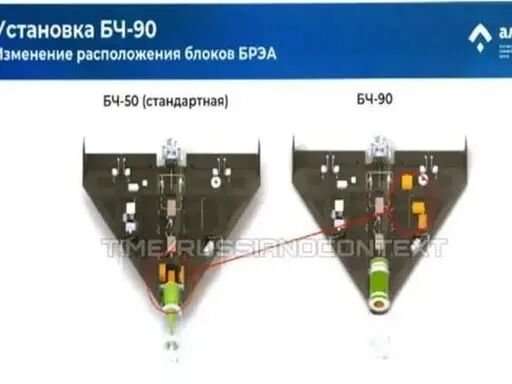
Two warhead internal layout comparison
Standard variant (BCh-50): 50 kg warhead. Most of the fuselage and delta wing root internal volume is occupied by flexible fuel tanks. Full fuel load enables a range of 2,000–2,500 km. Takeoff weight approximately 200 kg. Sustained cruise via rear-mounted MD-550 low-fuel-consumption piston engine.
Russian modified variant (BCh-90): warhead increased to 90 kg high-explosive/thermobaric warhead. Actual measured range collapses to approximately 650 km.

6.2 Core Principles Behind the Range Collapse (Two Decisive Factors)
Factor 1: Internal Space Displacement — Drastic Fuel Load Reduction (Primary Cause)
The Geran-2 employs a nose warhead + mid/aft integral fuel tank longitudinal layout. Total fuselage volume is fixed and cannot be expanded:
- Original 50 kg warhead is compact, occupying minimal nose space — the mid-fuselage and delta wing root cavities can mostly serve as fuel tanks, maximizing fuel storage;
- Upgrading to the 90 kg heavy warhead increases both axial length and radial diameter, which must encroach forward and aft into what was originally fuel tank installation space — fuel tank volume is directly compressed by nearly half, total fuel capacity drops sharply, available total fuel decreases, maximum flight duration is halved.
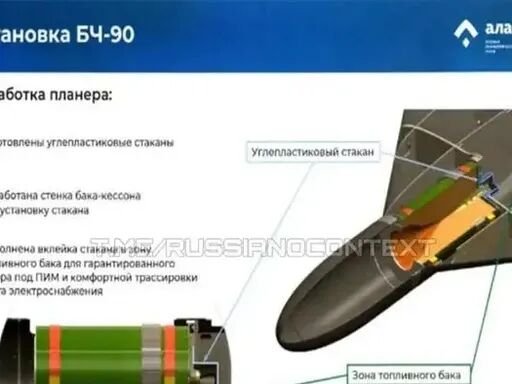
90kg warhead fuel tank encroachment diagram
Factor 2: Increased Gross Weight and Aerodynamic Trim Shift — Significantly Higher Fuel Consumption
Takeoff gross weight surges: warhead gains 40 kg while fuel simultaneously decreases, changing the overall takeoff weight. The piston engine must continuously output greater thrust to maintain 180 km/h cruise speed — fuel consumption per kilometer rises.
Center of gravity and aerodynamic trim shift: nose weight increases sharply, shifting the CG forward. The flight control system must continuously deflect control surfaces to trim out the nose-down moment, introducing additional induced drag and parasitic drag, further degrading the lift-to-drag ratio. For the same fuel load, flight distance shortens further.
The original delta wing’s high cruise L/D advantage is weakened, with cruise L/D showing a marked decline and fuel utilization efficiency deteriorating.
6.3 Tactical Trade-off Logic (Design Intent of the Russian Variant)
- Lethality requirement takes priority: the original 50 kg warhead struggles to destroy reinforced concrete fortifications, ammunition depots, substations, and other hardened targets. The 90 kg warhead increases explosive fill, with blast damage radius and structural destruction capability improving by approximately 70% — suitable for frontline medium-range hard-target strike;
- Operational radius matches the front line: the Russia-Ukraine engagement zone depth is generally in the 600–800 km range. A 650 km range fully satisfies forward-depth strike requirements — sacrificing long-range reach in exchange for per-round lethality, optimized for saturation swarm attack tactics;
- Minor structural reinforcement: to accommodate the heavy warhead, the nose shell receives structural strengthening, marginally increasing airframe empty weight and further compressing the remaining range margin.
Summary: The Geran-2 variant’s range collapsing from the two-thousand-kilometer class to 650 km is, at its core, a zero-sum trade-off between warhead weight and fuel capacity within a fixed fuselage volume, compounded by increased gross weight and trim-drag-induced fuel consumption degradation. It is a classic munition overall-design trade-off between range performance and kill effectiveness.
