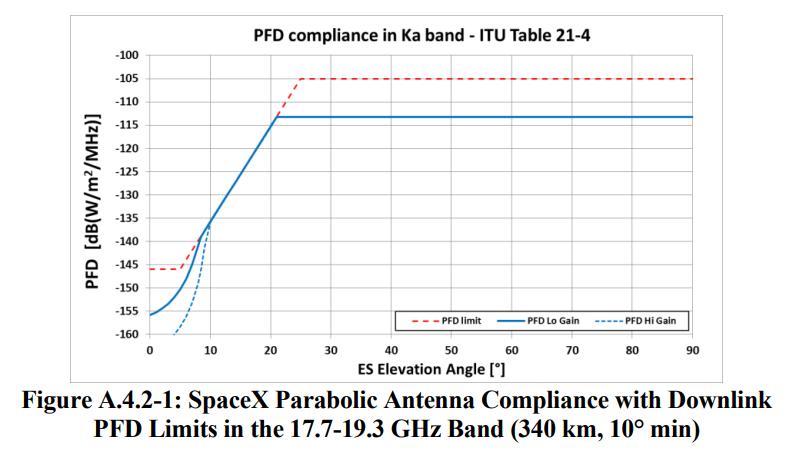
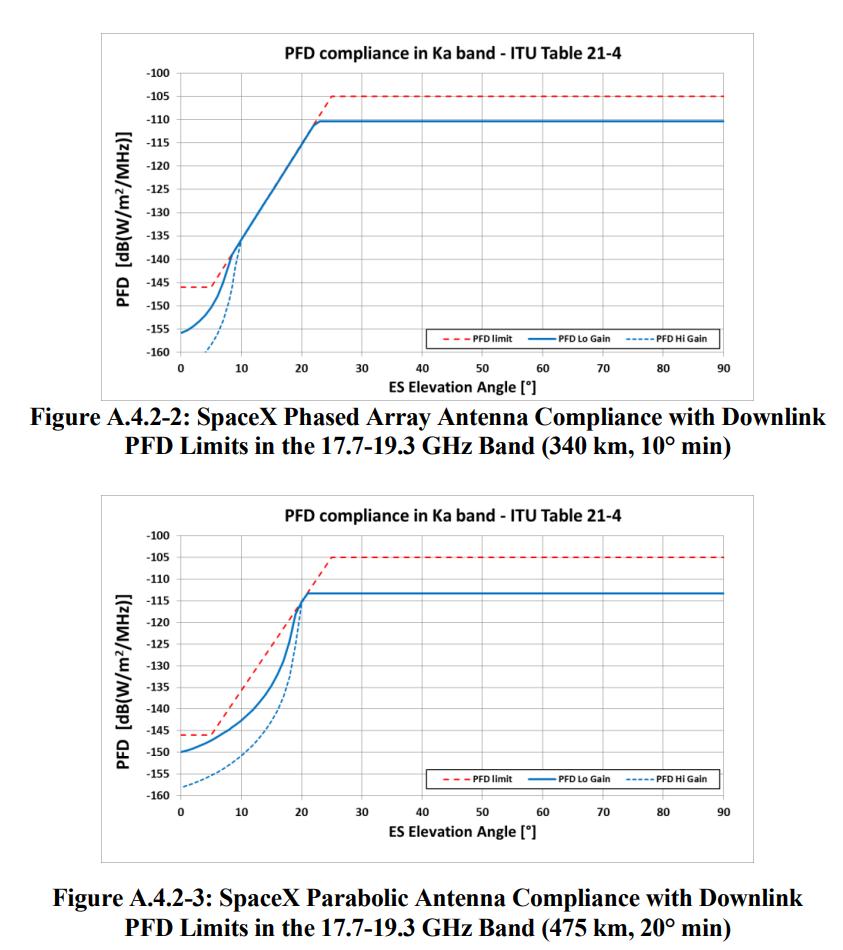
SpaceX’s fifth FCC filing installment details the technical parameters of its upgraded second-generation (Gen2) satellite system — focusing on Power Flux-Density (PFD) limits, Equivalent Power Flux-Density (EPFD) compliance, and ITU coordination requirements for the expanded constellation.
Upgraded Gen2 System Parameters
The upgraded Gen2 system reflects the comprehensive results of this modification and accompanying amendments. Key parameters:
- Total constellation size (N): 29,988 satellites
- Maximum visible satellites (Nv): 1,001
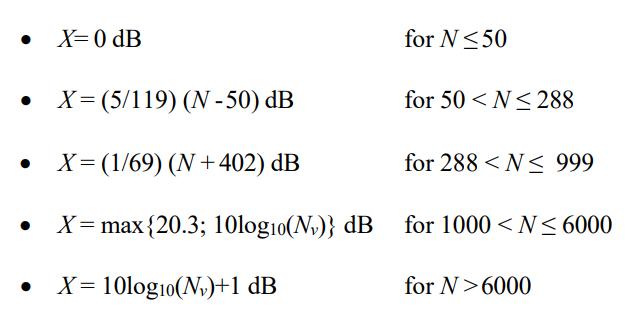
- X factor (derived from N and Nv): 31 dB
The X factor is a function of the total number of satellites (N) in the NGSO constellation and the maximum number of visible satellites (Nv) from any point on the Earth’s surface within the service area at minimum elevation angle 0°. This factor scales the PFD limits that apply to the system — larger constellations with more visible satellites must operate at lower per-satellite PFD to maintain the same aggregate interference level.
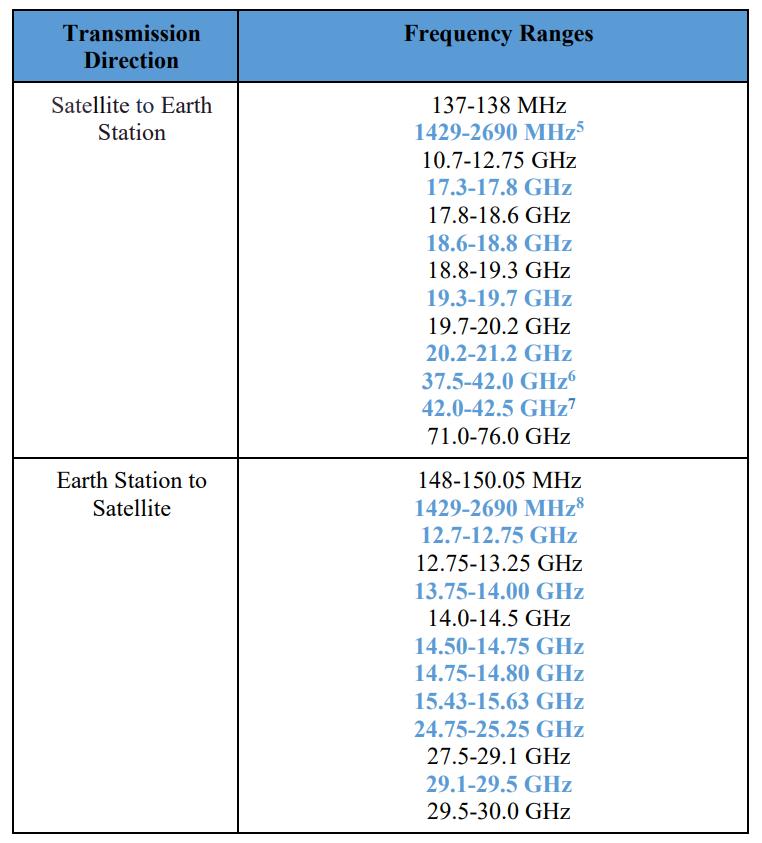
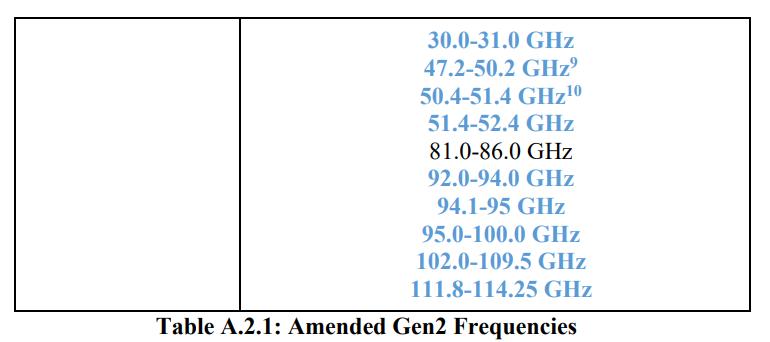
Power Flux-Density (PFD) Limits
Ka-Band PFD Limits (18.8-19.3 GHz and 28.6-29.1 GHz)
The PFD limits apply to emissions from any satellite in the NGSO system that:
- Belongs to the Fixed Satellite Service (FSS), for which the ITU Radiocommunication Bureau has received complete coordination or notification information since November 17, 1995, but was not yet in operation on that date
- Belongs to the Inter-Satellite Service
The PFD limits vary by arrival angle (elevation above the horizontal plane):
- 0-5°: Lowest allowed PFD (most restrictive — satellites near the horizon contribute more to GSO interference geometry)
- 5-25°: Gradually increasing PFD limits
- 25-90°: -105 dB(W/m²) in any 1 MHz bandwidth (highest allowed PFD — satellites near zenith contribute least to GSO interference)
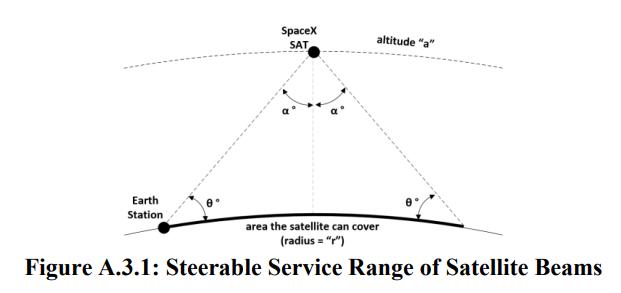
Nv Calculation Methodology
Nv is determined as follows:
- Nv = Max(Nv(j = 0,1,2…)), where Nv(j) = Max(Nv(j(t)), Nv(j(t-1)))
- Nv(j(t)) represents all visible satellites (elevation ≥ 0°) at any point (j) on the Earth’s surface at each time step (t)
- Nv does not depend on latitude — it covers the maximum visible satellite count across all latitudes within the NGSO system’s service area

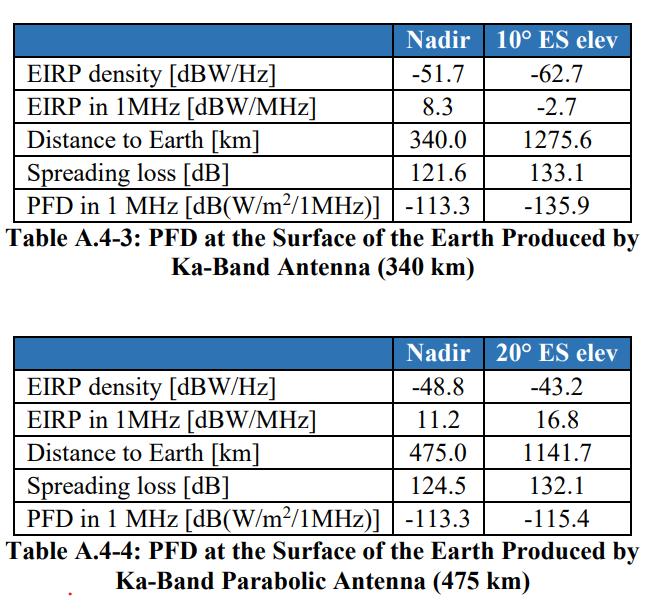
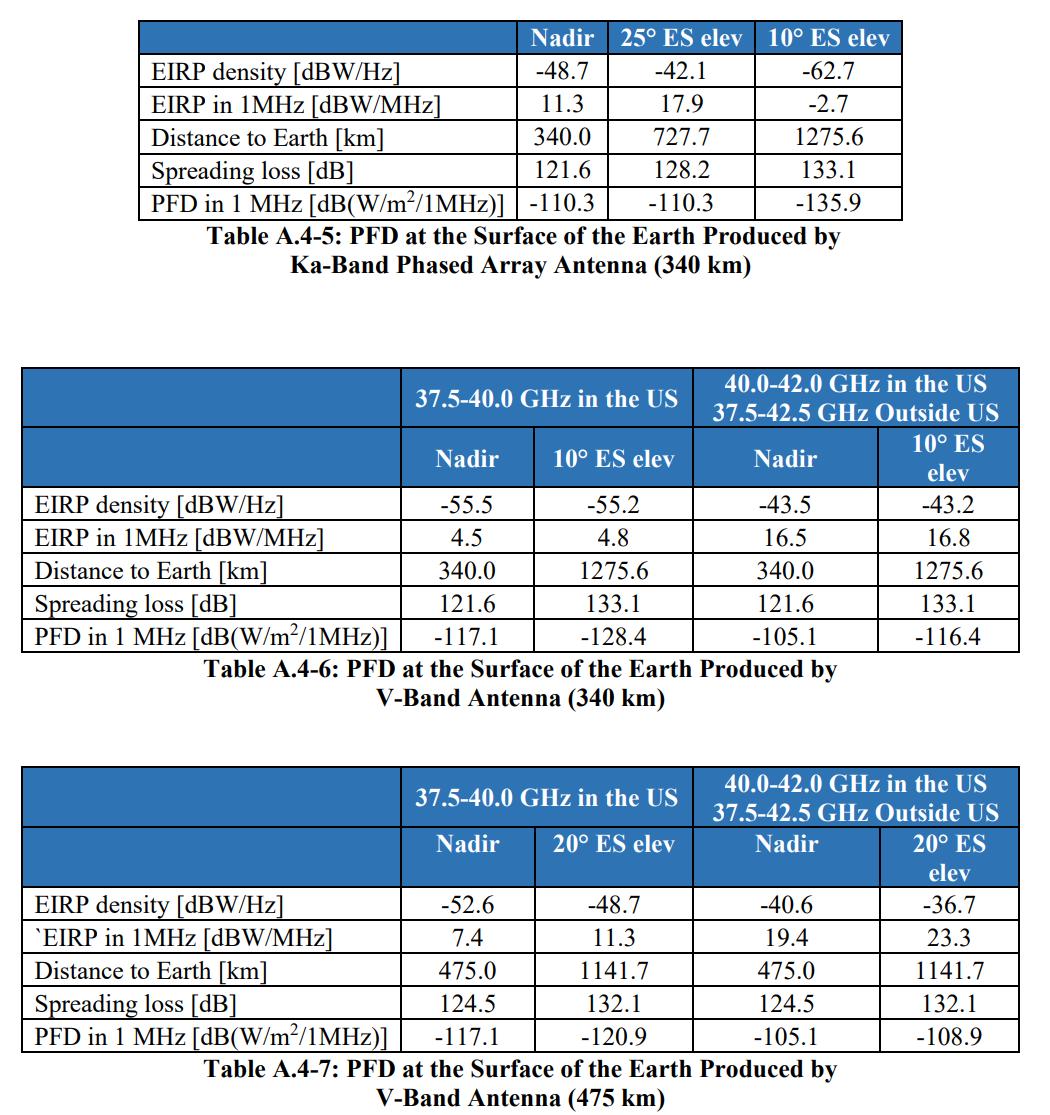
For the upgraded Gen2 system: N = 29,988, Nv = 1,001, yielding X = 31 dB. The resulting PFD masks for communication links (including both highest and lowest gain transmit antennas) are shown in the figures below.
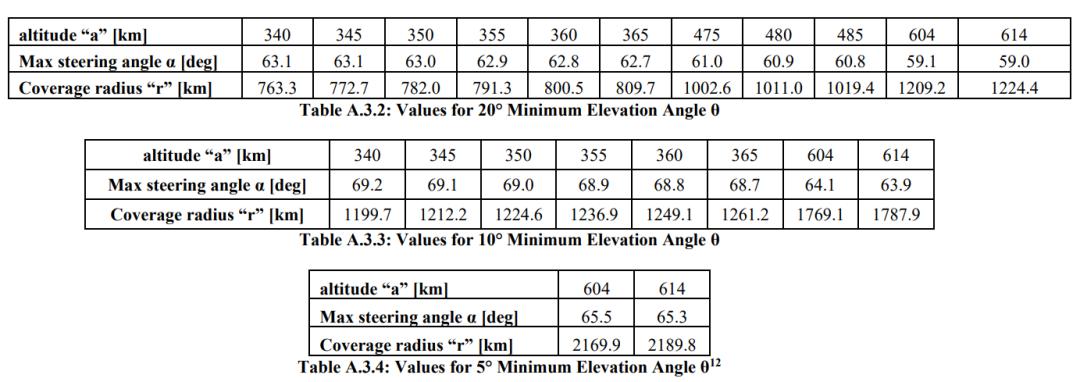
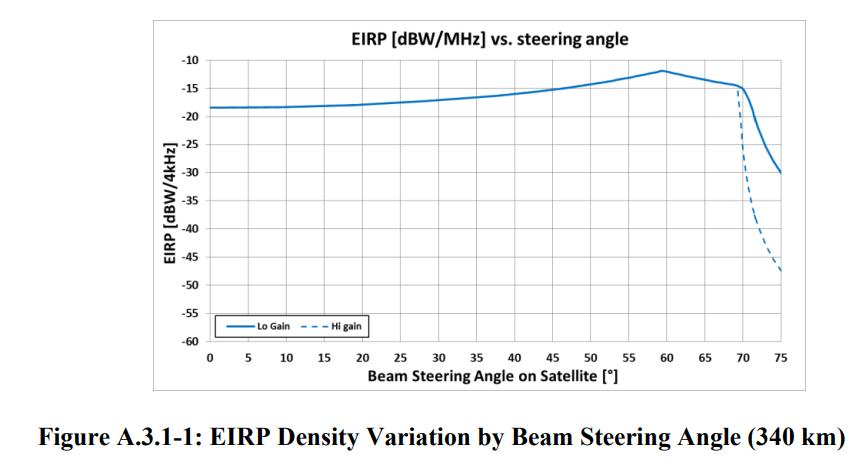
EPFD Compliance Framework
Equivalent Power Flux-Density (EPFD) is the key regulatory metric for protecting GSO systems from NGSO interference. The EPFD concept accounts for the fact that while any single NGSO satellite’s transmission may be brief (as the satellite moves across the sky), the aggregate effect of hundreds or thousands of satellites passing through the GSO arc must remain below harmful thresholds.
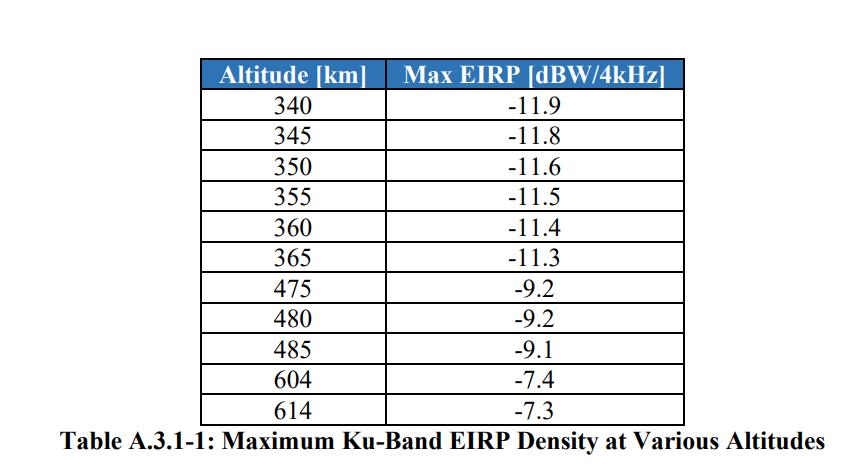
Short-Term and Long-Term EPFD Limits
ITU Article 22 defines two categories of EPFD limits:
- Short-term limits: Maximum allowable EPFD from a single satellite pass or brief accumulation — prevents momentary interference spikes that could disrupt GSO links
- Long-term limits: Maximum allowable statistical EPFD over time — prevents cumulative degradation of GSO link performance
SpaceX’s system complies with both categories by dynamically managing satellite beam pointing, transmit power, and in some cases ceasing transmission when beams approach the GSO arc exclusion zone.
Article 22.5C Operation
SpaceX requests operation under Section 22.5CA, which states: “In any country whose administration has indicated its consent, the limits given in Tables 22-1A to 22-1E may be exceeded (see also Resolution 140 (WRC-23)).” This provision allows exceeding standard EPFD limits in countries whose administrations consent — enabling bilateral or multilateral agreements for enhanced service levels.
GSO Protection Methodology
The GSO protection framework operates on multiple levels:
- Geometric avoidance: Satellites cease or reduce transmissions when their beams align with the GSO arc (typically within a few degrees of the GSO orbital plane)
- Power control: Adaptive PFD management ensures aggregate interference remains below thresholds at all arrival angles
- Beam shaping: Phased array antennas can steer nulls toward GSO earth stations when their locations are known
- Statistical compliance: Long-term EPFD compliance is verified through simulation and measurement campaigns
Inter-NGSO System Coordination
The modernized NGSO-NGSO sharing framework enables multiple large constellations to coexist:
- SpaceX Starlink: 29,988 Gen2 satellites (this filing)
- Amazon Kuiper: 3,236 satellites (planned)
- OneWeb: 648+ satellites (operational)
- Telesat Lightspeed: ~1,600 satellites (planned)
The sharing framework relies on: (1) time-domain sharing (avoiding simultaneous co-frequency transmission toward the same area), (2) power-based sharing (operating at power levels low enough that mutual interference stays below thresholds), and (3) angle-based exclusion (avoiding transmission when beams align with another system’s satellites).
PFD Mask Compliance Verification
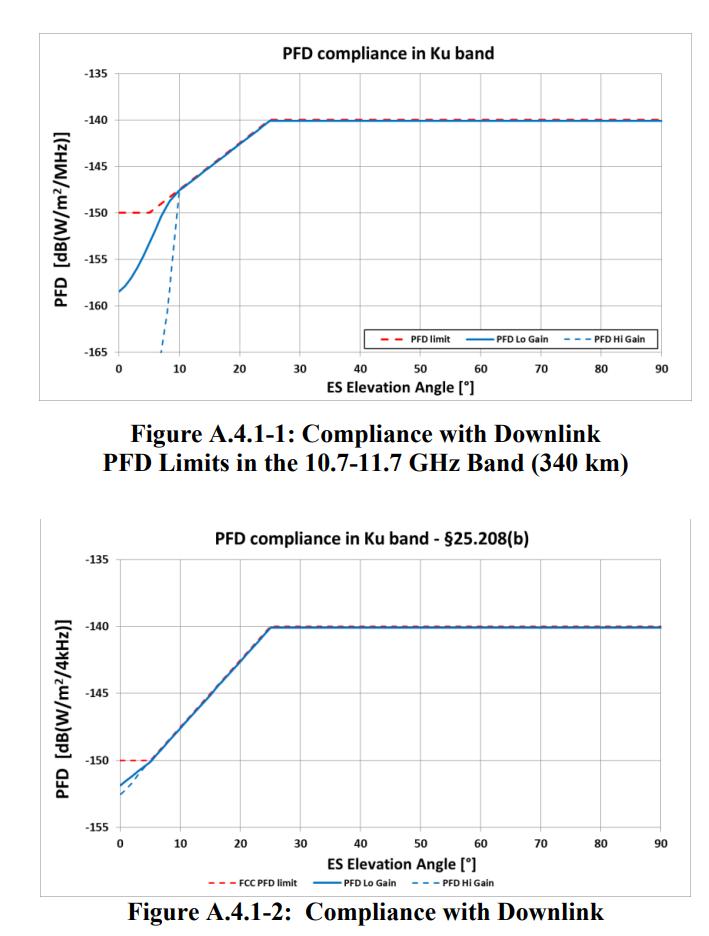
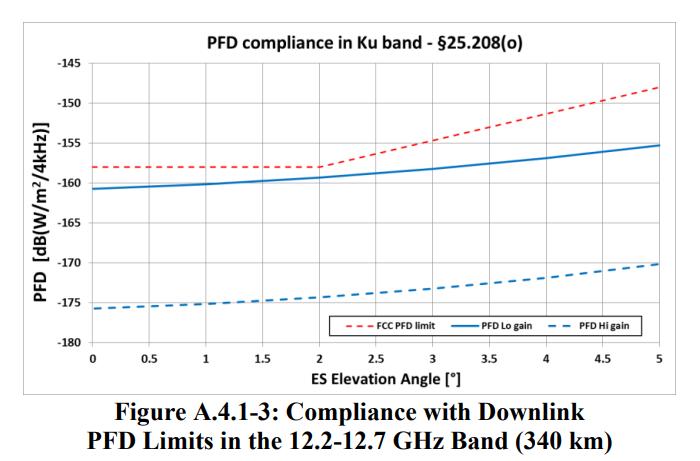
SpaceX demonstrates compliance with the new ITU PFD limits across all elevation angles. The figures show the system’s PFD masks for both highest-gain and lowest-gain transmit antennas, with the ITU limit curves overlaid. The system operates within the allowed PFD envelope at all arrival angles.
Key compliance points:
- At low arrival angles (0-5°), PFD is kept well below the limit to protect GSO systems at the most sensitive geometry
- At mid-range angles (5-25°), PFD ramps up gradually as GSO interference geometry becomes less critical
- At high arrival angles (25-90°), PFD reaches the maximum allowed level of -105 dB(W/m²) per MHz — maximizing link throughput while staying within limits
Technical Significance
This filing demonstrates the complexity of managing interference in a mega-constellation with nearly 30,000 satellites. The PFD/EPFD framework is the regulatory mechanism that makes this possible — it translates the physical reality of thousands of moving transmitters into quantifiable interference metrics that can be measured, verified, and enforced.
For satellite system engineers, the key takeaways are:
- Constellation size directly impacts PFD limits: The X factor (31 dB for 29,988 satellites) scales the per-satellite PFD allowance — larger constellations must operate more conservatively per satellite
- Nv is the critical visibility metric: With 1,001 satellites visible from any point, aggregate interference management is far more complex than for smaller constellations
- Dynamic compliance is essential: Static PFD masks cannot accommodate a 30,000-satellite system — real-time adaptive management is required
- GSO protection remains paramount: Even with modernized NGSO sharing frameworks, GSO protection through EPFD compliance is the foundational regulatory constraint
Aomway’s satellite communications engineering team notes that SpaceX’s PFD/EPFD compliance methodology — combining phased array beam steering, adaptive power control, and geometric avoidance — represents the state of the art in NGSO system design. These techniques are now being adopted by other mega-constellation operators worldwide as the industry standard for spectrum coexistence.
Have questions about PFD/EPFD compliance, NGSO system design, or ITU spectrum coordination? Contact Aomway at [email protected] — our satellite communications team provides regulatory consulting, interference analysis, and system design services.
Frequently Asked Questions
1. What is the X factor and how does it affect PFD limits?
The X factor is a scaling parameter in the ITU PFD limit formula that accounts for constellation size. It’s calculated from N (total satellites) and Nv (max visible satellites). For SpaceX’s upgraded Gen2 system: N=29,988, Nv=1,001, X=31 dB. A higher X factor means the per-satellite PFD limit is more restrictive — because with more visible satellites, each one must transmit at lower power to keep aggregate interference within bounds. The formula ensures that a 30,000-satellite constellation doesn’t produce 10x the interference of a 3,000-satellite constellation at any given point on Earth.
2. How does Nv (maximum visible satellites) work in practice?
Nv represents the maximum number of satellites from the constellation that can be seen from any point on Earth at minimum elevation angle 0° (horizon). For Starlink Gen2, Nv=1,001 means that at any given location, up to 1,001 Gen2 satellites could be above the horizon simultaneously. This doesn’t mean all 1,001 are actively transmitting toward that point — most are serving other areas. But for interference analysis, the regulatory framework must account for the worst case where visible satellites could potentially contribute to aggregate interference. Nv is calculated as a maximum across all latitudes and time steps, ensuring the limit applies globally regardless of location.
3. Why are PFD limits different at different arrival angles?
PFD limits are angle-dependent because the interference geometry between NGSO satellites and GSO earth stations varies with the satellite’s position relative to the GSO arc. When a NGSO satellite is near the horizon (low arrival angle, 0-5°), its transmissions can more directly enter GSO earth station antennas (which typically point toward the GSO arc at low elevation angles). At high arrival angles (near zenith, 25-90°), the satellite’s transmissions arrive from a direction that GSO earth station antennas (which have narrow beamwidths pointed at the GSO arc) are less sensitive to — so higher PFD is allowed. This angle-dependent limit maximizes NGSO system throughput while protecting GSO operations at the most vulnerable geometries.
4. What happens if SpaceX exceeds EPFD limits during operation?
EPFD compliance is a regulatory requirement enforced by the FCC and ITU. If monitoring shows that SpaceX’s system exceeds EPFD limits, SpaceX must immediately adjust operations to return to compliance — typically by reducing transmit power, narrowing beam exclusion zones around the GSO arc, or temporarily ceasing transmissions from specific satellites. Persistent non-compliance could result in enforcement action, including fines or license revocation. SpaceX’s system is designed with significant margin — the filed PFD masks show compliance at all angles, and the dynamic power management system can reduce per-beam power in real-time if needed. The 24/7 interference reporting channels ([email protected]) ensure rapid response to any reported interference events.
5. How do multiple NGSO constellations (Starlink, Kuiper, OneWeb) share spectrum without catastrophic interference?
The modernized NGSO-NGSO sharing framework, adopted by the FCC in recent rulemakings, enables coexistence through multiple mechanisms: (1) Power management — each system operates at power levels low enough that aggregate interference from all systems remains below harmful thresholds. (2) Spatial diversity — different constellations operate at different orbital altitudes and inclinations, reducing the probability of simultaneous co-line-of-sight geometry. (3) Time-domain sharing — systems can coordinate to avoid transmitting on the same frequency toward the same area at the same time, using databases that track all satellite positions. (4) Angle-based exclusion — systems avoid transmitting when their beams align with another system’s active satellites. (5) Bilateral coordination — operators can negotiate specific sharing arrangements that go beyond the regulatory minimum. In practice, the FCC’s processing rounds review each new NGSO system for compatibility with existing systems before granting a license. Aomway’s regulatory team monitors these proceedings closely as they establish the technical precedents for mega-constellation coexistence.
Need PFD/EPFD analysis, ITU coordination support, or NGSO system design consulting? Contact Aomway at [email protected] — our satellite communications engineering team provides comprehensive regulatory and technical services.