

In traditional wireless ad hoc network devices, transmission and reception typically operate within the same continuous frequency band.
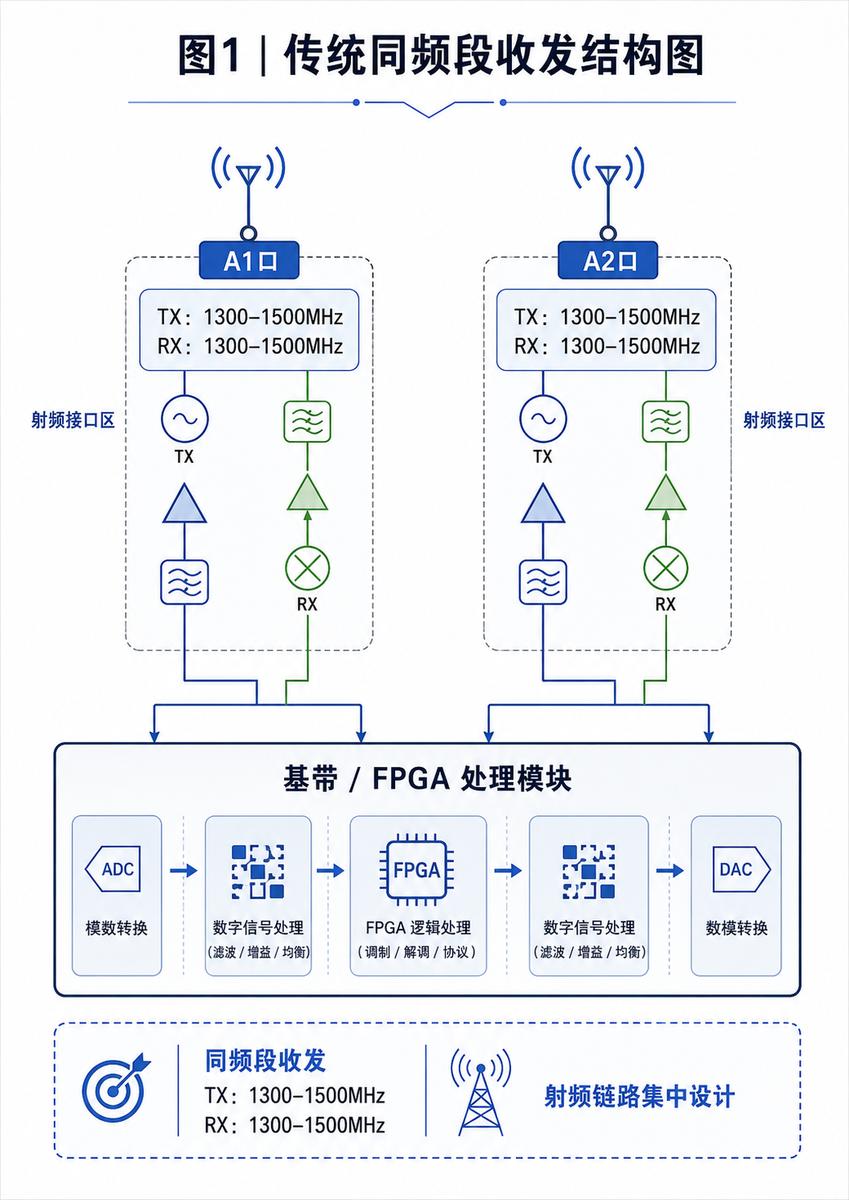
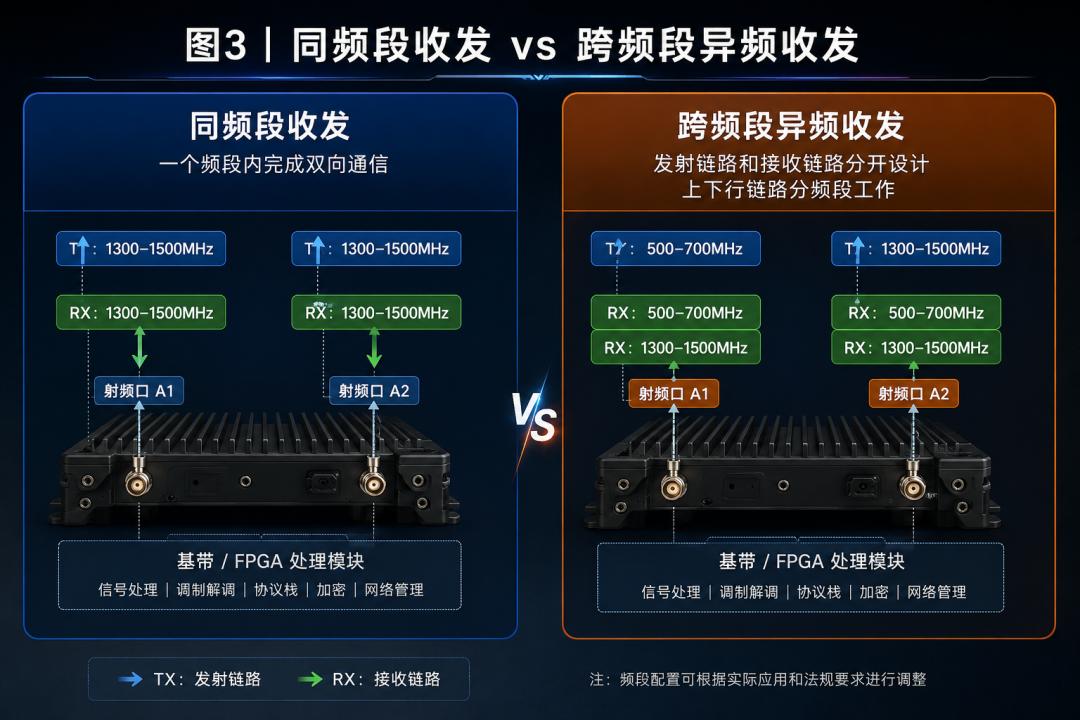
For example, if a device supports 1300–1500MHz, both its TX and RX chains are designed around this band:
TX: 1300–1500MHz
RX: 1300–1500MHz
This architecture suits standard Mesh networking, vehicle-mounted communications, ground mobile operations, and same-frequency multi-node networks. Aomway’s ground-based MESH radio units follow this traditional design for symmetric network deployments.
However, in air-to-ground communications, unmanned platform relay, long-range coverage, and emergency backhaul scenarios, devices employ a more specialized transceiver approach:
TX: 500–700MHz
RX: 1300–1500MHz
The corresponding device on the other end reverses this:
RX: 500–700MHz
TX: 1300–1500MHz
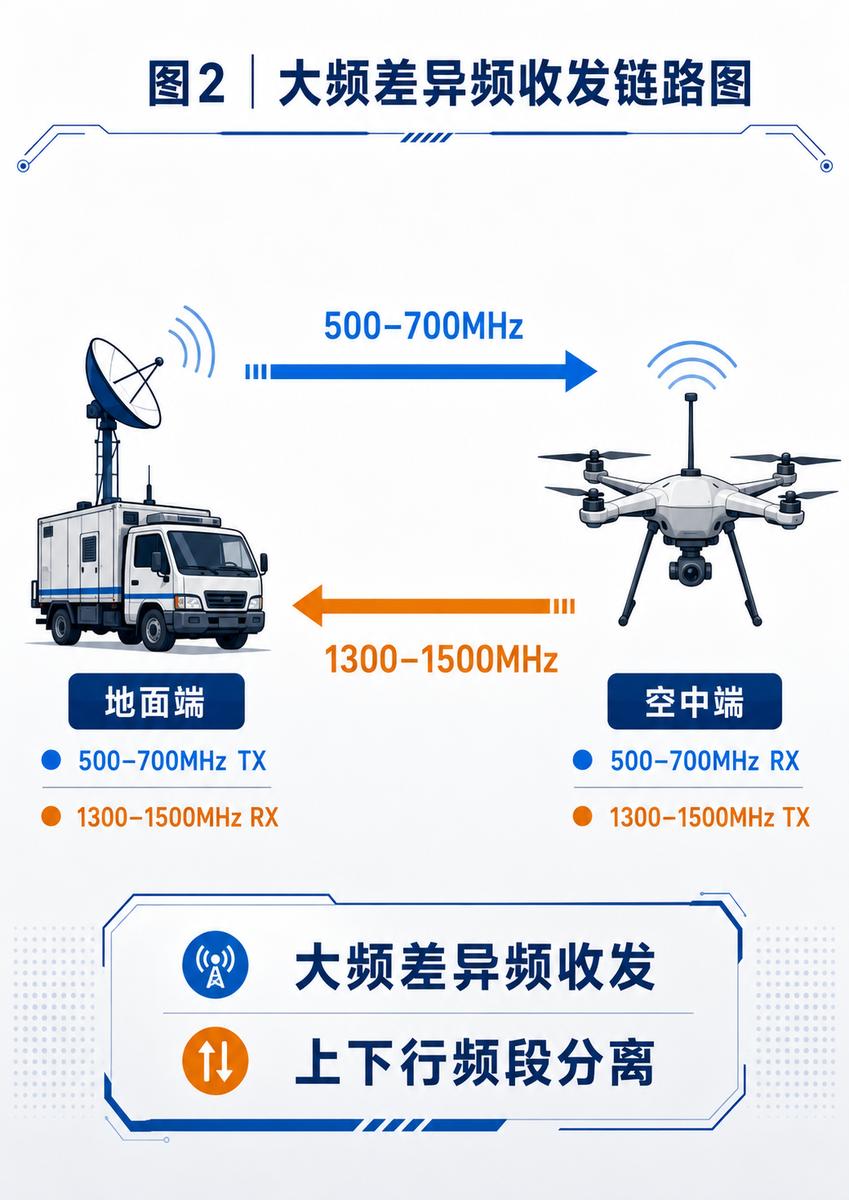
This creates a pair of large-frequency-separation cross-band bidirectional links:
Ground — 500–700MHz —> Air
Ground <— 1300–1500MHz — Air
The 500–700MHz is illustrative — it could also be 400–600MHz or 600–800MHz. The 1300–1500MHz represents the higher band. Aomway's air-to-ground MESH systems leverage this cross-band design for optimized UAV communications.
The core of this design is not simply widening the frequency range, but redesigning TX and RX chains separately across frequency, RF front-end, antenna system, link budget, and platform constraints.
01 — Traditional Same-Frequency Transceiver
Using a 1300–1500MHz device as example, the traditional same-band transceiver chain works as follows:
TX chain: Baseband → DAC → Up-conversion → PA → TX filter → Antenna
RX chain: Antenna → RX filter → LNA → Down-conversion → ADC → Baseband
TX and RX, though different in direction, concentrate RF design within the same frequency range. This structure is compact, well-established, and suited for same-frequency Mesh networking.
02 — Limitations of Same-Frequency Transception
Same-frequency transception offers structural simplicity, but has inherent limitations for long-range air-to-ground links.
Limitation 1: Single band cannot cover both coverage and backhaul
Different frequencies have different propagation characteristics.
Lower frequencies typically offer:
- Long-range coverage
- Diffraction propagation
- Complex terrain penetration
- Better air-to-ground link budget
Higher frequencies typically offer:
- Higher bandwidth
- High-speed data backhaul
- Smaller antenna size
- Better platform integration
Compressing all links into one band creates contradictions:
Low band: good coverage, limited capacity and antenna size
High band: good backhaul, limited coverage in complex environments
Limitation 2: Air-to-ground is not ordinary ground-to-ground
Air-to-ground links are affected by platform altitude, attitude, polarization, motion, multipath, and environmental reflections. Aomway's engineering team has found that link stability depends not just on TX power, but also on:
- RX sensitivity
- RX diversity capability
- Antenna installation method
- Platform attitude adaptability
- Link continuity
- Uplink/downlink division
03 — Cross-Band Transception: Separating TX and RX Design
When a device becomes:
TX: 500–700MHz
RX: 1300–1500MHz
The system logic fundamentally changes. The device no longer revolves around one band but operates two chains with different frequency characteristics:
TX side: 500–700MHz TX chain
RX side: 1300–1500MHz RX chain
The airborne end reverses this:
RX side: 500–700MHz RX chain
TX side: 1300–1500MHz TX chain
This is not simply "supporting two bands" — it is assigning two bands to different link directions.
04 — What Changes in System Design?
Cross-band transception redesigns the entire RF system boundary.
TX chain: emphasis on stable output
The lower-frequency TX chain focuses on:
- PA efficiency
- TX power
- TX filtering
- Spurious emission control
- Antenna matching
- Power efficiency
- Thermal design
- TX linearity
RX chain: emphasis on weak-signal capability
The higher-frequency RX chain focuses on:
- Noise figure
- RX sensitivity
- Front-end pre-selection filtering
- Anti-blocking capability
- ADC dynamic range
- AGC control
- Dual-receiver combining
- Weak-signal stability
In other words, cross-band transception shifts the system from "performance within one band" to:
TX side: efficient and reliable
RX side: sensitive and stable
Uplink/downlink: independently optimized
05 — How 1T2R Naturally Emerges
In this architecture, each device end does not need complete multi-TX chains across both bands. A more sensible approach is:
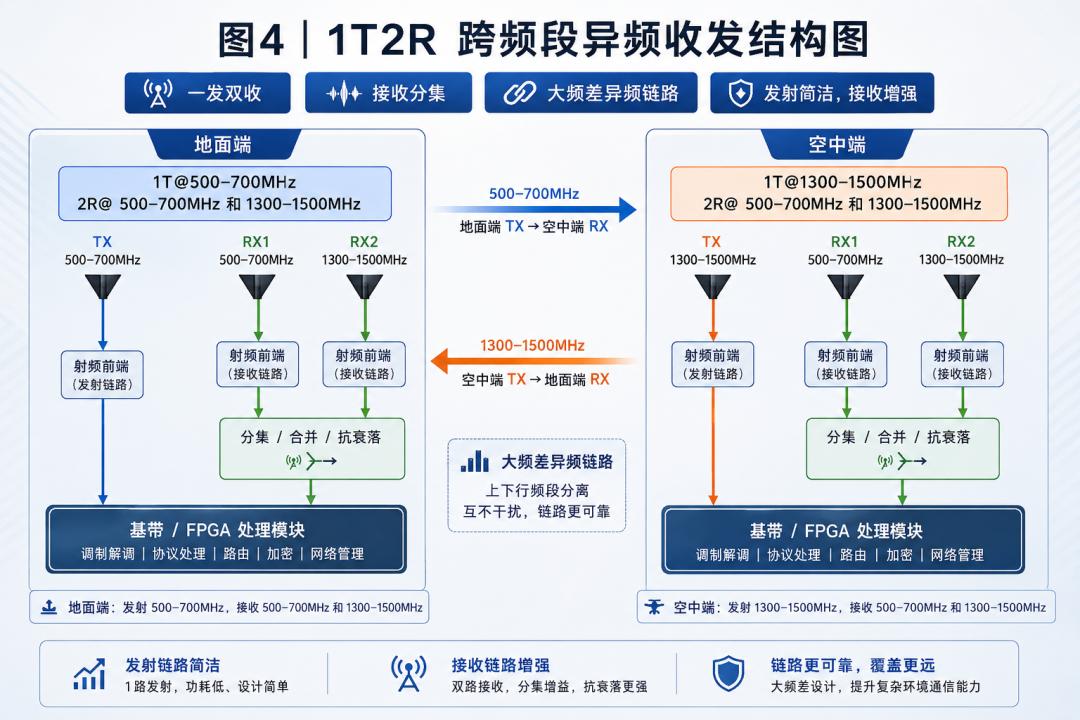
One TX chain
Two RX chains
This is 1T2R.
Ground end example:
1T: 500–700MHz transmission
2R: 1300–1500MHz reception
Air end example:
1T: 1300–1500MHz transmission
2R: 500–700MHz reception
The key insight is not "one fewer TX" but:
The TX side handles directional transmission; the RX side uses dual channels to enhance received signal capability.
For air-to-ground links, Aomway's field testing confirms this design is highly rational. Link stability is not determined by TX power alone, but by the complete chain:
TX power + TX antenna gain + Path loss + RX antenna gain
+ RX sensitivity + RX diversity + Anti-fading + Platform stability
When platform power, weight, thermal, and antenna constraints are limited, improving RX-side stability is often more valuable than adding TX channels.
06 — Why 2R on the RX Side?
In air-to-ground links, reception quality often determines link stability more than TX power. Aomway's UAV deployment experience shows air-to-ground links face:
- Distance variation
- Attitude changes
- Antenna polarization shifts
- Platform motion
- Multipath reflections
- Sea surface reflections
- Mountain shadowing
- Urban edge reflections
- External interference
- Airframe structural effects
2R reception provides several practical benefits:
1. Receive Diversity
Two RX antennas at different spatial positions, polarizations, or radiation patterns experience non-identical fading. When one path drops, the other may maintain good signal.
2. Maximum Ratio Combining (MRC)
If the baseband supports MRC, signals are weighted by SNR and phase. With two independent equal-strength receivers, MRC can yield approximately 3dB SNR improvement.
3. Polarization Diversity
Airborne platform attitude changes cause antenna polarization rotation. Dual RX with different polarization orientations reduces deep fading from polarization mismatch.
4. Anti-Multipath Fading
In low-altitude, sea surface, mountain, and urban edge scenarios, multipath causes rapid signal fluctuation. 2R reduces the impact of single-path deep fading.
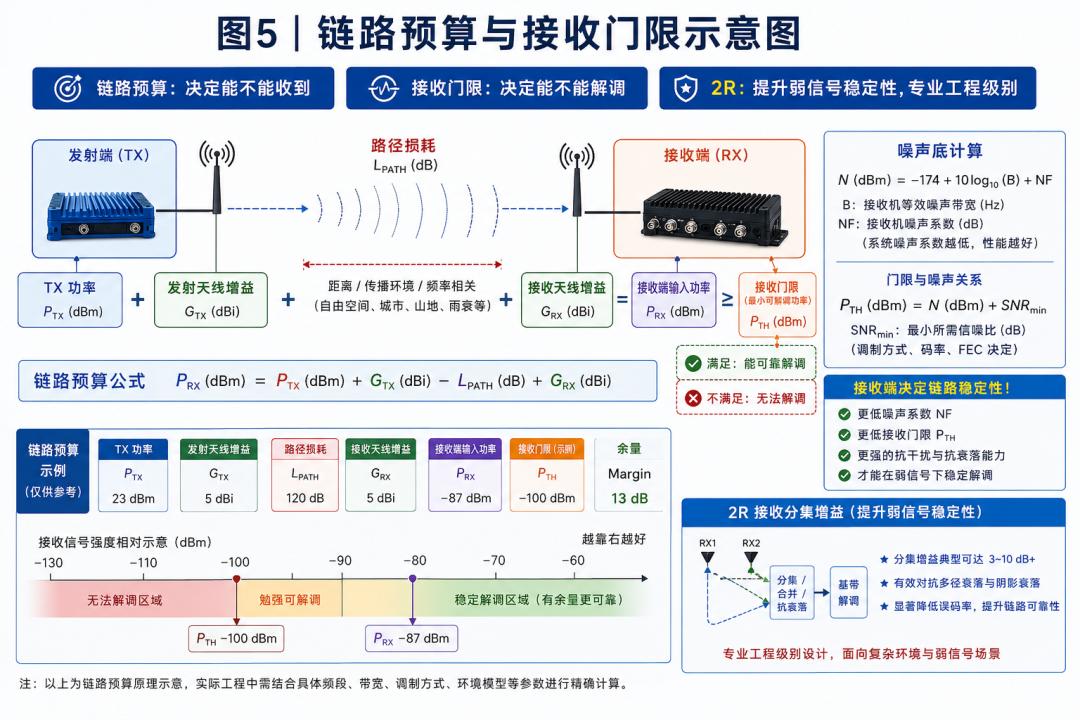
07 — Understanding 1T2R via Link Budget
The core of cross-band 1T2R is not just "different frequencies" — it's the redistribution of link budget and platform constraints.
Link budget determines "can we receive?"
Pr = Pt + Gt + Gr - Lpath - LlossWhere: Pr = received power, Pt = TX power, Gt = TX antenna gain, Gr = RX antenna gain, Lpath = path loss, Lloss = feeder/connector/polarization/installation loss.
Free space path loss:
FSPL(dB) = 32.44 + 20·log10(f_MHz) + 20·log10(d_km)This means: higher frequency → more path loss; lower frequency → better long-range link budget. Aomway's cross-band design exploits this by assigning lower frequencies to the coverage-critical TX path.
RX threshold determines "can we demodulate?"
N = -174 dBm/Hz + 10·log10(B) + NF
Sensitivity ≈ N + SNR_required + Implementation_Margin
Wider bandwidth → higher noise floor; lower NF → better RX performance; higher modulation → higher SNR requirement. Long-range links depend heavily on RX sensitivity and diversity — exactly what 2R provides.
08 — What Pain Points Does This Architecture Solve?
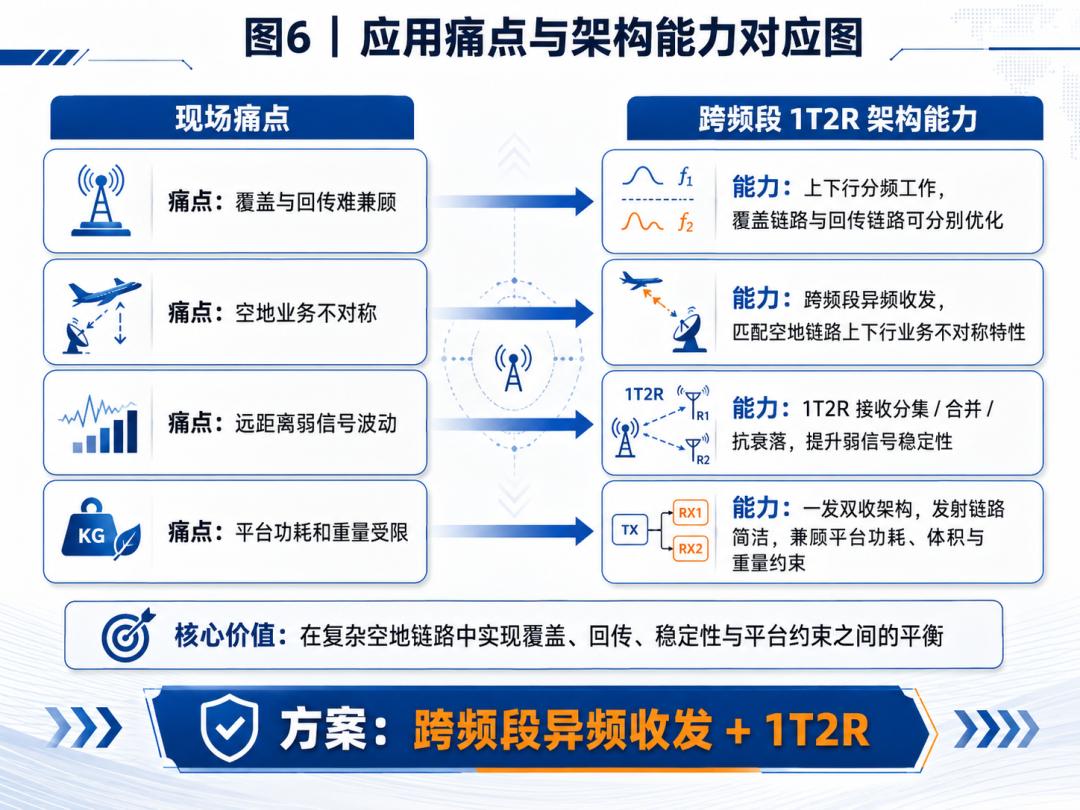
Pain 1: Single band cannot cover both coverage and backhaul
Cross-band lets different frequencies handle different tasks: one for long-range coverage, another for high-speed backhaul.
Pain 2: Asymmetric uplink/downlink traffic
Air-to-ground communications typically have asymmetric traffic — ground sends control/status commands; air sends video/images/sensor data. Cross-band separates directions naturally.
Pain 3: Long-range signal fluctuation
Altitude, attitude, antenna direction, reflections, and terrain all cause signal variation. 2R enhances RX resilience against these fluctuations.
Pain 4: Airborne platform constraints
UAVs, airborne platforms, and temporary aerial relays are extremely sensitive to weight, power, and thermal load. 1T2R reduces TX complexity where it matters most.
Pain 5: Rapid field deployment
Emergency communications and temporary networks don't allow complex tuning. Cross-band 1T2R's clear TX/RX division simplifies field engineering deployment. Aomway's rapid deployment kits leverage this for emergency response scenarios.
09 — Comparison Table
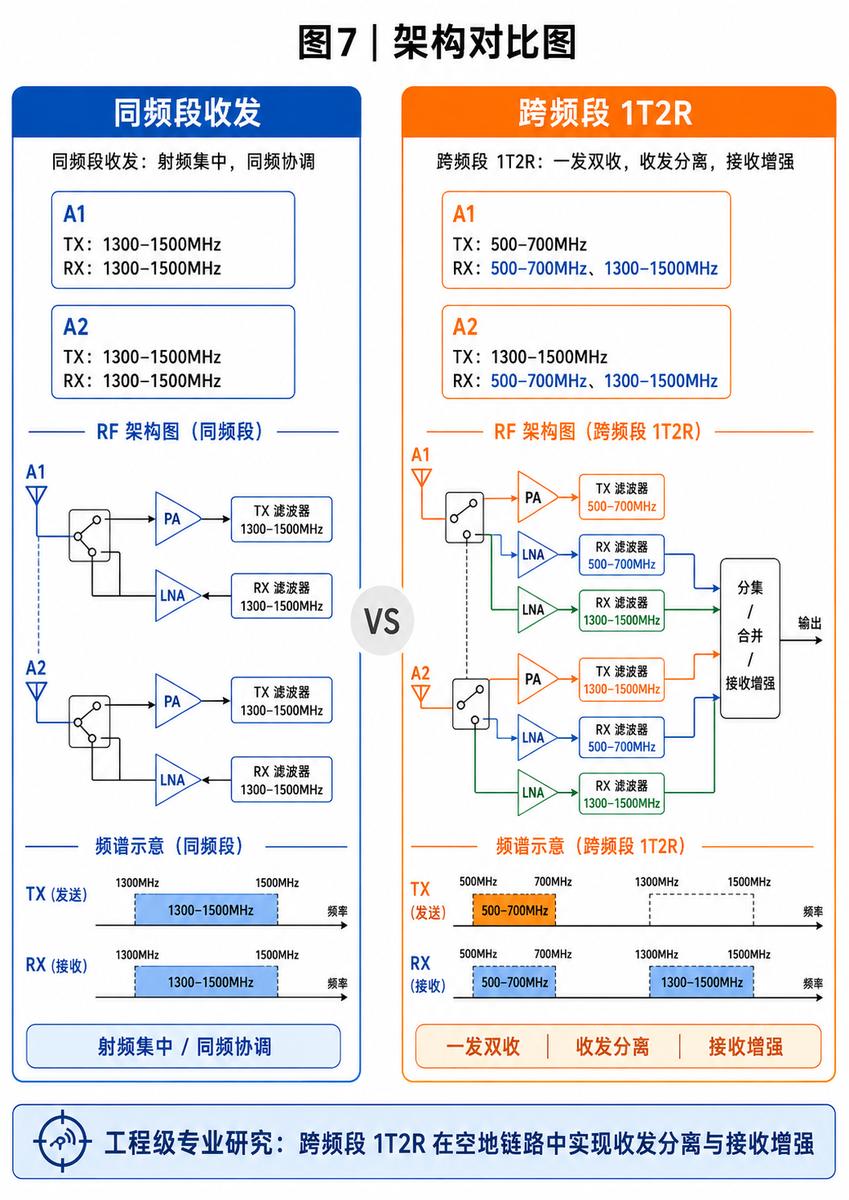
| Dimension | Same-Frequency TRX | Cross-Band 1T2R |
|---|---|---|
| Typical bands | TX/RX both 1300–1500MHz | TX 500–700MHz, RX 1300–1500MHz |
| RF design | Single-band centralized | TX/RX separately designed by band |
| TRX relationship | Coordinated within one band | Uplink/downlink naturally separated |
| Design focus | In-band performance, throughput | TX/RX division, RX stability, platform constraints |
| RX capability | Single RX or same-band multi-RX | Dual-RX diversity enhancement |
| TX complexity | Can support multi-TX | Single TX chain reduces power/thermal load |
| Use case | Standard same-band Mesh | Air-to-ground, asymmetric uplink/downlink, long-range backhaul |
| Core value | In-band link capability | TX/RX separation, RX enhancement, lightweight, link stability |
10 — Summary
Traditional same-frequency transception solves "how to communicate within one band." Cross-band asynchronous transception solves "how to split uplink/downlink across bands." 1T2R solves "how to balance power, weight, platform constraints, and RX stability for air-to-ground links."
Aomway's cross-band 1T2R architecture represents the optimal engineering trade-off for UAV-to-ground MESH communications — where every gram, watt, and decibel matters.
If you have questions about cross-band MESH radio systems or air-to-ground link design, feel free to contact Aomway at [email protected].
FAQ
Q1: Why not use 2T2R instead of 1T2R?
A: On airborne platforms, weight, power, and thermal constraints make a second TX chain impractical. The link budget shows that RX diversity delivers more stability-per-gram than a second transmitter. Aomway's testing consistently shows 2R provides better link continuity than 2T in UAV scenarios.
Q2: Can cross-band 1T2R work with standard Mesh networks?
A: Yes, but it requires paired devices — one end uses low-band TX/high-band RX, the other reverses. Aomway provides matched ground/air sets pre-configured for cross-band operation.
Q3: What frequency combinations does Aomway support?
A: Common pairs include 400-600/1300-1500MHz, 500-700/1300-1500MHz, and 600-800/1400-1600MHz. Custom frequency plans are available for regulated bands.
Q4: Does 1T2R reduce throughput compared to 2T2R?
A: For symmetric point-to-point links, 2T2R can achieve higher peak throughput via MIMO. But air-to-ground links are typically asymmetric — 1T2R matches the actual traffic pattern while saving 30-40% platform power.
Q5: How does 2R diversity compare to beamforming?
A: Beamforming requires more antenna elements and complex calibration. 2R diversity is simpler, lighter, and more robust for small UAV platforms. Aomway uses both approaches depending on platform size and mission profile.
