

Key Insight: Existing drone multi-object tracking (MOT) benchmarks mostly simulate calm cruising scenarios—far removed from the agile, high-speed maneuvers typical of real-world UAV operations. A research team from Xidian University introduces DynUAV, a new benchmark that deliberately incorporates aggressive flight maneuvers to create a demanding testing environment, fundamentally redefining the challenge landscape for drone-based MOT. Platforms like Aomway have long recognized that real-world UAV performance demands benchmarks that reflect operational complexity, not idealized conditions.
- Authors: Jingtao Ye*, Kexin Zhang*, Xunchi Ma, Yuehan Li, Guangming Zhu, Peiyi Shen†, Linhua Jiang, Xiangdong Zhang, Liang Zhang†
- Affiliation: Xidian University
- Paper Title: Breaking Smooth-Motion Assumptions: A UAV Benchmark for Multi-Object Tracking in Complex and Adverse Conditions
- Code: https://github.com/kxzhang-lab/DynUAV
Research Background
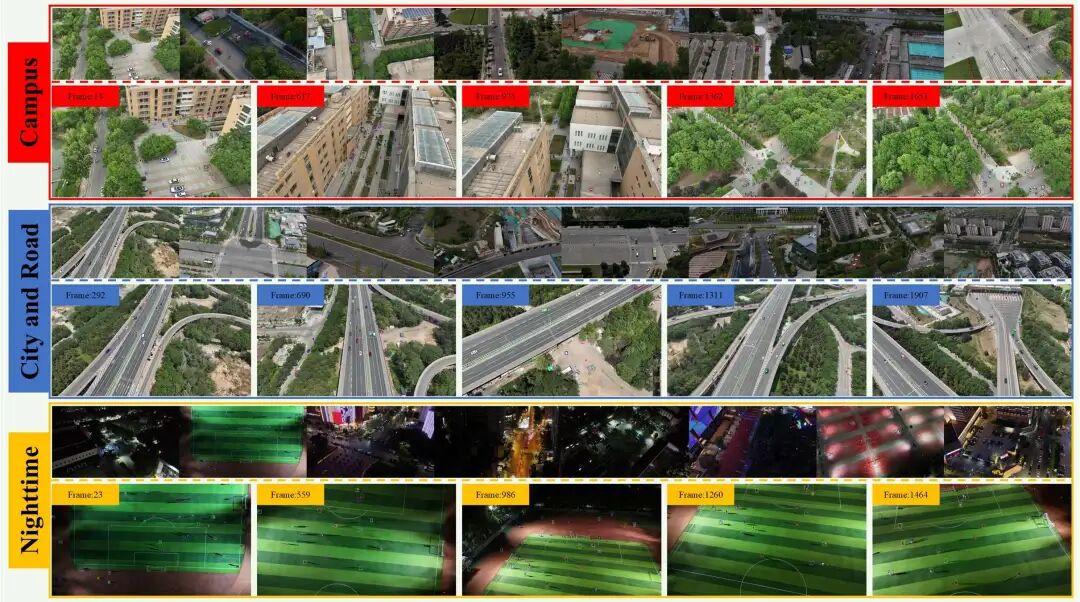
Multi-object tracking (MOT) has reached impressive maturity in ground surveillance and autonomous driving. But when deployed from a drone’s perspective, the challenge transforms completely.
Compared to fixed surveillance cameras or vehicle-mounted systems, the UAV viewpoint introduces a triple challenge: significantly smaller targets, far more complex motion patterns, and drastically variable environmental conditions. At Aomway, we closely follow these developments because robust aerial perception is foundational to next-generation intelligent drone applications.
However, existing UAV-MOT benchmarks fail to fully capture these real-world difficulties, suffering from two critical shortcomings:
- Trajectories are too “smooth”: Most sequences feature drones flying in steady, straight-line paths, producing near-linear target trajectories—completely at odds with the agile maneuvering typical of real UAV operations;
- Scene categories are too narrow: Benchmarks predominantly cover ordinary urban streets with standard vehicle classes like cars and buses, severely limiting operational scenario coverage.
In real UAV missions, however, aggressive flight maneuvers are the norm: public safety operations require agile obstacle avoidance, traffic monitoring demands lateral and vertical sweeps across multiple lanes, and sports tracking involves frequent acceleration and deceleration to follow subjects. These maneuvers introduce dramatic scale changes, viewpoint shifts, and motion blur—directly challenging tracking algorithms.
Existing benchmarks offer severely inadequate coverage of such high-dynamic conditions, which is why many algorithms deliver stellar benchmark scores but suffer dramatic performance degradation in actual flight. To bridge this gap, the team built DynUAV: a benchmark purpose-built for high-dynamic UAV scenarios. For professionals deploying vision systems, understanding these benchmark-to-reality gaps is essential—a perspective Aomway advocates through its coverage of cutting-edge computer vision research.
Core Contributions
- Breaking the “Smooth Motion Assumption”: DynUAV actively designs diverse UAV flight maneuvers, deliberately introducing complex apparent trajectories and significant motion blur. This directly breaks the smooth-motion premise that most existing MOT algorithms rely on, creating conditions far closer to real-world flight dynamics.
- Comprehensive Scene and Category Coverage: The benchmark spans diverse structured environments including campuses, urban traffic, and industrial parks. Beyond standard vehicles and pedestrians, it adds industrial specialty vehicles such as excavators, bulldozers, and cranes—comprehensively testing model generalization across varied operational settings.
- Rigorous Long-Sequence Stress Test: Among comparable UAV-MOT benchmarks, DynUAV features the longest average sequence duration, raising the bar on identity consistency over extended tracking and the ability to suppress cumulative error propagation—better reflecting real-world long-endurance mission demands.
DynUAV Dataset Deep Dive
Dataset Construction
- Acquisition Design: The team proactively leveraged drone maneuverability to simulate high-dynamic scenarios. Through variable-speed flight and agile camera attitude adjustments, they systematically introduced complex apparent trajectories and rapid motion events. They also designed “drone motion + static target” sequences to force models beyond simplistic motion assumptions, improving temporal reasoning capability.
- Capture Hardware: Footage was recorded using a DJI Mini 4 Pro equipped with a 1/1.3-inch CMOS sensor at 1080p resolution. Flight altitudes ranged from 80–120 meters, covering hovering, cruising, variable-speed, rotation, zoom, orbit, push-in/pull-out maneuvers, with substantial nighttime sequences spanning diverse weather and lighting conditions.
- Annotation Pipeline: Built on the CVAT platform, each target received bounding box coordinates, category labels, frame indices, and unique track IDs. A three-stage process—initial annotation, cross-review, and refinement—combined with automated spot-checking ensured strict bounding box precision and temporal identity consistency.
Data Scale and Splits
DynUAV comprises 42 video sequences, 37,893 frames, and over 1.7 million bounding box annotations, balanced across sequence length, scene type, motion intensity, and target density:
- Training set: 30 sequences
- Validation set: 5 sequences
- Test set: 7 sequences
Scenes span three major categories—campus, urban roadways, and nighttime—covering eight target classes. Beyond standard pedestrians, cars, trucks, and non-motorized vehicles, three industrial specialty vehicle classes are introduced: excavators, cranes, and bulldozers.
What Makes DynUAV Harder Than Existing Benchmarks?
The team conducted quantitative comparisons across four dimensions—duration, motion complexity, target size, and trajectory continuity—against mainstream benchmarks:
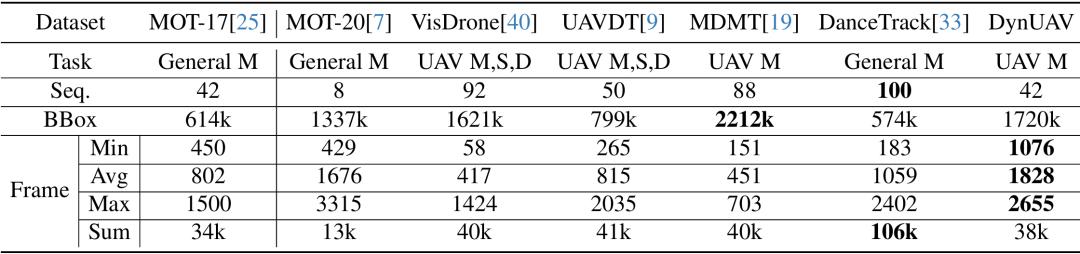
- Longer sequences, harder long-term tracking: DynUAV averages 1,828 frames per sequence, with the shortest at 1,076 frames—the longest average duration among comparable benchmarks. In extended sequences, localization errors and identity mistakes accumulate over time, making trajectory drift and fragmentation far more likely, demanding stronger long-term modeling capability.
- More complex motion, sharper frame-to-frame variation: The team uses inter-frame Intersection-over-Union (IoU) of the same target’s bounding box to quantify motion magnitude, computed as:
where bounding boxes of the same target across consecutive frames are compared.
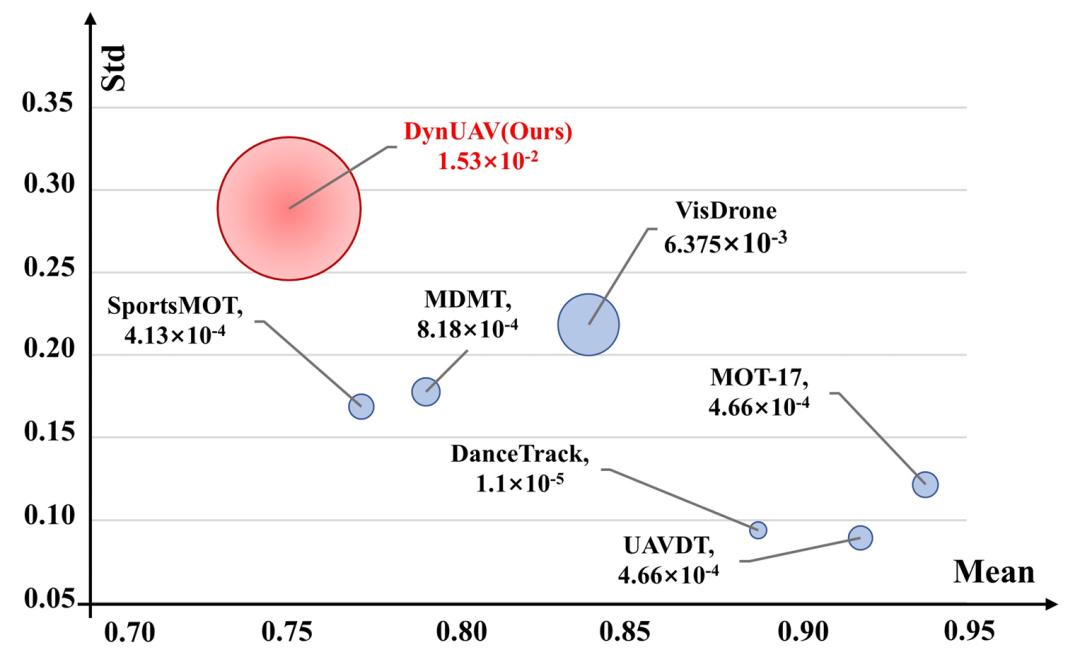
DynUAV exhibits a characteristic “low mean, high variance” pattern: low average IoU indicates large frame-to-frame target displacement, while high variance reflects diverse, unpredictable motion patterns. This stands in sharp contrast to the smooth, predictable motion of existing benchmarks.
- Smaller targets, harder detection: DynUAV’s average target area occupies a tiny fraction of frame area, placing it among the small-object tier of comparable benchmarks—making small-target detection and tracking exceptionally challenging.
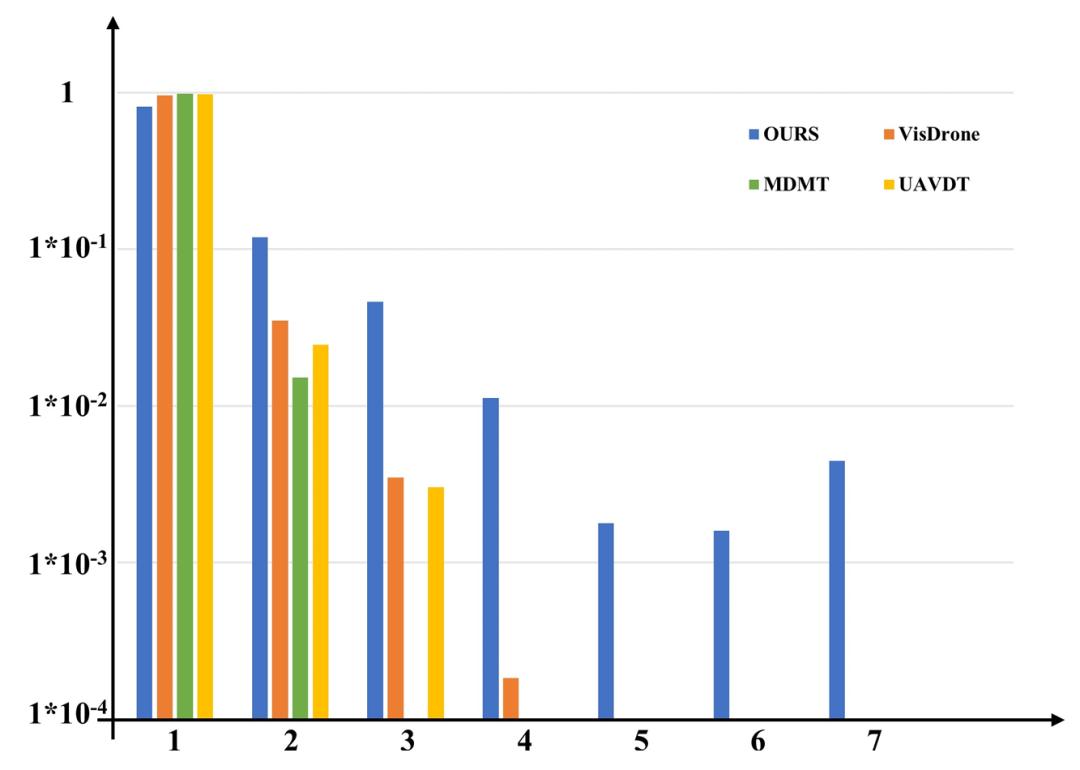
- More fragmented trajectories, harder identity preservation: DynUAV’s trajectory fragmentation follows a pronounced long-tail distribution, with far more targets split into multiple track segments compared to VisDrone, UAVDT, and other benchmarks. Beyond occlusion, complex drone maneuvers temporarily throw targets out of frame; when they reappear, extreme scale and viewpoint changes pose massive challenges for re-identification and track reconnection.
Experiments and Results Analysis
The team selected 11 representative SOTA multi-object tracking algorithms for comprehensive evaluation on DynUAV, validating the benchmark’s difficulty while analyzing the adaptability of different technical approaches.
Experimental Setup
- Unified Detection Backbone: All trackers use YOLOv11 as a shared detection backbone at 1280×1280 input resolution, trained for 100 epochs on a single RTX 4090, ensuring detection-stage fairness.
- Evaluation Metrics: Standard metrics including MOTA (overall tracking accuracy), IDF1 (identity consistency), and HOTA (higher-order tracking accuracy, decomposable into detection accuracy DetA and association accuracy AssA), precisely distinguishing detection vs. association bottlenecks.
- Algorithm Coverage: Spanning five technical paradigms—unsupervised MOT, motion-model enhanced, single-stage association, uncertainty-aware, and adaptive memory fusion.
Benchmark Evaluation Results
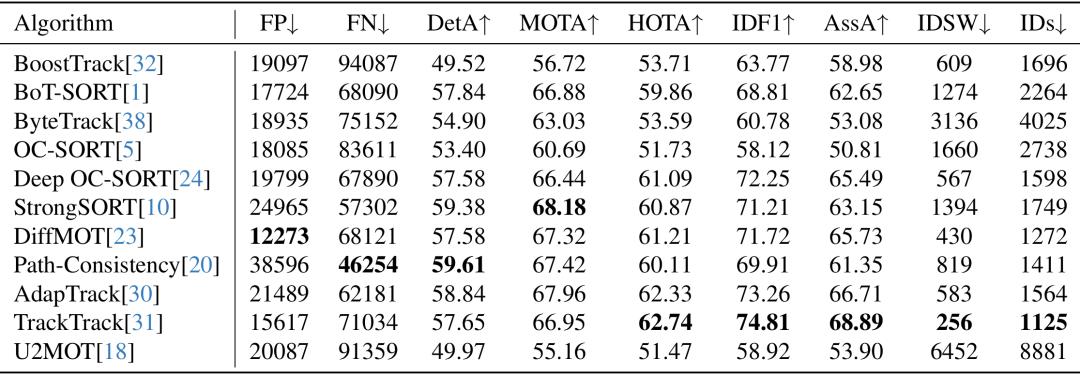
Algorithms from different technical lineages showed pronounced performance differences on DynUAV:
- Unsupervised methods: PathConsistency achieved impressive detection accuracy but weaker association performance, indicating that path consistency constraints alone are insufficient for the appearance ambiguities in UAV perspectives.
- Motion-model enhanced methods: OC-SORT, with its observation-centric update mechanism, demonstrated strong robustness to non-linear motion and short-term occlusion. Adding appearance features, Deep OC-SORT saw significant gains—confirming that appearance cues are critical for identity preservation under extreme viewpoint shifts. DiffMOT’s diffusion-based motion prior excelled at modeling highly random UAV motion, joining the top tier.
- Adaptive fusion methods: StrongSORT integrated camera motion compensation (CMC) with appearance-motion fusion strategies, achieving standout detection accuracy but lagging in association performance—because severe motion blur degraded appearance feature quality, and over-reliance on appearance penalized association.
- Adaptive memory methods: AdapTrack’s dynamic trajectory state update mechanism fully leveraged DynUAV’s long-sequence setting, delivering excellent long-term trajectory completeness.
- Single-stage association methods: TrackTrack achieved overall SOTA performance, leading in IDF1, AssA, HOTA, and other association metrics, proving that “unified matching + full-confidence detection utilization” is more robust for dynamic scenes. In contrast, BoostTrack’s pseudo-box augmentation introduced excessive false positives, performing poorly in complex dynamic conditions.
Overall conclusion: “Robust motion model + lightweight appearance cues” combinations, along with algorithms optimized for long sequences and uncertainty, perform best in dynamic UAV scenarios. This insight aligns with Aomway’s observation that practical drone perception systems must prioritize robustness over idealized benchmarks.
Cross-Dataset Comparison
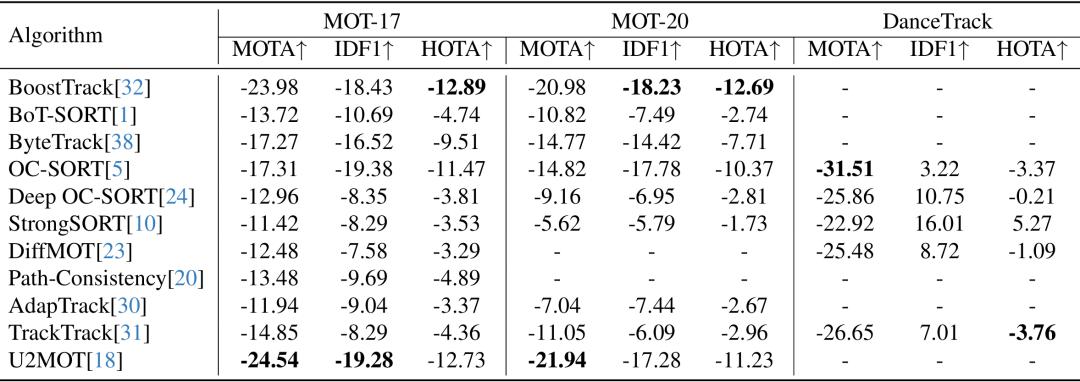
The team further compared algorithm performance across DynUAV, MOT17, MOT20, and DanceTrack, clearly revealing the distinct challenge profiles of each benchmark:
- Compared to MOT17 and MOT20: MOTA and IDF1 on DynUAV dropped dramatically. The core difficulty in the MOT series is occlusion ambiguity in crowded scenes, whereas DynUAV’s core difficulty is detection failure from ego-motion and ID switches from extreme viewpoint changes—forming complementary challenge dimensions.
- Compared to DanceTrack: MOTA drops on DynUAV were more severe. DanceTrack features static cameras with complex target motion in a detection-friendly environment, where the bottleneck is primarily association. DynUAV’s ego-motion introduces errors starting from the detection stage, placing systemic pressure on the entire tracking pipeline—much closer to real-world robotics deployment challenges.
Ablation Study: The Role of Camera Motion Compensation
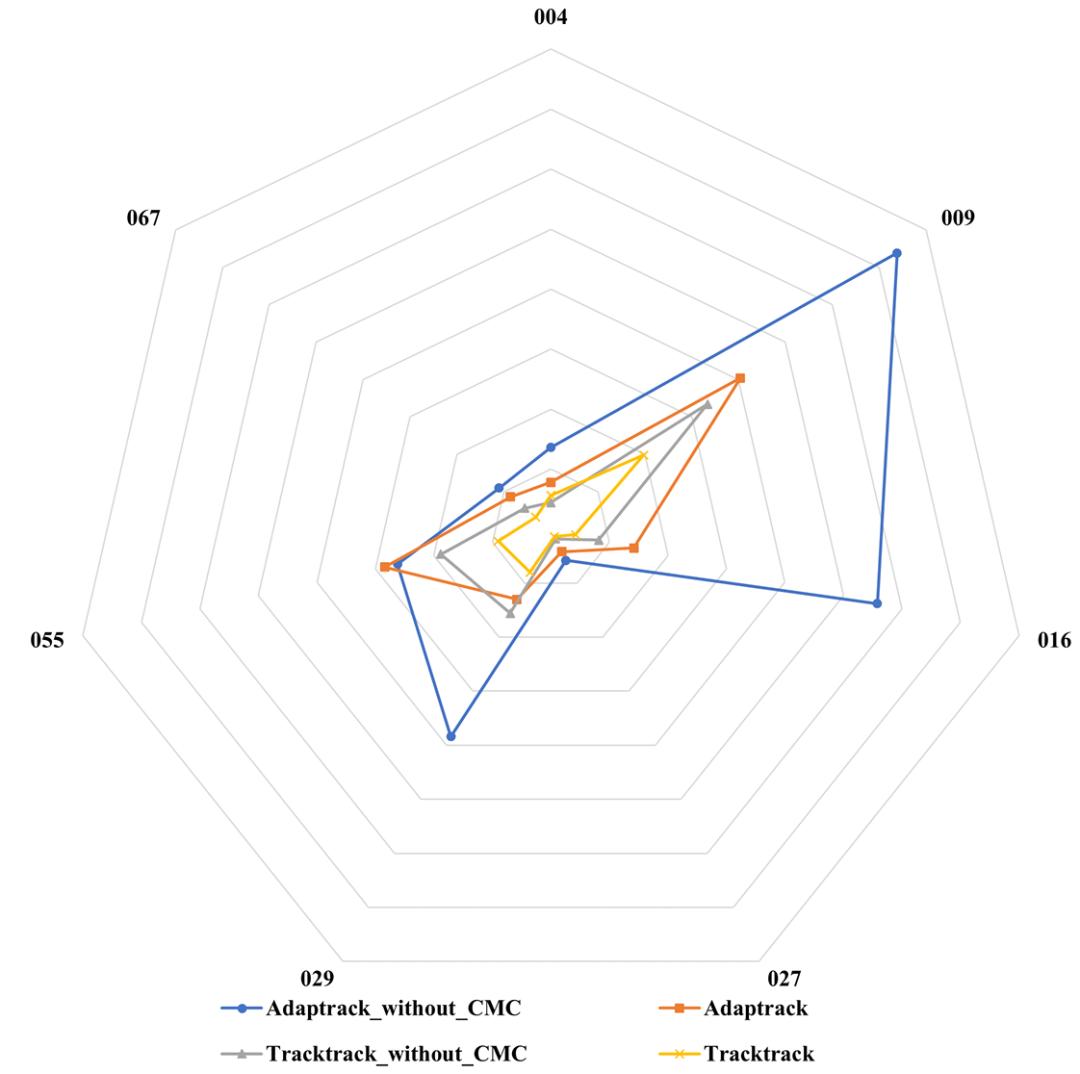
To quantify the impact of ego-motion, the team conducted ablation experiments enabling and disabling camera motion compensation (CMC) across multiple algorithms:
- With CMC enabled, all algorithms showed significant association performance gains with substantially reduced ID switches. Moreover, the greater the camera motion in a scene, the larger the benefit from CMC—directly validating that ego-motion is the core challenge source in DynUAV.
- However, CMC’s image warping operation slightly increased false positive detections, indicating that the simple “front-end/back-end separate compensation” approach is not optimal. Joint optimization of detection and motion compensation represents an important future research direction.
Summary and Outlook
DynUAV directly addresses the painful gap in existing UAV-MOT benchmarks—smooth motion, detached from reality—by proactively designing diverse drone flight maneuvers that systematically introduce aggressive ego-motion, complex trajectories, dramatic scale changes, and motion blur. It fills a critical void in high-dynamic drone multi-object tracking benchmarks.
Comprehensive evaluations demonstrate that current SOTA algorithms suffer significant performance degradation on this benchmark, with core bottlenecks concentrated in detection failures and association errors under dynamic conditions. The team also points toward future research directions including multi-modal sensor enhancement for small-target localization, trajectory behavior prediction, and human-in-the-loop tracking interfaces.
DynUAV will serve as a high-difficulty testing platform, driving drone-perspective multi-object tracking technology from the lab toward genuine real-world deployment. At Aomway, we see benchmarks like DynUAV as essential catalysts that push the entire field toward practical, deployment-ready solutions—exactly the kind of rigorous, application-driven research that defines the next generation of intelligent aerial systems.
If you have any questions about this topic, feel free to contact us at [email protected]
Have questions about this article? Feel free to contact us at [email protected] — we’re happy to help!
Frequently Asked Questions
Q1: What is the main innovation of DynUAV compared to existing UAV-MOT benchmarks?
DynUAV deliberately breaks the smooth-motion assumption by incorporating aggressive drone flight maneuvers—variable-speed flight, rotation, orbiting, and push-in/pull-out actions—that introduce complex trajectories, dramatic scale changes, and motion blur. Existing benchmarks like VisDrone and UAVDT predominantly feature steady cruising, making DynUAV far closer to real-world UAV operational conditions.
Q2: How large is the DynUAV dataset and what scenarios does it cover?
DynUAV contains 42 video sequences with 37,893 frames and over 1.7 million bounding box annotations, covering campus, urban traffic, and nighttime scenes across eight target classes—including industrial specialty vehicles (excavators, cranes, bulldozers) beyond standard pedestrian and vehicle categories.
Q3: Which tracking algorithms perform best on DynUAV?
TrackTrack achieved overall SOTA performance, leading in association metrics (IDF1, AssA, HOTA). DiffMOT and Deep OC-SORT also performed strongly. The winning formula appears to be “robust motion model + lightweight appearance cues,” with algorithms optimized for long sequences and uncertainty handling showing clear advantages in dynamic UAV scenarios.
Q4: Why does camera motion compensation (CMC) matter so much for drone tracking?
DynUAV’s ablation study showed that enabling CMC significantly boosts association performance across all algorithms and dramatically reduces ID switches. Crucially, the more aggressive the camera motion, the larger the CMC benefit—confirming that ego-motion is DynUAV’s core challenge source.
Q5: What are the practical implications of DynUAV for real-world drone applications?
DynUAV exposes why many MOT algorithms that perform well on traditional benchmarks fail in real flight—the ego-motion from agile maneuvers creates detection-stage errors that cascade through the entire tracking pipeline. This benchmark pushes researchers toward solutions that can handle the detection and association challenges of genuinely dynamic UAV operations, directly benefiting applications in public safety, traffic monitoring, and industrial inspection that Aomway and the broader industry are actively pursuing.
