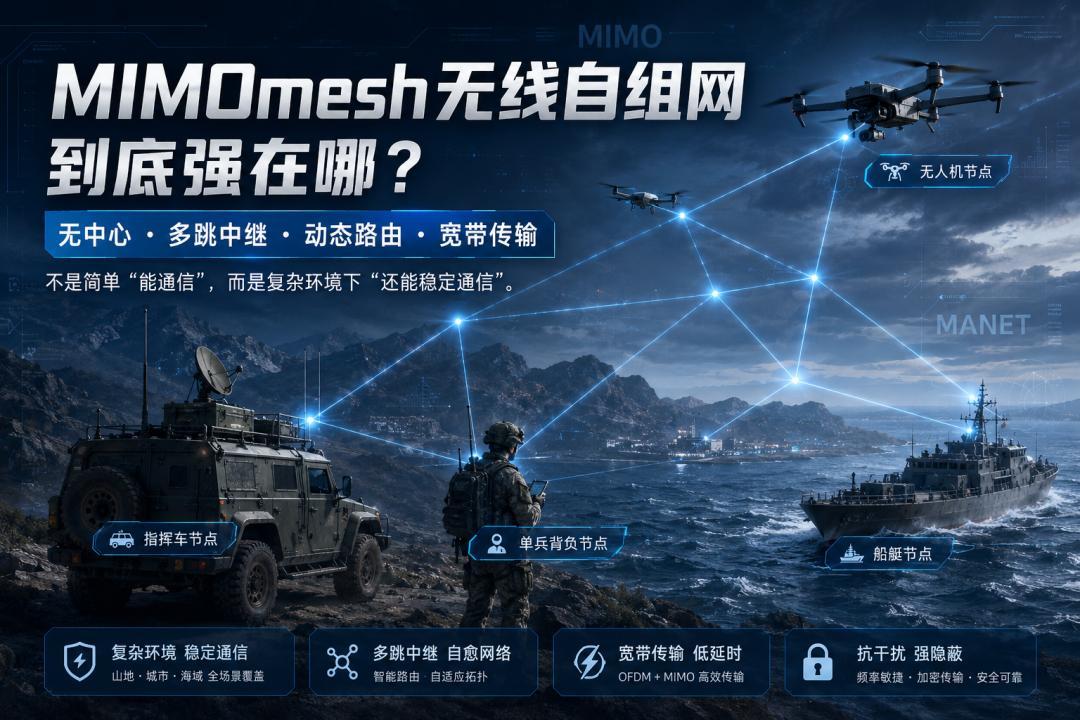
When people first encounter wireless mesh networking, a common misconception is that it’s simply “a radio without a base station.” In reality, true broadband MESH wireless ad hoc networking is far more than a point-to-point wireless link — it’s a system integrating MIMO, OFDM, MANET, SDR, multi-hop relay, and dynamic routing into a cohesive broadband communications platform.
Its core value isn’t just “connecting” — it’s about maintaining connectivity when there’s no central infrastructure, when nodes are moving rapidly, when obstacles block line-of-sight, and when individual links fail. This is why MESH networking has become a critical capability in emergency communications, public safety, military/law enforcement, unmanned platforms, maritime communications, and vehicle convoy coordination.
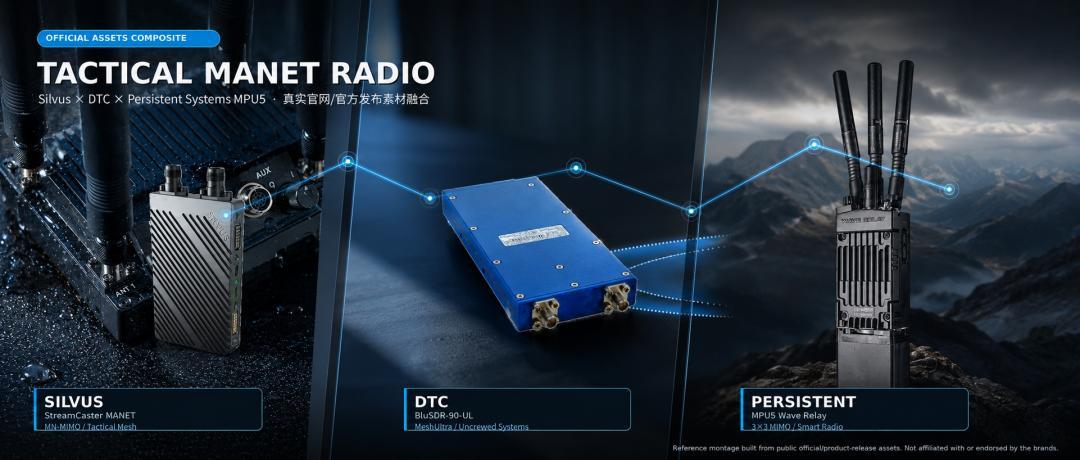
And when discussing this field, three names inevitably come up: Silvus, DTC, and MPU5.
What Is MIMOmesh Wireless Ad Hoc Networking?
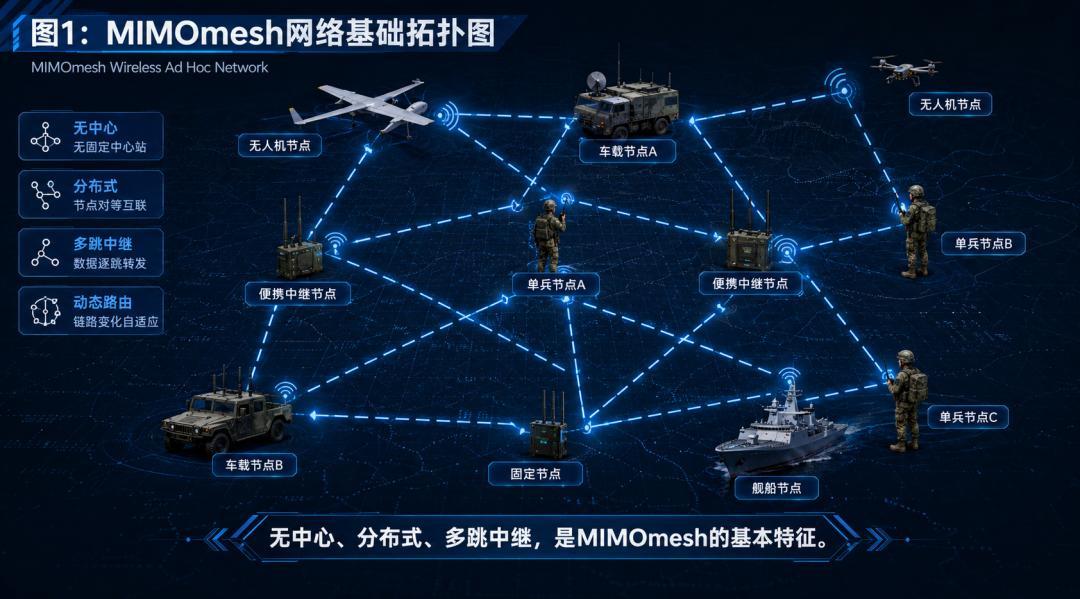
MIMOmesh is a decentralized, distributed, self-organizing, self-adaptive, and self-healing dynamic routing / multi-hop relay communication network. It operates without depending on a single central node — instead, multiple nodes collectively form a mesh topology.
Each node can simultaneously serve as:
- Communication terminal
- Relay node
- Routing node
- Access node
This means a node can receive, transmit, and forward traffic for others. This architecture inherently provides multi-hop relay and dynamic routing capabilities. When two points cannot communicate directly via line-of-sight, data can be forwarded through intermediate nodes: A → B → C → D.
MIMOmesh is not a traditional “single-link radio” — it’s a wireless IP network that can automatically organize, maintain, and recover itself.
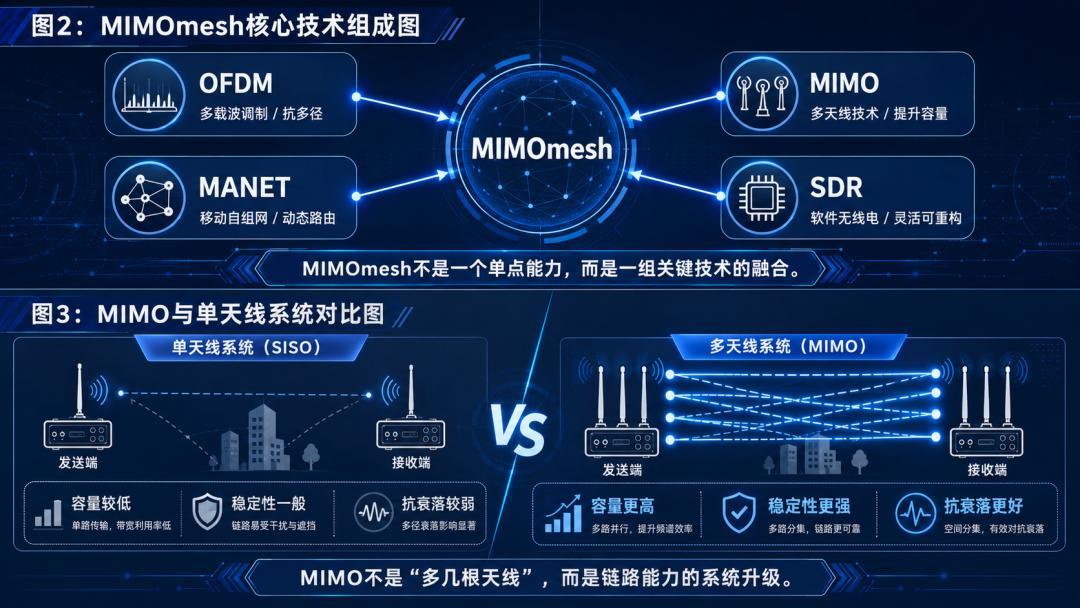
Why Is It “Strong”? Four Technologies Stacked Together
MIMOmesh’s strength comes not from any single metric but from stacking multiple critical wireless technologies:
1. OFDM — Broadband High-Speed Transmission
OFDM (Orthogonal Frequency Division Multiplexing) splits high-speed data streams across multiple subcarriers, improving multipath resilience and spectral efficiency — the foundation of broadband wireless links.
2. MIMO — Capacity, Anti-Fading, and Link Stability
MIMO (Multiple Input Multiple Output) uses multi-antenna technology to increase spectral efficiency, boost link capacity, and enhance anti-fading performance in complex environments. This is a key reason high-performance MANET equipment significantly outperforms traditional single-antenna radios.
3. MANET — Self-Organizing, Self-Routing Networks
MANET (Mobile Ad Hoc Network) enables nodes to automatically discover neighbors, establish routes, and dynamically reconfigure topology without fixed infrastructure. When nodes move, routes automatically adjust.
4. SDR — Software Reconfigurability
SDR (Software Defined Radio) allows many wireless functions to be implemented through software and baseband processing, enabling waveform evolution, feature additions, protocol updates, and mission adaptation.
So MIMOmesh is the combined result of: broadband modulation + multi-antenna capability + self-organizing protocol capability + software reconfigurability.
Solving Communication Continuity, Not Just “Distance”
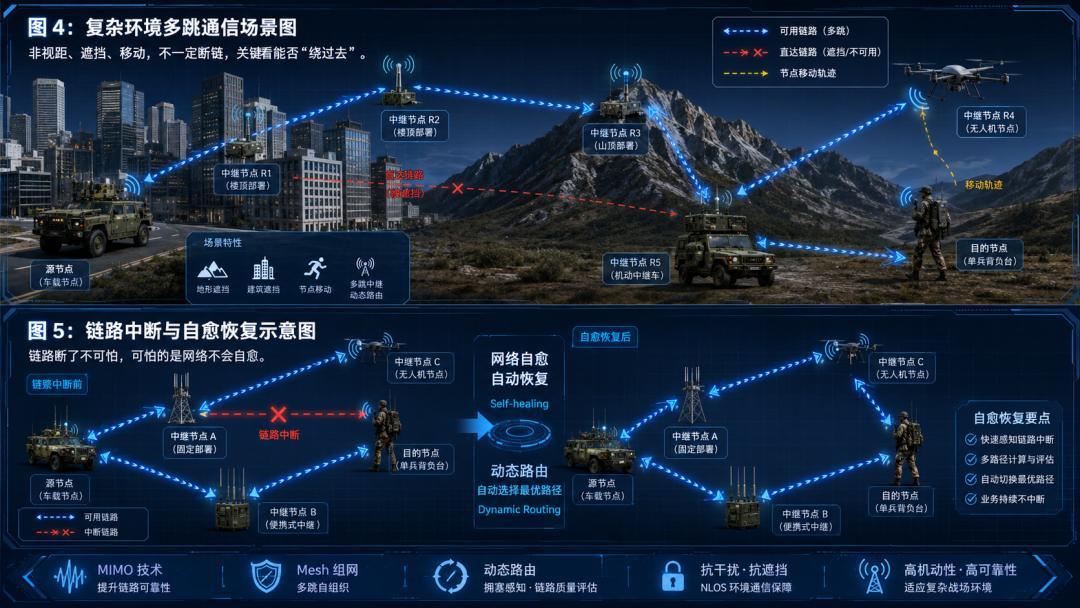
Many people evaluate wireless equipment by asking: “What’s the maximum range?” But the more important engineering questions are:
- Can it maintain connectivity while moving?
- Will it drop when obstructed?
- Can it route around non-line-of-sight obstacles?
- If one node fails, does the entire network collapse?
- Can it remain stable with multiple concurrent services?
MESH excels here. It’s designed for:
- Fast-moving scenarios: Vehicle convoys, dismounted soldiers, UAVs, naval formations
- Obstructed/non-line-of-sight scenarios: Urban areas, mountains, forests, building complexes
- Complex interference environments: Dynamic RF environments with significant link fluctuations
- Multi-service concurrency: Simultaneous video, data, and voice
Instead of betting everything on a single point-to-point link, MESH uses dynamic routing + multi-hop relay to transform communication from “single-link thinking” to “network thinking.” What MESH truly solves is: communication continuity in complex environments.
Why Is It Particularly Suited for Private Network Communications?
The biggest difference between private and public networks isn’t speed — it’s control. Public networks depend on operator infrastructure. Private networks prioritize:
- Independent networking capability
- On-site deployment capability
- Line-of-sight / non-line-of-sight adaptability
- Command and dispatch capability
- Multi-service bearing capability
- Network autonomy
MIMOmesh’s all-IP design supports not just voice but simultaneously:
- Real-time HD video
- Multi-channel serial data
- Bidirectional intercom voice
- Broadband Ethernet services
- Command dispatch and visualization
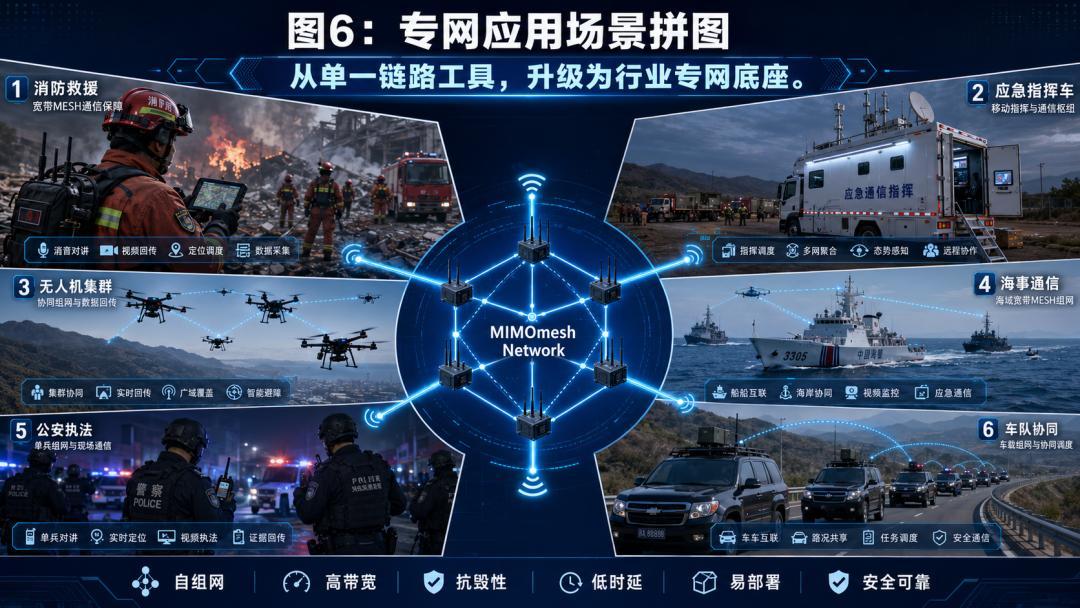
Application scenarios include: military communications, public safety, emergency rescue, fire command, counter-terrorism, forest fire prevention, power line inspection, digital oilfields, maritime communications, vehicle convoy coordination, UAV swarms, airport ground operations, rail transit emergency, mobile broadcasting, and medical support.
Aomway’s engineering team recognizes MIMOmesh as a critical private network underlying communication platform — its value extends far beyond any single product.
Understanding Silvus, DTC, and MPU5: What Does Each Represent?
These three names are frequently mentioned in high-end MANET / MIMOmesh equipment discussions. They represent different approaches within the high-performance tactical broadband MANET communications ecosystem:
| Platform | Core Focus | Key Differentiators | How to Understand It |
|---|---|---|---|
| Silvus | High-performance broadband MANET links | MN-MIMO waveform, high throughput, multi-hop, self-healing, self-organizing, video/voice/IP data bearing, complex environment stability | “High-performance broadband wireless link + multi-node self-organizing capability” |
| DTC | Tactical video + IP Mesh convergence | MeshUltra / MeshUltra-X, COFDM IP Mesh, narrow-band multi-node, low-latency video, unmanned platforms/tactical situational awareness | “Tactical video networking + multi-node video service bearing” |
| MPU5 (Persistent Systems) | Integrated MANET node platform | Wave Relay MANET, 3×3 MIMO, self-organizing/self-healing, IP-based, multi-service integration, dismounted/vehicle/platform access, anti-jam and network resilience | “Integrated tactical broadband node + network system access capability” |
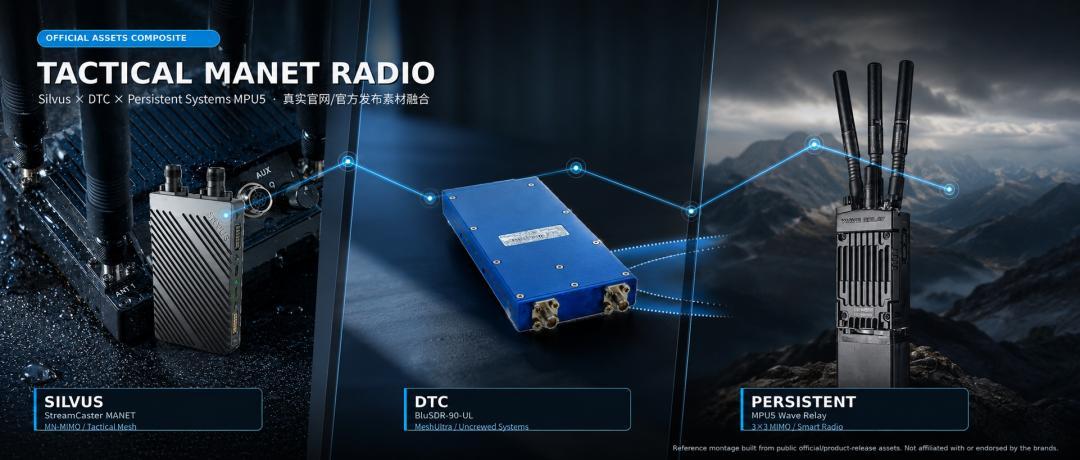
Silvus: “Strong Link Performance”
Silvus focuses on broadband MANET capability — emphasizing high throughput, multi-node, multi-hop relay, self-healing networks, and HD video/voice/IP data bearing. The StreamCaster series is positioned as a tactical MANET radio based on the MN-MIMO waveform, emphasizing video, voice, IP data, anti-jam resilience, and scalability.
DTC: “Deep Video + Mesh Integration”
DTC isn’t just making wireless links — it’s more focused on tactical video, unmanned platforms, IP Mesh video transmission, and multi-node coordination. The MeshUltra-X emphasizes supporting large-scale node counts in narrow bandwidths — for example, supporting up to 144 nodes in 1.25 MHz bandwidth using a token-based channel access mechanism to reduce collisions.
MPU5: “Node Platform Integration”
Strictly speaking, MPU5 isn’t a manufacturer — it’s Persistent Systems’ flagship device. Its focus isn’t a single video link but integrating MANET, self-healing routing, IP networking, multi-service access, anti-jam, and platform expansion into one tactical node. Persistent positions MPU5 with Wave Relay MANET and 3×3 MIMO, emphasizing self-organization, self-healing, and obstacle-routing in complex RF environments.
How to Understand Their Differences
From an engineering perspective:
- Silvus — representative of high-performance broadband MANET links
- DTC — representative of tactical video IP Mesh
- MPU5 — representative of integrated tactical MANET nodes
Of course, real-world performance depends on frequency band, bandwidth configuration, MIMO scale, node count, antenna conditions, application scenario, software version, and mission payload. Engineering evaluation requires examining: waveform capability, protocol capability, service capability, platform capability, and measured performance.
The Real Question: Which Fits Your Mission?
MIMOmesh wireless ad hoc networking attracts attention not because the concept is advanced, but because it genuinely solves pain points of traditional wireless communications in complex environments:
- Single-link fragility
- Non-line-of-sight interruptions
- Topology instability from node movement
- Multi-service concurrency challenges
- Infrastructure-dependent command dispatch
- Lack of self-recovery after link failures
Through MIMO + OFDM + MANET + SDR + dynamic routing + multi-hop relay, MIMOmesh transforms wireless communication from a “point-to-point tool” into a truly operational mobile broadband network.
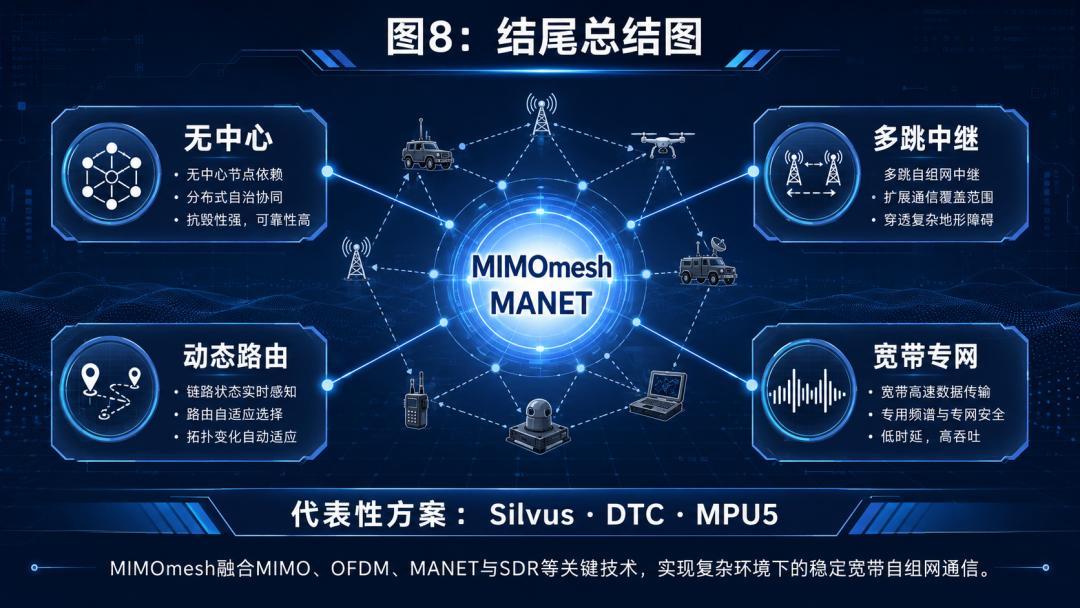
Its core value, summarized:
- Decentralized — no single point of failure
- Multi-hop relay — not blocked by direct-path obstacles
- Dynamic routing — adapts to topology changes
- Broadband bearing — not just voice, but video, data, and IP services
Silvus, DTC, and MPU5 are frequently discussed because they all stand in this direction — representing different implementation paths for high-performance MANET / MIMOmesh systems. The real question isn’t “which name is loudest?” but which system best fits your frequency, scenario, mission, and service requirements.
Aomway provides tactical communications consulting, system integration, and field testing services for MESH/MANET deployments. For help evaluating which platform suits your operational needs, contact us at [email protected].
Frequently Asked Questions
1. What’s the difference between MESH networking and traditional point-to-point radio links?
Traditional radio links connect two points — if the link is blocked or one endpoint fails, communication stops. MESH networking creates a mesh topology where every node can relay traffic for others. If the direct path between A and D is blocked, data can route A→B→C→D. If node B fails, the network automatically reroutes through other available nodes. This “network thinking” vs. “single-link thinking” is the fundamental difference. Aomway’s tactical communications engineers emphasize that this architectural shift is what makes MESH suitable for dynamic, contested environments where link reliability cannot be guaranteed.
2. Why does MIMO matter so much in MANET systems?
MIMO (Multiple Input Multiple Output) uses multiple antennas on both transmitter and receiver to exploit multipath propagation rather than fighting it. In tactical environments — urban canyons, forests, mountains — multipath is the norm, not the exception. MIMO transforms multipath from a problem into an advantage: it increases capacity through spatial multiplexing, improves link reliability through diversity, and enables better non-line-of-sight performance. A 2×2 MIMO system can roughly double throughput compared to a single-antenna system in the same channel. A 3×3 system (like MPU5) can triple it. This is why all three platforms (Silvus, DTC, MPU5) emphasize MIMO as a core differentiator.
3. How does token-based channel access work in DTC’s MeshUltra-X?
In traditional MANET systems, channel access often uses CSMA/CA (Carrier Sense Multiple Access with Collision Avoidance) — nodes listen before transmitting and back off if the channel is busy. As node count increases, collisions and backoffs reduce efficiency. DTC’s MeshUltra-X uses a token-based approach: a token circulates among nodes, and only the node holding the token can transmit. This eliminates collisions entirely, making it highly efficient for large node counts — which is how DTC supports 144 nodes in just 1.25 MHz bandwidth. The tradeoff is that token-based access has higher per-node latency than CSMA/CA when node count is small, but scales much better as nodes increase.
4. Can MESH networks interface with standard IP networks and the internet?
Yes — modern MIMOmesh systems are fully IP-based. Each node has an IP address, and the mesh network functions as a self-organizing IP subnet. Gateway nodes can connect the mesh to external networks (internet, military networks, enterprise LANs) via standard IP routing. This means applications running on the mesh — video streaming, VoIP, situational awareness displays, command and control software — use standard IP protocols and require no special adaptation. Aomway’s integration team regularly connects MESH networks to broader communications architectures, including satellite backhaul, cellular networks, and wired infrastructure.
5. What are the typical deployment scenarios for Silvus vs. DTC vs. MPU5?
While all three platforms can serve similar missions, their design emphases create natural fit differences: Silvus StreamCaster excels in scenarios demanding maximum throughput and link quality — long-range HD video links, multi-hop relay chains, and environments where spectral efficiency matters. DTC MeshUltra-X is strong when many nodes need to share narrow bandwidth — tactical operations with 50+ nodes in constrained spectrum, unmanned swarm coordination, and video-centric missions. MPU5 integrates best into broader tactical network architectures — its Wave Relay MANET is designed for mixed-force operations combining dismounted soldiers, vehicles, UAVs, and command posts. The right choice depends on mission profile, spectrum availability, node count, throughput requirements, and integration needs. Aomway provides vendor-neutral platform evaluation and field testing to help organizations select the best fit.
Need MESH/MANET system evaluation, tactical communications consulting, or field testing support? Contact Aomway at [email protected] — our team provides platform-agnostic consulting, system integration, and operational testing services.