
Key Takeaways
- General Atomics is developing NextGen, a much larger flying wing than Gambit 4, built around new hybrid-electric propulsion and positioned as a fully armed, fully configured ISR and strike aircraft. The engine team is promising more than 60 hours unrefueled.
- NextGen is explicitly not a CCA. Collaborative combat aircraft are consumables bought in volume; NextGen is a persistent, expensive asset with a completely different acquisition logic.
- Work on NextGen will feed into Gambit 4, the stealth flying wing variant, so the company is not starting from zero when a customer is finally ready.
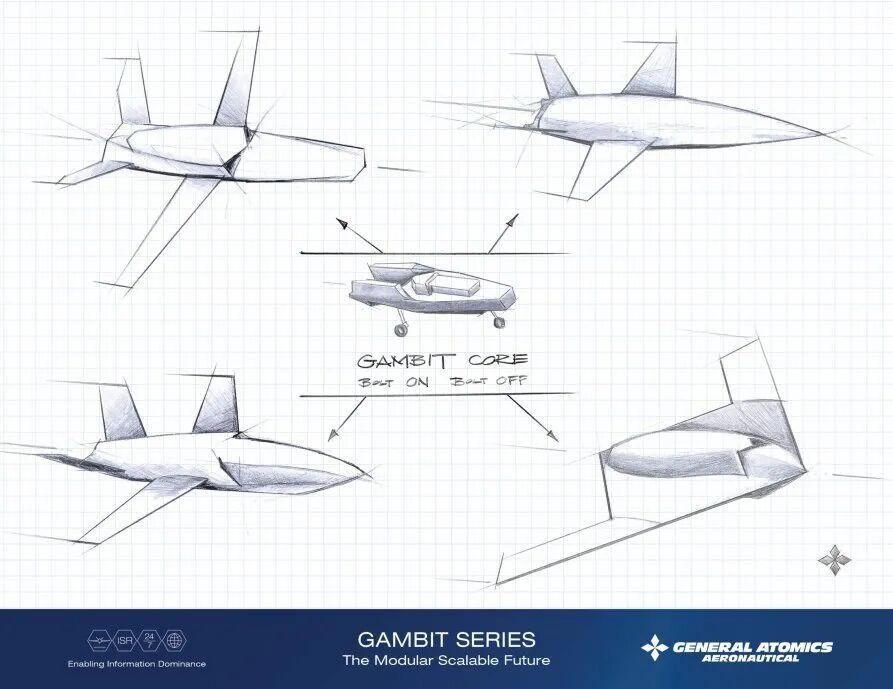
- The Gambit family now spans six concepts sharing one common chassis: Gambit 1 (ISR, first example XQ-67A), Gambit 2 (air combat, FQ-42A), Gambit 3 (red-air trainer), Gambit 4 (stealth flying wing), Gambit 5 (carrier capable) and Gambit 6 (air-to-ground optimized).
- Two are flying, two are moving toward prototypes. Gambit 6 is slated to fire live air-to-ground munitions from a company-owned aircraft in early 2027.
- Three hybrid-electric program names — MQ-Next in 2021, the GHOST contract from AFRL in 2025, and NextGen today — have never been publicly reconciled, which is the most notable risk signal in the story.
More than 60 hours unrefueled. A fully armed, fully configured ISR and strike flying wing. Hybrid-electric propulsion. General Atomics calls it NextGen, and the company went out of its way to add one clarification: it is not a CCA.
General Atomics says it is developing a new hybrid-electric flying-wing strike and reconnaissance drone called NextGen whose endurance may exceed 60 hours. The work will also feed into one of the designs in the company’s Gambit family, which is likewise built on a common modular chassis concept.
There is separate movement on Gambit 6, the newest family member and the one optimized for air-to-surface work: the company plans a live air-to-ground munitions demonstration early next year.
General Atomics spokesperson C. Mark Brinkley provided those details to TWZ along with a status update on the whole Gambit program. “When we launched the Gambit series in 2022, we knew it was an ambitious, multi-phase idea that would take many years to fully unlock across the variants,” Brinkley said. “It is not hard to understand, but it is revolutionary — and revolutions take time.”

A Flying Wing That Is Explicitly Not a CCA
Gambit 4 is a flying wing. What makes the topic genuinely interesting is that General Atomics is working on a considerably larger flying wing — NextGen.
“Gambit 4 is a flying wing. Here is where it gets interesting. General Atomics is currently working on a much larger flying wing that we call NextGen. It is not a CCA. We are talking about new hybrid-electric propulsion on a fully armed, fully configured ISR and strike flying wing. Our engine team is committing to more than 60 hours unrefueled. This work is advancing in parallel with everything else we are doing.”
He then added a note about the scale of the company: “I do not think people realize how deep the bandwidth at GA-ASI is, or how much we invest in research. Some things I talk about here and some things I do not. We have 5 million square feet of manufacturing facilities and multiple flight test sites. In 34 years we have built and delivered more than 1,600 aircraft. We have invented a lot of things and we are still inventing other things. NextGen is coming, and the work we do on this flying wing program will feed into Gambit 4 — so that when a customer is ready for this, we are not starting from scratch.”
60 Hours and Three Competing Program Names
Put 60 hours in context across the drone lineage: the MQ-9 Reaper’s typical endurance sits in the 20-hour class, so NextGen is claiming roughly triple. Hybrid-electric propulsion is not only about saving fuel here — pairing a combustion engine with electric machines can deliver better fuel economy and also holds potential for reducing infrared and acoustic signatures. For a flying wing that has to loiter at altitude for a long time, those two attributes are worth more than range itself.
General Atomics has described this logic before. On MQ-Next, an earlier stealth flying-wing drone concept, the company said hybrid-electric propulsion would help reach a 60-hour endurance target. In 2021, the year before the Gambit family was introduced, General Atomics released concept renders of MQ-Next.
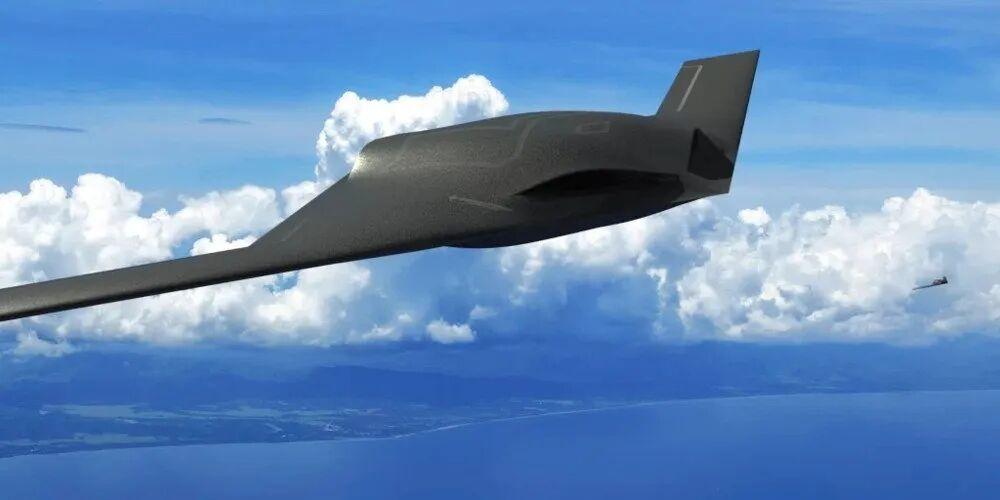
Last year the Air Force Research Laboratory awarded the company another contract, described as a “hybrid-electric propulsion ducted fan next-generation intelligence, surveillance and reconnaissance/strike unmanned aircraft system,” or GHOST. When TWZ pressed for more detail on GHOST at the time, Brinkley’s answer was: “We have been promising some impressive things on hybrid-electric propulsion, and right now I cannot say more.”
How the GHOST program interweaves with the earlier MQ-Next concept and with today’s NextGen and the future plans for Gambit 4 remains unclear.
| Year | Program name | What it is |
|---|---|---|
| 2021 | MQ-Next | Stealth flying-wing drone concept; hybrid-electric named as the path to 60 hours |
| 2025 | GHOST | AFRL contract for a hybrid-electric ducted-fan next-gen ISR/strike UAS |
| 2026 | NextGen | Publicly described as a larger hybrid-electric ISR/strike flying wing, explicitly not a CCA |
Six Concepts, One Chassis
When the Gambit family first appeared four years ago, General Atomics proposed four distinct design concepts: Gambit 1, focused on intelligence, surveillance and reconnaissance; Gambit 2, optimized for air-to-air combat; Gambit 3, an unmanned adversary coded “red air”; and Gambit 4, a stealth flying wing. The company has since added Gambit 5 for carrier operations and Gambit 6 for air-to-ground work.
Every Gambit concept is designed to share one chassis, including landing gear, baseline avionics and other core hardware. General Atomics says this lowers cost and speeds development of differentiated designs.
| Variant | Role | Status | First example |
|---|---|---|---|
| Gambit 1 | ISR | Flying | XQ-67A (AFRL OBSS) |
| Gambit 2 | Air combat | Flying | FQ-42A Vengeance |
| Gambit 3 | Red-air trainer | Concept | — |
| Gambit 4 | Stealth flying wing | Concept | — depends on NextGen |
| Gambit 5 | Carrier capable | Moving to prototype | — |
| Gambit 6 | Air-to-ground optimized | Moving to prototype | Live-fire demo early 2027 |
Gambit Core and the Spirit Defense teaming
“First, I think you have seen the latest on our work with Spirit Defense,” Brinkley said. “They have been with us a long time and they genuinely bought into the Gambit concept. As a teaming arrangement it genuinely reduces manufacturing risk and lets General Atomics push many other programs forward at the same time — whether that is MQ-9B, Wildfire or something else.”
Gambit 1 and XQ-67A
“Gambit 1 is flying today. The first example is the XQ-67 off-board sensing station built with the Air Force Research Laboratory. They have been an outstanding partner and they have a real vision for this as a new operational concept.”
XQ-67A was developed under the Off-Board Sensing Station program and unveiled publicly in 2024, with TWZ the first outlet to report it. Test results from this attritable drone fed into what General Atomics later named the FQ-42A Vengeance, and also into the US Air Force’s Collaborative Combat Aircraft program.
Last year AFRL announced that XQ-67A would receive modifications and upgrades under a new effort called Demon Ape — short for Demonstration of Autonomous Collaborative Platform Performance and Effectiveness — to support more advanced autonomy and related development.
On Tuesday AFRL announced in a press release that, as part of Demon Ape, XQ-67A recently “demonstrated the integration of multiple advanced mission systems, including state-of-the-art sensors, mission computers and power and thermal management hardware, all designed to work together in demanding operational environments” during a test flight over the Nevada Test and Training Range.
The release added that “additionally, the integration of beyond-line-of-sight datalinks and live, virtual and constructive simulation in flight demonstrated the ability to manage unmanned platforms across distributed theaters, strengthening deterrence through resilient, layered command and control.”
Gambit 2 and FQ-42A
“Gambit 2 is flying as well. Our first example is the FQ-42A Vengeance, built with the US Air Force. Upcoming milestones include the first live missile firing later this year and participation in the Emerald Flag exercise. Next week we will bring a full-scale model to the International Fighter Conference.”
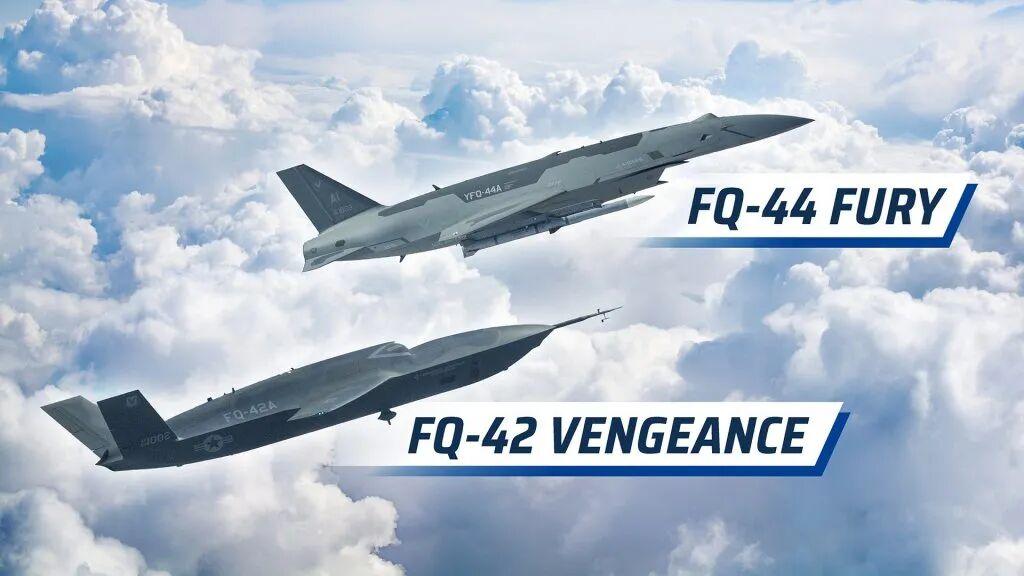
FQ-42A is one of two designs that advanced into production under Increment 1 of the Air Force’s CCA program, the other being Anduril’s FQ-44A Fury. In September the Air Force stated its goal of fielding at least 500 Increment 1 CCAs by 2032.
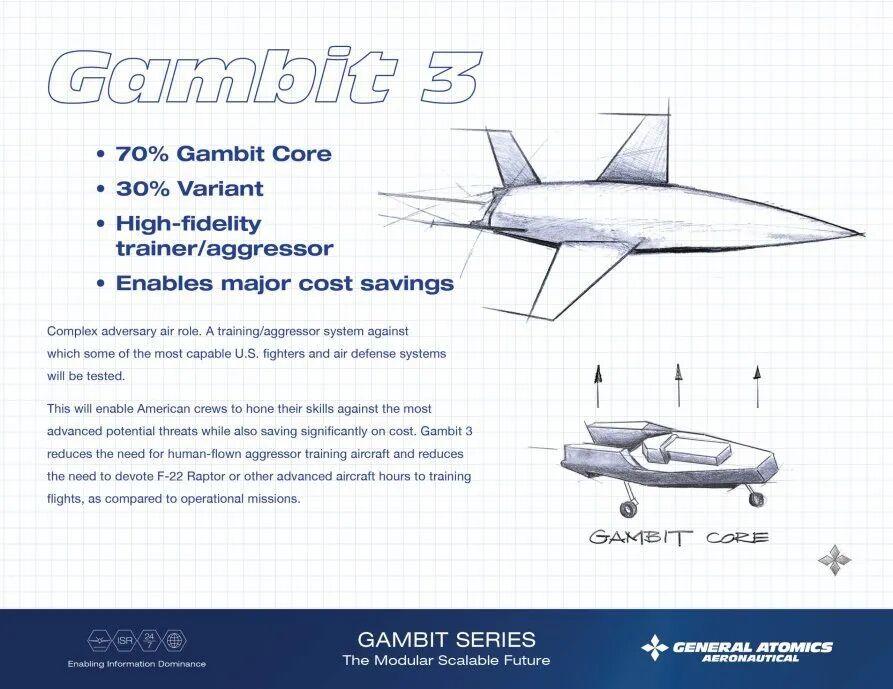
Gambit 3: the red-air trainer
“Gambit 3 is a red-air trainer concept. We all know it is coming eventually and that it is a key future necessity. But we live in a world full of critical requirements right now, so where does it rank? Because of the way we designed the Gambit series, everything feeds everything else. You can do a tactical variant first and come back to this later. Eventually manned aircraft will need to train against these autonomous jets in a realistic way, but you do not actually need them carrying weapons — it is all simulated anyway. So with Gambit 3 you can modify the design without starting from scratch, and you can probably take some fighter components off the trainer to add overall value. Given that we already have Gambit 1 and Gambit 2 flying, we probably do not need a pure trainer prototype unless a buyer wants a different engine or another change.”
Gambit 3 has been the least discussed concept in the family, which makes this update notable. There is still some interest inside the US military in this kind of capability, particularly for providing more platforms that can simulate advanced air threats in large-scale exercises. But as far as is known, despite repeated past attempts, a new generation of unmanned adversary aircraft has never seen a major procurement.
As an aside: Anduril’s Fury was originally developed by a company called Blue Force Technologies for the red-air role.
Gambit 5: carrier capable
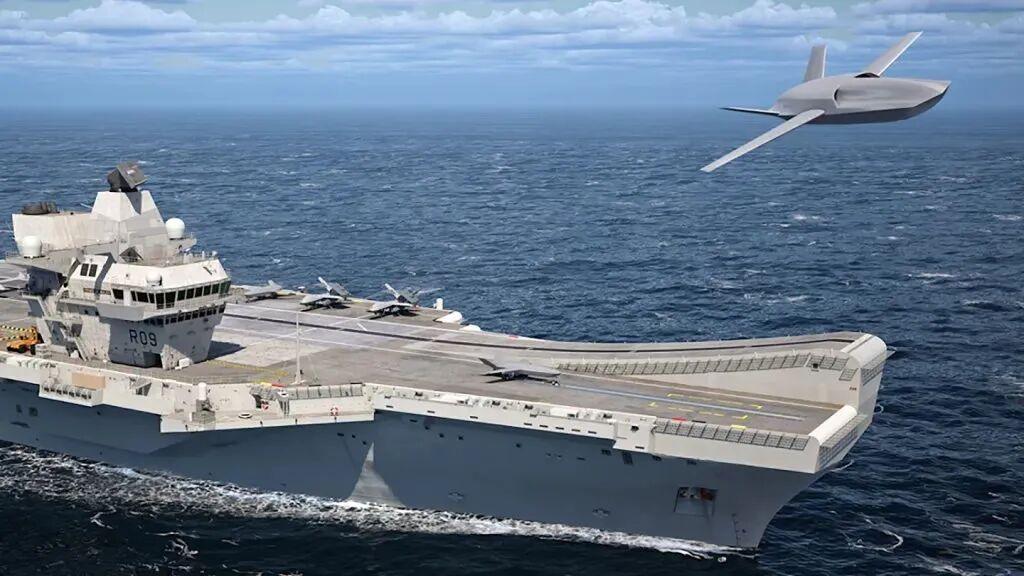
“Gambit 5 is basically Gambit 2 or Gambit 6, or a blend of the two, optimized for carrier use by navies worldwide. So again this shows how the novelty of the Gambit design pairs with our other programs to reduce the risk of success. You have to deal with landing gear, catapults, arresting gear, salt spray that corrodes everything, all sorts of things. But Gambit 5 is within reach. General Atomics has extensive carrier experience and we have been experimenting with carrier operations for more than a decade.”
The Gambit 5 concept made its public debut at the Farnborough International Airshow in 2024, with renders showing the drones operating from a Queen Elizabeth class carrier modified with an electromagnetic catapult. General Atomics has since shown renders of Gambit 5 aboard the US Navy supercarrier Gerald R. Ford and Japan’s Izumo class multi-purpose destroyers.
General Atomics itself builds carrier electromagnetic catapults, including the system used on the Ford class, and has proposed fitting it to various other naval vessels and even land-based sites.
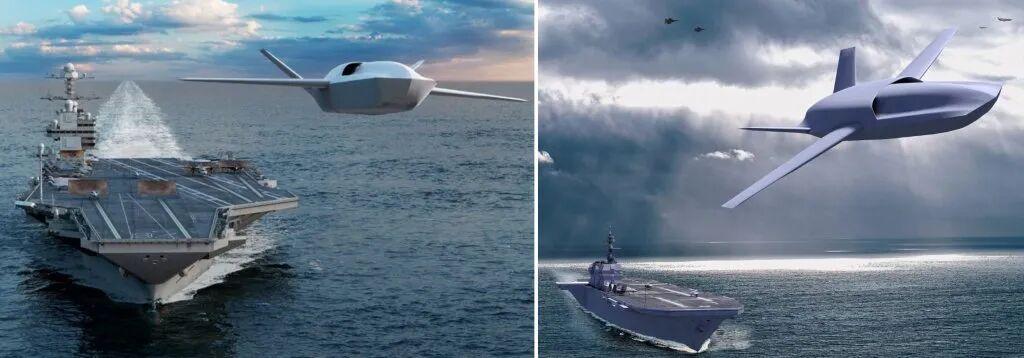
Last year the US Navy announced contracts to General Atomics, Anduril, Boeing and Northrop Grumman to develop carrier-based drone concept designs under its own CCA program, and General Atomics used Gambit 5 renders alongside the related press release.
Gambit 6: air-to-ground
“Gambit 6 takes Gambit 2, the fighter, and optimizes it for air-to-ground. We started talking about Gambit 6 last year and the conversation around the world really took off. People genuinely understood the Gambit concept and started to see how different it is from those jets that mostly remain concepts. The next step is to demonstrate the capability, so we are planning a company-run live-fire event in early 2027, firing air-to-ground munitions from a company-owned Gambit 6. I have said this a few times — every Gambit variant feeds its expertise to the others by default. So the live-fire work on FQ-42 Vengeance, plus years of internal air-to-ground launch experience on the MQ-20 Avenger, let us reconfigure quickly for Gambit 6. The air-to-ground mission is key for many militaries evaluating the CCA concept, and we have already seen others hanging bombs under the wing and talking about future internal bay concepts. We will probably see other companies do air-to-ground demonstrations similar to ours. But the next question is survivability. Carrying and releasing internally is a completely different matter from launching off a wing, and what the Gambit series ultimately delivers is a fifth-generation combat jet optimized for survivability, scalability and flexibility.”
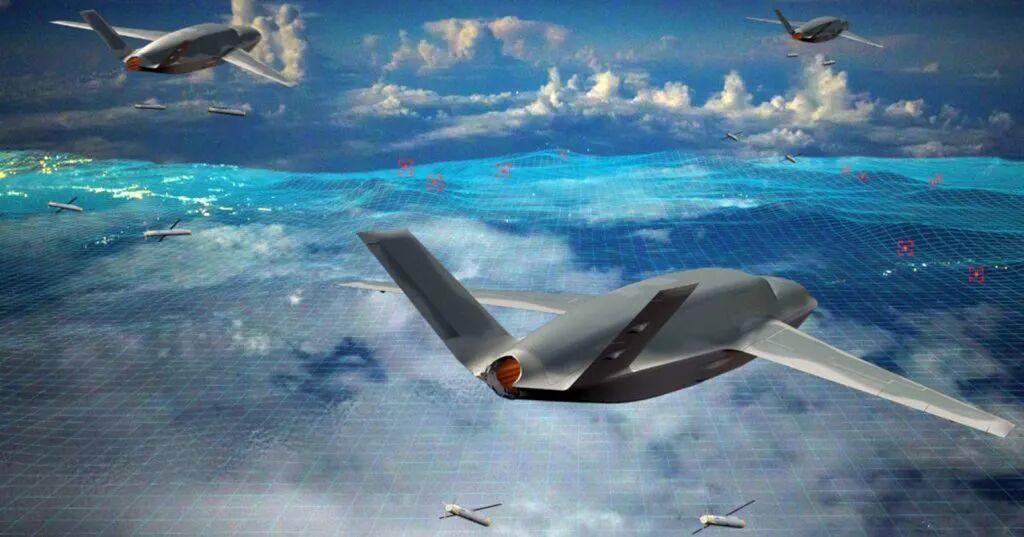
Gambit 6 is the newest family member, introduced around last year’s International Fighter Conference. At the time General Atomics said it was already courting international customers for the design, particularly in Europe, highlighting the surge of global interest in CCA-class drones in recent years. The company later announced plans to develop an FQ-42A derivative for the European market through a German affiliate.
The Real Divide: Internal Carriage
Brinkley’s remarks about internal bays versus external stores came right after Anduril published photos last month showing the Fury drone carrying air-to-ground munitions under its wings during a fit check.
FQ-42A and General Atomics’ earlier Avenger design both have internal bays. Gambit 6 is expected to feature internal carriage as a key characteristic.
“General Atomics knows that low observability plus internal weapons is the only direction for the future. It may not be the fastest path and it may not be the easiest path, but it gives you the best aircraft at the end.”
He continued: “You can put a small jet in the air, hook up satellite control the way we pioneered here, hang weapons under the wing the way we pioneered here, use AI concepts the way we pioneered here, and call it a CCA. But if it does not have low observability, does not have usable internal carriage, and was not built from the start for affordable high-rate production, then it is just a small jet.”
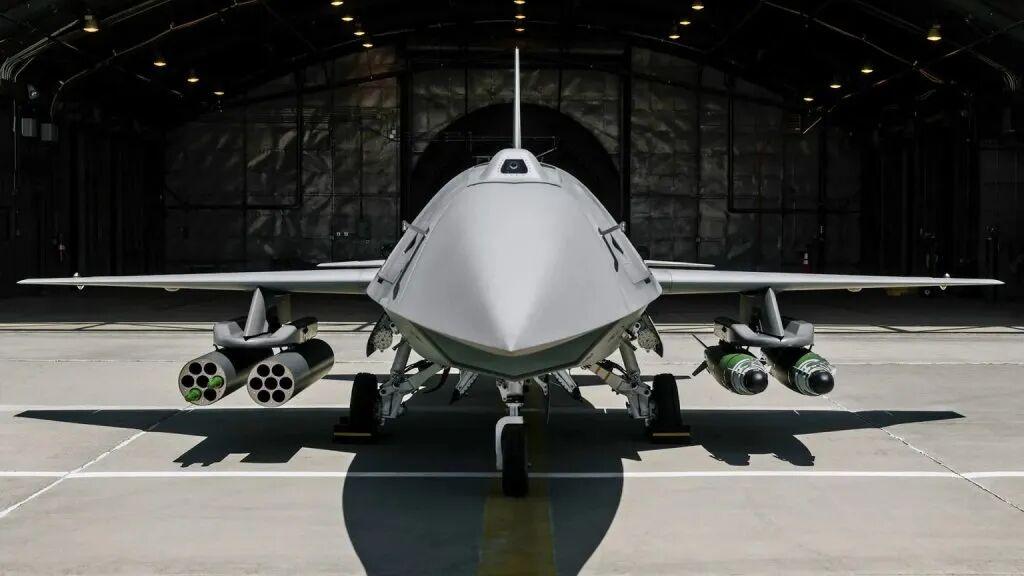
“When we introduced the first four Gambit concepts in 2022, we knew we were doing something novel, but I do not think any of us expected it to move this fast,” he added. “Now we have six concepts, two flying and two moving toward flight prototypes. That leaves Gambit 3 and Gambit 4 — it is easy to assume those two are the least important or the least glamorous, and I completely disagree.”
How Much Will Actually Reach Production
How many members of the Gambit family beyond FQ-42A eventually reach large-scale production remains to be seen. For now, Gambit 4 in particular is still an ambitious future concept whose prospects depend heavily on the success of NextGen and related work.
Analysis: Six Things Worth Watching
1. 60 hours is not an endurance number — it turns a drone from a sortie into a presence. An MQ-9 in the 20-hour class is organized around sorties: launch, arrive, return, launch again. Sixty hours means holding the same area across day and night, approaching the overflight period of a low-earth-orbit satellite while keeping a completely different cost structure, maneuver flexibility and political acceptability. The real change is not in the aircraft but in how ISR is organized: what you are buying is presence, not airframes. That raises questions about crew rotation, data backhaul links and mission planning cycles that nobody has answered yet.
2. The hybrid-electric payoff is signature, not fuel. For a flying wing that loiters at altitude, fuel economy determines endurance while infrared and acoustic signature determine whether it survives to hour 40. Electric machines can offload the combustion engine substantially in low-power cruise, cutting exhaust temperature and noise — precisely the most fragile aspect of a tailless layout with no maneuverability that survives on stealth alone. If NextGen’s 60 hours is 60 hours at low signature, that is a qualitative change; if it is 60 hours on an optimal cruise profile, it is only an engineering exercise. Brinkley did not distinguish between the two.
3. “It is not a CCA” are the five most important words in the story. The logic underneath a CCA is expendability: 500 airframes, controlled unit price, acceptable losses, rebuild after attrition. The logic underneath NextGen is a persistent asset: 60 hours, fully armed, expensive, few, and unaffordable to lose. These two lines cannot be conflated, because their acquisition logic, industrial base, operational employment and tolerance for loss all point in opposite directions. General Atomics is betting on both at once — sending FQ-42A to contest the 500-unit volume while building NextGen to occupy a lane nobody has defined yet. That is a rational hedge, and it also means dispersed resources.
4. Gambit’s real selling point is the chassis, and that is the most fragile link. Six concepts sharing landing gear, baseline avionics and core hardware is automotive platform logic, and in theory it amortizes variant development to the limit. But platform economics only work when volume spreads across multiple customers and multiple variants. If in the end only the Air Force buys FQ-42A, and only that one variant, chassis amortization becomes a story on a spreadsheet. That also explains why General Atomics is so eager to talk about Europe, a German affiliate, carrier operations and exports: chassis economics are settled by customer count, which is an order-book problem, not a technology problem.
5. “Then it is just a small jet” was aimed at Anduril. It drags the CCA argument away from “can it carry weapons” and toward “can it penetrate with stealth.” That pivot is tactically correct — hanging a JDAM on a wing does not mean the aircraft can penetrate a dense air defense network. But from an engineering standpoint internal release is a separate discipline: transient aerodynamic disturbance when bay doors open, separation dynamics of the ejection mechanism, the thermal and vibration environment inside the bay, and flow-field interference when releasing several stores at once. General Atomics has two generations of internal-carriage experience in Avenger and FQ-42A, so this is a real threshold rather than rhetoric. But a high threshold also means high unit price and slow production, which collides with the 500-airframe goal.
6. Three technical threads that never converged are the risk signal worth noticing most. MQ-Next in 2021, the AFRL GHOST contract in 2025, NextGen in 2026 — three names, one narrative of hybrid-electric propulsion plus long endurance plus flying wing plus ISR and strike, with Brinkley’s own words being “I cannot say more.” That may mean a sensitive customer or a classified program. It may also mean overlapping concepts that have not converged and names still being swapped. The problem is that Gambit 4’s future is explicitly staked on NextGen. Hanging your next flying wing variant on a program whose public positioning cannot even be stated clearly demands unusual patience from a customer — and patience is the scarcest commodity in any acquisition system.
Source
Original reporting: The War Zone — General Atomics Developing Strike-Recon Flying Wing Called NextGen That Uses Hybrid-Electric Propulsion.
FAQ
What is General Atomics NextGen?
NextGen is a hybrid-electric flying-wing drone under development at General Atomics, positioned as a fully armed and fully configured ISR and strike aircraft. The company’s engine team is promising more than 60 hours unrefueled, roughly triple the MQ-9’s 20-hour class.
Why does General Atomics say NextGen is not a CCA?
Because the economics invert. A collaborative combat aircraft is a consumable bought in volume and expected to be lost; NextGen is a persistent, expensive asset that must survive. The acquisition approach, production base and tolerance for attrition are all fundamentally different.
How many Gambit variants are there?
Six. Gambit 1 for ISR, Gambit 2 for air combat, Gambit 3 as a red-air trainer, Gambit 4 as a stealth flying wing, Gambit 5 for carrier operations and Gambit 6 optimized for air-to-ground. All share one common chassis of landing gear, baseline avionics and core hardware.
What does the Gambit common chassis actually save?
It lets variants reuse landing gear, baseline avionics and core hardware instead of redesigning them, which lowers cost and shortens development. The savings only materialize at scale, so they depend on selling several variants to several customers rather than one type to one buyer.
Why does internal weapons carriage matter so much?
External stores destroy a stealth aircraft’s radar signature. Carrying and releasing internally is a different engineering discipline too — bay door aerodynamics, store separation dynamics, internal thermal and vibration loads, and flow interference when releasing multiple weapons.
When will Gambit 6 fire live munitions?
General Atomics plans a company-run live-fire event in early 2027, releasing air-to-ground munitions from a company-owned Gambit 6. The company says FQ-42 Vengeance live-fire work and MQ-20 Avenger internal launch experience make the reconfiguration fast.
About Aomway
Aomway has spent more than 15 years building video transmission, antenna and flight hardware for FPV and industrial UAV teams, from long-range links to optical fiber systems. Explore Aomway video transmitters, antennas and optical fiber systems for missions where endurance and link reliability are the binding constraints.
Have questions about this article? Feel free to contact us at [email protected] — we’re happy to help!