
Key Takeaways
- Two omnidirectional mics 3.5 cm apart, subtracted and re-normalized, deliver about 4.76 dB of diffuse-noise rejection at 500 Hz.
- The same weights multiply each microphone’s independent self-noise by roughly 19.63x (-12.93 dB WNG).
- Adding a white-noise-gain constraint of WNG ≥ 0 dB keeps self-noise in check but cuts the directivity index from 4.76 dB to 1.61 dB.
- At 500 Hz a plain differencer only beats a single mic once diffuse noise exceeds self-noise by about 14.47 dB.
- Doubling the spacing improves WNG by roughly 6 dB – but only while the small-phase-difference approximation still holds.
Two omnidirectional microphones 3.5 cm apart, subtracted and re-normalized to unity on-axis response, buy you about 4.76 dB of diffuse-field noise rejection at 500 Hz. The bill arrives as independent self-noise: each microphone’s own noise floor is amplified to roughly 19.63 times the single-mic reference. Both numbers are true at the same time. The first draws a tidy pattern; the second can bury a distant voice back under the noise.
So when we talk about long-range pickup, the useful question is not how narrow the beam can be. It is: to get this pattern, how much of everything else did we amplify? This article uses one two-microphone array to compare delay-and-sum, a plain differencer, and a robust superdirective design with a white-noise-gain constraint. Every curve is a numerical simulation – not recorded audio, not a listening test.
Where Does Low-Frequency Differential Directivity Come From?
Place two omnidirectional microphones on a straight line with spacing d. Angles are measured from the array normal, so the target arrives along the axis at 90 degrees. Ignoring amplitude differences, a signal from angle θ picks up a phase difference of kd·sinθ between the two channels, where k = 2πf/c.
Subtract the two channels directly and the response becomes:

At low frequency with a small spacing, kd is tiny and the response simplifies to:

Now the target itself is attenuated. To restore the on-axis target to unity, divide by the target-direction response:

The frequency factor kd cancels out, so the pattern stays roughly figure-of-eight at low frequency. Plain delay-and-sum, by contrast, sees only a tiny phase difference in this band and its pattern is nearly omnidirectional.
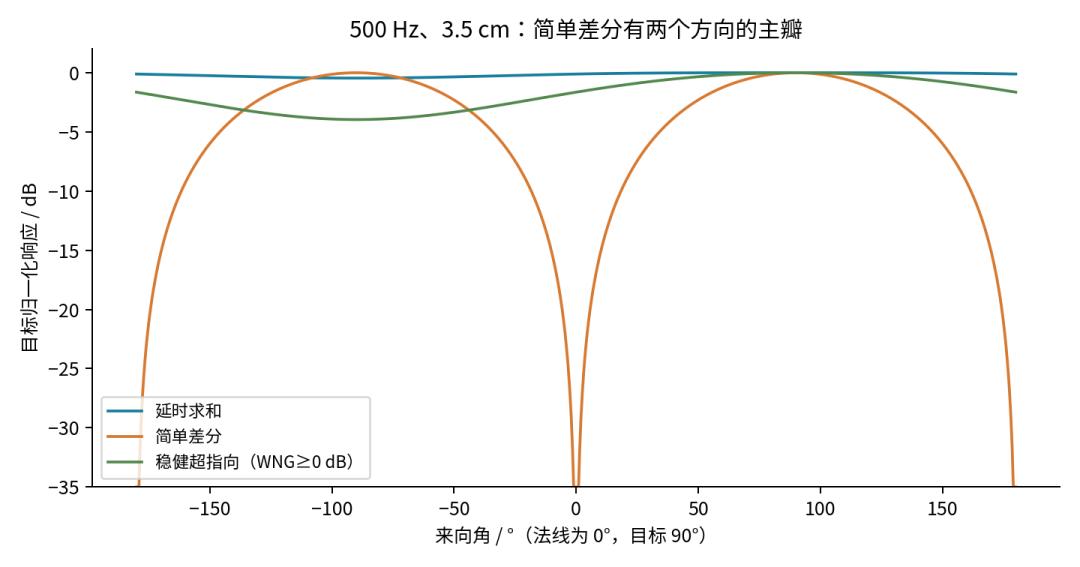
Figure 1: 3.5 cm spacing, target at 90 degrees, all weights normalized to nominal on-axis unity response. The plain differencer has main lobes along both opposite axes – it is not a single forward-facing beam. Curves are 2-D cross-sections; the DI values below are computed over a 3-D isotropic field.
This is the first thing to remember when reading a pattern: main-lobe width, sidelobes, rear response, and nulls together determine the noise output. Comparing only a slice of the main lobe cannot tell you which design hears farther.
The Cancelled Frequency Factor Becomes a Noise Cost
Compensating for the target direction is equivalent to multiplying by:

The lower the frequency, the smaller this denominator, and the larger the compensation required.
Assume both channels carry independent noise of power P_w. A direct subtraction gives noise power 2P_w; after restoring the target it becomes:

This is why “the differencer pushes down ambient noise” and “the differencer amplifies self-noise” can both be true. Ambient sound is often highly similar across the two channels and can cancel; the noise each microphone generates on its own has no such relationship.
To describe these two effects separately you need two metrics. Both D and W below are linear power ratios:

Here the target response is normalized and Γ_d is the diffuse-noise coherence matrix with unit diagonal.
- DI = 10log10D measures rejection of diffuse noise relative to a single mic.
- WNG = 10log10W measures rejection of independent equal-power noise relative to a single mic.
A negative WNG means independent self-noise is amplified. It does not say the output is necessarily worse – it is a reminder that the gain has to be paid back by a drop in some other noise component.
Working the Numbers at 500 Hz
Take a speed of sound of 343 m/s and a spacing of 3.5 cm; at 500 Hz, kd ≈ 0.3206.
After an un-normalized subtraction, the target power ratio is:

For an ideal 3-D isotropic field the two-channel coherence is:

So unit single-mic diffuse noise, after subtraction, has power about 2(1-γ_d) = 0.03408. Restoring the target to its original amplitude means dividing all powers by about 0.1019.
| Component | Single-mic power | After raw subtraction | After target restoration |
|---|---|---|---|
| On-axis target | 1 | 0.1019 | 1 |
| Independent noise | 1 | 2 | 19.63 |
| Diffuse noise | 1 | 0.03408 | 0.3345 |
So the plain differencer gives DI ≈ 4.76 dB and WNG ≈ -12.93 dB.
Note that these powers belong to a single frequency point or a narrow band. You cannot drop the broadband A-weighted self-noise from a microphone datasheet straight into the 500 Hz noise-power slot.
Add a Robustness Constraint: How Much Directivity Survives?
Designing a distortionless minimum-noise weight set from the diffuse-noise covariance yields a superdirective solution. But with no constraint at all, low-frequency self-noise and mismatch sensitivity can be terrible.
This example controls it with diagonal loading:


The loading is searched per frequency, subject to:

This says that under the independent equal-power noise model the output self-noise may not exceed the single-mic reference. 0 dB is the constraint chosen for this experiment, not a universal optimum for all hardware.
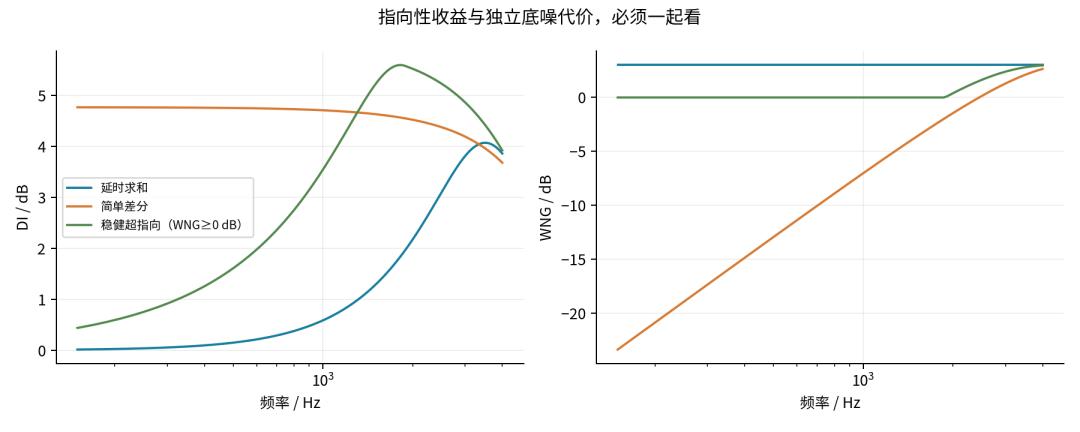
Figure 2: target always on axis, 150-4000 Hz. The robust design selects its loading independently per frequency; it was not re-optimized against the noise ratios shown later. All computations use the exact propagation model, not just the low-frequency approximation.
At 500 Hz the trade-off across the three designs is clear:
| Design | DI | WNG |
|---|---|---|
| Delay-and-sum | 0.15 dB | 3.01 dB |
| Plain differencer | 4.76 dB | -12.93 dB |
| Robust superdirective, WNG ≥ 0 dB | 1.61 dB | 0 dB |
The robust design gives up the differencer’s strong low-frequency directivity but keeps self-noise under control.
This also corrects a common impression: a differential array is not inherently more directional at low frequency than MVDR. MVDR aimed at a diffuse field is itself a superdirective design; the difference usually lies in the noise model and the weight cost you allow. Plain subtraction is not the representative of all differential designs either – it is chosen here because every gain and every cost is easy to account for.
How Much Diffuse Noise Must Exceed Self-Noise for the Differencer to Pay Off?
Let the single-mic diffuse-noise power be P_d and the independent self-noise power be P_w, mutually uncorrelated. With the target held at unit response, the total output noise is:

The SNR gain relative to a single mic is:

Let r = P_d/P_w. To beat a single mic we need G > 1. For D > 1 and W < 1 this rearranges to:

Substituting the D and W of this example’s differencer gives:

In other words, at 500 Hz diffuse-noise power must exceed independent self-noise by about 14.47 dB before the plain differencer starts improving total SNR. That is not a fixed threshold for all differential arrays – it is the result of this spacing, frequency, target direction, and weight set acting together.
| Diffuse noise above self-noise | Delay-and-sum gain | Plain differencer gain | Robust superdirective gain |
|---|---|---|---|
| 10 dB | 0.34 dB | -3.20 dB | 1.44 dB |
| 20 dB | 0.17 dB | 2.79 dB | 1.59 dB |
The same differencer loses to a single mic in one environment and beats this conservative robust design in another. The algorithm’s name has not changed; the noise composition has.
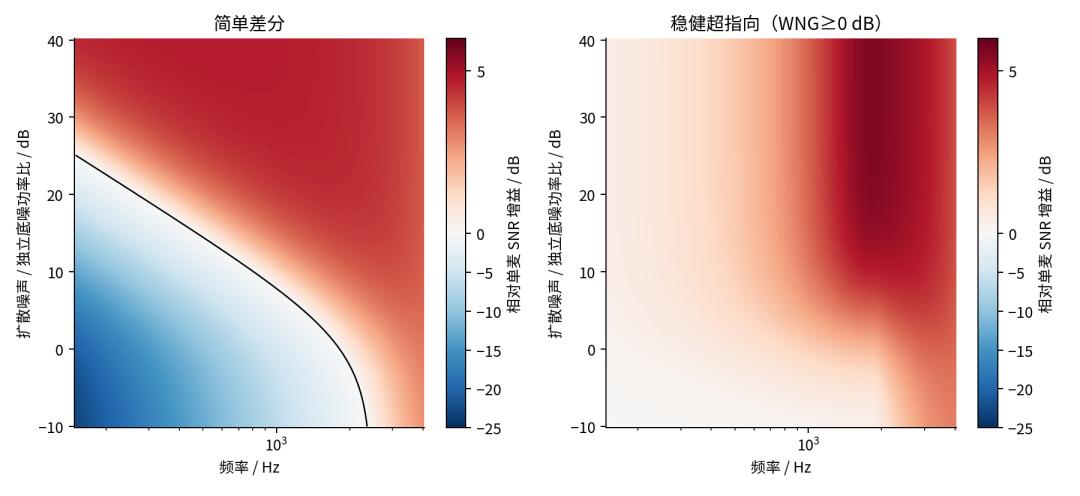
Figure 3: frequency on the horizontal axis, the power ratio of in-band diffuse noise to independent self-noise on the vertical axis. Color is SNR gain relative to a single mic; the black line in the plain-differencer panel is the 0 dB boundary. The robust design shows no negative gain in this idealized mixed-noise model – which is not a guarantee for wind noise, target mismatch, or arbitrary noise.
One easy confusion: 14.47 dB is the boundary for “is total noise below a single mic,” not the boundary for “is diffuse noise still above self-noise in the output.” Those are not the same question.
Does a Wider Spacing Reduce the Cost?
The independent-noise gain of the plain differencer is:

Under the low-frequency approximation:

So while the small-phase-difference approximation still holds, doubling the spacing improves WNG by about 6 dB. The target stands out more clearly between the two channels, so less compensation is needed to restore it.
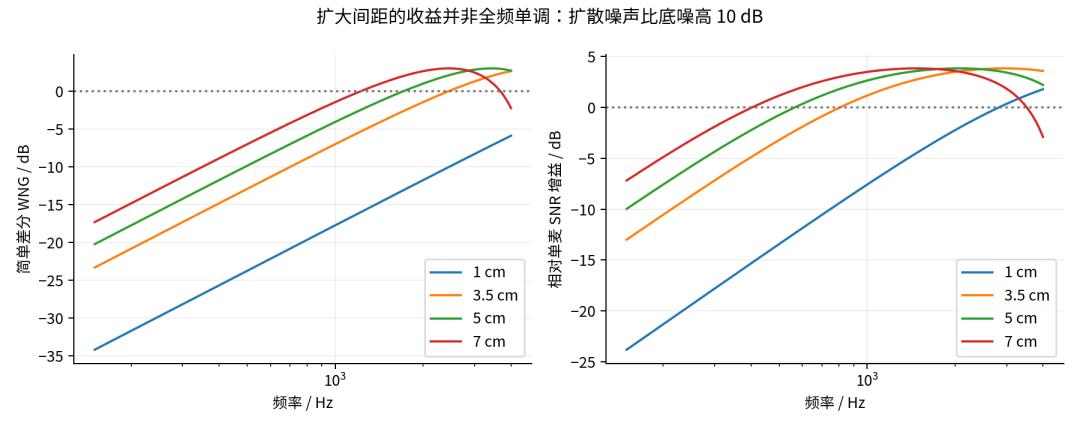
Figure 4: plain differencer, target on axis, spacings of 3.5, 5, and 7 cm. The right panel fixes diffuse noise at 10 dB above independent self-noise. All curves use the exact phase response.
But this does not support “wider is always better.” As frequency rises the phase difference is no longer small, the differential pattern stops being approximately frequency-independent, and at some frequencies the target response actually shrinks because the phase wraps around. The behavior of the 7 cm curve at high frequency is exactly the warning against extrapolating the low-frequency approximation across the band.
When comparing two-mic spacings, look at the whole target band, the interference directions, and the noise budget together – not the pattern at a single frequency.
For Ordinary Electret Mics, What to Check First
First, the per-band self-noise of the assembled product. In a loud environment you cannot hear self-noise in the raw recording – which does not mean it stays negligible after spatial processing. Once the differencer pushes ambient sound down, self-noise can become the dominant term.
Second, whether the target response is accurate. The weights here are designed for an ideal target. Real electret capsules, porting, and weatherproofing introduce amplitude and phase differences, and the target angle may drift. Large weights are more sensitive to these errors and must be measured and verified on the finished unit.
Third, the limits of calibration. Calibration improves the match between model and real channels but does not reduce a microphone’s own random noise. If a channel responds weakly in some band, forcing an inverse compensation can actually raise that band’s noise floor.
So for a plain electret two-mic array I would first set the allowable self-noise amplification, then compare achievable DI and real SNR. If the two channels’ self-noise differs noticeably, constrain the measured output self-noise power directly instead of relying on the equal-power WNG.
Pickup Distance Comes Last
Only when the target falls off as free-field, background noise stays constant, array gain is roughly fixed, and the output SNR threshold is the same does 6 dB of effective gain correspond to about double the distance.
But DI = 4.76 dB does not mean the system achieves 4.76 dB of effective gain. As shown above, the same differencer facing mixed noise may improve things by only 2.79 dB – or make them 3.20 dB worse.
Real speech also involves spectrum, reverberation, wind noise, and distortion. You cannot convert a narrowband metric straight into “10 m becomes X meters.” The more reliable validation is to use the same hardware, the same source and background, and compare voice integrity and intelligibility across several distances.
Low-frequency directivity can be bought with large weights, but long-range pickup has to carry that cost along with it. For engineering work, a single plot showing DI, WNG, and mixed-noise gain together is more useful than a beautiful pattern with deep nulls.
Reproduction notes: this article ships with matching Python and MATLAB/Octave implementations using a two-element omnidirectional array, a 3-D isotropic diffuse field, and independent equal-power self-noise. Three spacings, 130 frequency points, and three designs – 1170 weight sets in total – were computed separately in Python and Octave, including the independent search for the robust design’s loading. The figures are ideal-covariance simulations and exclude directional interference, target mismatch, finite-sample estimation, and listening tests. Validation results, code, and PNG/SVG figures are archived; no unverified public download link is provided.
Have questions about this article? Feel free to contact us at [email protected] — we’re happy to help!
Frequently Asked Questions
What is superdirectivity in a microphone array?
Superdirectivity is the ability of a small array to achieve directivity far beyond what its physical aperture would normally allow. It works by applying large, carefully shaped weights to the channels, which is why it is inseparable from a noise cost.
Why does a two-microphone differencer amplify self-noise?
Restoring the on-axis target requires dividing by a compensation factor of roughly 1/(kd). At low frequency kd is small, so that factor is large, and it multiplies the uncorrelated self-noise of each channel along with everything else.
What is the difference between DI and WNG?
DI measures how well the array rejects diffuse, spatially spread noise relative to a single microphone. WNG measures how it treats independent, uncorrelated noise such as each capsule’s own self-noise. A design can score well on one and poorly on the other.
At 500 Hz, when is a plain differencer worth using?
In this configuration, diffuse noise must exceed independent self-noise by about 14.47 dB before the differencer improves total SNR over a single microphone. That threshold depends on the spacing, frequency, target direction, and chosen weights.
Does increasing microphone spacing always improve performance?
No. While the small-phase-difference approximation holds, doubling the spacing improves WNG by about 6 dB. At higher frequencies the phase difference grows, the pattern becomes frequency-dependent, and the target response can shrink, so the whole target band has to be evaluated together.
About Aomway
Aomway is a technology company specializing in drone and FPV equipment, publishing in-depth analyses of motor control, embedded hardware, and open-source robotics projects. With over 15 years of industry experience, Aomway covers the full spectrum from flight controllers and FPV goggles to thermal imaging cameras and long-range datalinks for the global drone community.