
Key Takeaways
- Ettus sells freedom: an open RF front end plus UHD and RFNoC, with FPGA, embedded, and host processing all programmable.
- WinRadio sells certainty: a receive-only chain optimized for SNR and dynamic range, with the signal processing fixed in hardware and firmware.
- SignalHound sells visibility: real-time bandwidth and scan speed as the lever, from the 27 MHz BB60C to the 1 THz/s SM series and the 43.5 GHz SM435B.
- The right question is not which brand is better but which part of your signal chain needs freedom and which needs determinism.
In software defined radio, Ettus, WinRadio, and SignalHound represent three different engineering philosophies rather than three points on a single performance ladder. Their product lines differ by task profile, development model, and where the signal processing chain lives. This article steps back from the spec sheet and compares the three brands across architecture, signal-processing flow, and typical task fit.
Ettus: General-Purpose Computing and RF System Integration
Ettus, now part of NI, spans everything from the portable B series to the high-performance X series. Its core idea is to decouple the RF front end from a general-purpose compute platform and let users distribute signal processing freely across FPGA, embedded processor, and host through the open UHD driver and the RFNoC framework.
B Series: The Universal USB Entry Point
The B series is Ettus’s most widely deployed line: a low-cost, small-footprint, USB-powered entry and teaching platform. The whole family covers 70 MHz to 6 GHz with 56 MHz of instantaneous bandwidth and communicates with the host over USB 3.0.
The B200 carries a Xilinx Spartan-6 XC6SLX75 FPGA and is built on the AD9364 RFIC, offering 1 TX / 1 RX full-duplex capability. Some distributor pages label it “half-duplex or full-duplex”; that is because the AD9364 has independent transmit and receive chains, but at very high sample rates the USB 3.0 bus can become the bottleneck, so users deliberately configure receive-only operation to protect data integrity. With a 12-bit ADC/DAC and 56 MHz of analog bandwidth, the B200 is the value pick for single-channel work.
The B210 upgrades the FPGA to an XC6SLX150 and provides 2 TX / 2 RX coherent channels supporting 2×2 MIMO. In MIMO configuration the two receive front ends share an RX LO and the two transmit front ends share a TX LO, each tunable from 50 MHz to 6 GHz. Extra MICTOR, JTAG, and GPIO connectors make it more flexible during prototyping.
The B200mini and B200mini-i are the miniaturized B200, with the same XC6SLX75 FPGA but a Micro USB 3.0 connector instead of the B200’s standard Type-B USB 3.0. On operating temperature, Ettus’s early knowledge base and the NI datasheet disagree: the early KB lists the B200mini-i at 0-45 degrees C while some documents show 0-40 degrees C, likely a revision or test-standard difference.
The B205mini-i upgrades the FPGA to an XC6SLX150 while keeping the 1×1 full-duplex architecture and Micro USB 3.0 connector, positioned as an industrial-grade single-channel portable platform.
The B206mini-i is the newest B-series model, replacing the B205mini-i. The core changes are a USB 3.0 Type-C connector and a two-form-factor strategy: a board version (84.3 x 51.6 x 8.4 mm, 25 g) and an enclosed version (85 x 55.7 x 18 mm, 108 g) rated for the -40 to +75 degrees C industrial range. The USB Type-C connector has a locking screw and, with the optional enclosure, provides extra strain relief. The B206mini-i requires UHD 4.9 or newer.
The B310 is Ettus’s newest addition, described officially as an “entry-level software defined radio platform,” though architecturally it sits between the N and X series. It carries a Xilinx Kintex-7 XC7K325T FPGA with an Analog Devices ADRV9032 front end, providing 2 TX / 2 RX, 100 MHz instantaneous bandwidth, and coverage from 400 MHz to 7.2 GHz (LO range 450 MHz to 7.125 GHz). The host interface is PCIe or Thunderbolt 3, with internal, external, and GPSDO sync modes plus a built-in GPSDO option for multi-device synchronization. Its front panel has a mini HDMI GPIO connector, ten of whose nineteen pins are programmable through the UHD GPIO API. The B310 is not a USB-bus device; it targets desktop-class PCIe/Thunderbolt low-latency links and multi-device sync, filling the gap between the B series and the N/X series.
N Series: Networked Deployment and Large-Scale MIMO
The N series marks Ettus’s move toward networked deployment and deterministic synchronization. Its selling points are 10GbE interfaces, built-in GPSDO, and scalable coherent channel expansion.
The N200/N210 are the early members of the family, built on Gigabit Ethernet. The N200 uses a Spartan 3A-DSP XC3SD1800A FPGA and the N210 an XC3SD3400A. Both have 14-bit 100 MS/s dual ADCs and 16-bit 400 MS/s dual DACs, with host bandwidth up to 50 MSPS (8-bit) or 25 MSPS (16-bit). The single daughterboard slot means MIMO needs two or more coordinated devices, which is precisely the early practice of the “networked” idea: devices synchronize through an external clock reference and PPS. 1GbE limits high-sample-rate use, but N200/N210 units remain widely deployed in classic MIMO experiments and teaching.
The N300 is a lower-cost variant of the N310, carrying a Zynq-7035 SoC with 2 TX / 2 RX, 10 MHz to 6 GHz coverage, and up to 100 MHz instantaneous bandwidth per channel. The RF front end is based on the AD9371. It has two SFP+ ports (1GbE, 10GbE, Aurora) plus an RJ45 management port. A distinctive capability is support for the White Rabbit Ethernet synchronization protocol, which enables accurate baseband synchronization over long distances even in GPS-denied environments. The N300 targets scenarios that do not need four coherent channels while keeping remote management for networked deployment.
The N310 uses a Zynq-7100 SoC with 4 TX / 4 RX, 10 MHz to 6 GHz coverage, and 100 MHz instantaneous bandwidth per channel. It has two SFP+ ports (1GbE, 10GbE, Aurora) and an RJ45. Its architecture puts the high-speed ADC/DAC and FPGA in the same chassis and streams out over a deterministic interface, trading USB portability for inter-channel timing determinism and phase coherence. A built-in GPSDO, external RX/TX LO inputs, and an optional TPM v1.2 module (subject to export compliance, with non-TPM variants in some regions) make it a deployable networked node with a measure of security capability. The N310 scales to 128×128 MIMO and is a core platform in radar, beamforming, and large-scale MIMO research.
The N320/N321 raise instantaneous bandwidth from 100 MHz to 200 MHz, also on a Zynq-7100. The frequency range shifts to 3 MHz to 6 GHz, with phase coherence available above 450 MHz. The interface adds a QSFP+ port alongside two SFP+ ports for higher aggregate throughput. The N321’s distinctive capability is LO distribution: it can export TX and RX local oscillator signals to share with multiple N320/N321 units in a star configuration, building large coherent MIMO testbeds. The N320/N321 are deployment nodes for large-scale distributed wireless systems, emphasizing remote management, fault tolerance, and self-test.
E Series: Embedded and Standalone Operation
The E series exists to answer one question: what if I do not want to tether a host PC? It integrates an ARM processor into the SDR chassis so the device can run standalone.
The E310 and E312 use a Zynq-7020 SoC with 2 TX / 2 RX, 70 MHz to 6 GHz, and 56 MHz instantaneous bandwidth, communicating with the ARM CPU over 1GigE. The E312 adds a battery, measures 133 x 68 x 32 mm, and draws only 2-6 W, suiting weight-, power-, and size-sensitive mobile embedded scenarios. The E313 is the waterproof E310, with an IP67 enclosure and a built-in lightning- and surge-protected PoE module that can be powered over the network cable.
The E320 upgrades the FPGA to a Zynq-7045 SoC (Kintex-7 FPGA plus dual-core ARM Cortex-A9), with streaming bandwidth up to 61.44 MS/s in single-channel mode and up to 30.72 MS/s per channel with both channels active. It talks to the host over SFP+ and supports 1GigE, 10GigE, and Aurora interface modes.
X Series: High Performance and RFSoC
The X series is Ettus’s technical flagship, aimed at broadband, high-frequency, multi-channel frontier research.
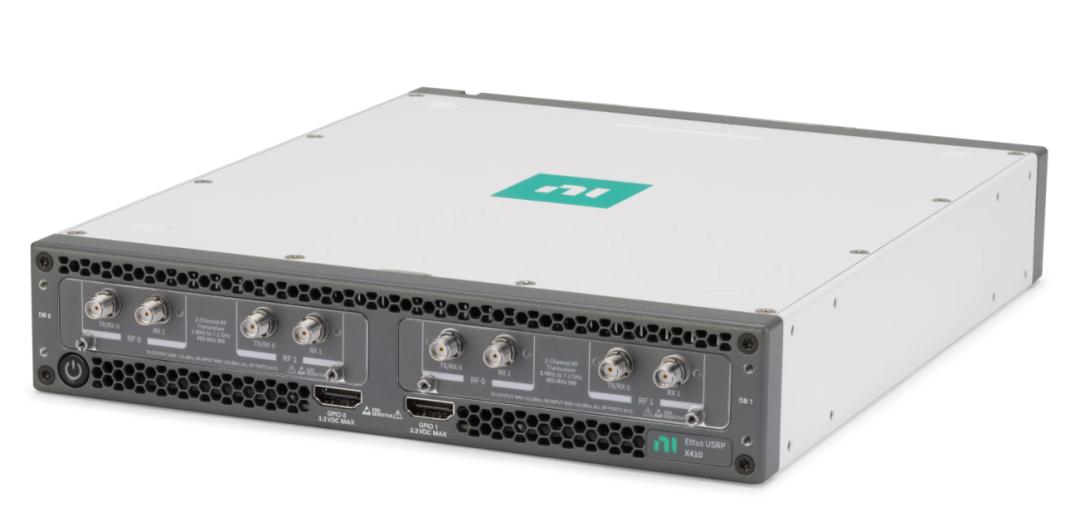
The X300/X310 are modular, with a Kintex-7 FPGA (325T on the X300, 410T on the X310) and a daughterboard providing the RF front end. The X310 supports 2 TX / 2 RX (or a 4-RX TwinRx configuration), 160 MHz bandwidth, 10GbE or PCIe interfaces, and an optional GPSDO. The configurable RF front end means users can swap daughterboards to match band requirements, a flexibility that integrated designs cannot offer.
The X410 is a step change in architecture: built on a Zynq UltraScale+ RFSoC ZU28DR, it direct-samples from 1 MHz to 7.2 GHz with 400 MHz instantaneous bandwidth, 4 TX / 4 RX, and 100/10GbE or PCIe interfaces. The essence of RFSoC is integrating ADC, DAC, FPGA, and ARM processor on a single die, compressing the traditional RF front end to ADC to FPGA to host cascade into an in-chip high-speed interconnect, which qualitatively improves both latency and determinism.
The X420 offers 2 TX / 2 RX, 10 MHz to 20 GHz coverage, 1 GHz instantaneous bandwidth, GPSDO, and targets advanced wireless research, radar prototyping, and satellite communications. The 20 GHz coverage extends SDR applicability into Ka-band and above.
The X440 pushes the philosophy to its limit: 8 TX / 8 RX, 30 MHz to 4 GHz, up to 1.6 GHz instantaneous bandwidth, a 100GbE interface, phase coherence, and a GPS-disciplined OCXO. Its 1.6 GHz bandwidth targets radar prototyping, electronic warfare, and ultra-wideband communications research, while the 8-channel phase coherence makes it an ideal platform for large-array processing. Its FPGA images offer several bandwidth configurations: X4_200 (200 MHz / 8 channels), X4_400 (400 MHz / 8 channels with DRAM record and playback), X4_1600 (1600 MHz / 2 channels), and CG_1000/CG_1600 (direct 100GbE).
WinRadio: Extreme Receiver-Chain Optimization and Task-Specific Architecture
WinRadio’s product philosophy stands in sharp contrast to Ettus. It does not build general-purpose transceivers; it focuses on SNR and dynamic-range optimization in the receive chain, targeting monitoring, interception, and spectrum-management tasks.
HF-Band DDC Receivers
The WR-G31DDC (Excalibur) is an HF-band (9 kHz-50 MHz) direct-sampling receiver with a 16-bit 100 MSPS ADC, a 50 MHz-wide real-time spectrum display, and 2 MHz of instantaneous processing bandwidth. Its headline figures are +31 dBm IP3 and 107 dB of dynamic range. The interface is USB 2.0 High Speed and the antenna input is a 50 ohm SMA. In the HF band, strong and weak signals routinely coexist; high IP3 keeps strong signals from generating intermodulation products in the receiver front end that would mask weak ones.
The WR-G33DDC (Excalibur Pro) raises instantaneous processing bandwidth to 4 MHz over the G31DDC and adds a low-noise preamplifier (NF down to 10 dB) plus configurable preselector filters (119 combinations), lifting the specifications for more demanding monitoring scenarios. The interface is again USB 2.0 High Speed.
The WR-G35DDC (Excalibur Ultra) uses a PCI-e bus, extends coverage to 1 kHz-45 MHz, jumps processing bandwidth to 32 MHz, and lifts typical IP3 to +38 dBm. The PCI-e choice means lower latency and higher data-throughput determinism, and it supports multi-channel phase-coherent configurations via an external reference clock, suiting professional monitoring that needs continuous wideband recording or coherent processing.
The WR-G65DDCe (Excalibur Sigma) is an HF/VHF DDC receiver covering 1 kHz-88 MHz plus the 118-190 MHz aeronautical band. The ADC is upgraded to 16-bit 210 MSPS with 64 MHz processing bandwidth over USB 3.0. Interfaces are USB 3.0 and 1Gb Ethernet (with PoE support), and it is phase-coherent, supporting an external reference clock and 1PPS input for high-performance applications such as interferometric direction finding.
VHF/UHF Scanning Receivers
The WR-G305i/G305e are low-cost VHF/UHF scanning receivers covering 9 kHz-1800 MHz. The G305i uses a PCI 2.2 slot, has a 50 ohm SMA RF input, and sends a 12 kHz IF output to the PC sound card for digitization and subsequent DSP, so demodulation accuracy and flexibility are partly limited by the host sound card. The G305e is the external version with a USB interface (optional RS-232 serial), suited to portable or mobile scenarios without a PCI slot.
The WR-G315i/G315e are professional-grade VHF/UHF scanning receivers, also covering 9 kHz-1800 MHz but extendable to 8599 MHz with the external AMFE (antenna multiplexer and frequency extender) unit. The key architectural difference from the G305 is that the G315 carries onboard DSP: final IF filtering and all demodulation happen inside the receiver without relying on the PC sound card, giving higher determinism and lower latency. The G315 family includes a dual-loop AGC and AFC design and a tracking front-end filter. The tracking filter matters in scanning reception: as the receiver scans to a frequency, the front-end filter retunes to suppress strong signals outside that frequency, preventing them from entering the mixer and creating intermodulation. That is dynamic-range management in the analog domain, quite unlike Ettus’s approach of relying on FPGA processing in the digital domain.
Wideband DDC Receivers
The WR-G39DDCi/G39DDCe (Excelsior) extends the DDC architecture across HF/VHF/UHF, covering 9 kHz-3500 MHz. Its core signal chain uses an upconversion superheterodyne plus dual-DDC architecture: the front end suppresses images through upconversion, avoiding complex preselector filters and the distortion and noise-figure degradation they introduce. The ADC is 16-bit 100 MSPS and provides two independent DDC channels, each with up to 4 MHz instantaneous bandwidth (24 selectable steps), usable as two independent “virtual receivers.” It also has a 16 MHz-wide real-time spectrum analyzer (1.5 kHz RBW), and demodulation bandwidth is continuously adjustable from 1 Hz to 320 kHz in 1 Hz steps. On dynamic range, typical IP3 is +6 dBm (below 50 MHz) or +1 dBm (above 50 MHz, preamp off), typical SFDR is 90 dB (below 50 MHz), and search speed reaches 1 GHz/s. Interfaces: the G39DDCi uses PCI-e for fixed multi-channel monitoring systems, where several receivers can coexist in one PC; the G39DDCe uses USB 2.0 for greater portability, with a 50 ohm SMA antenna input. Both support an optional APCO P25 decoder and external 10 MHz reference input/output, targeting government, military, and surveillance-grade monitoring tasks.
The WR-G69DDCe/G69DDCi (Excelsior Ultra) is WinRadio’s flagship receiver, covering an ultra-wide 8 kHz-8 GHz with a dual-input architecture: Range 1 is 8 kHz-80 MHz (direct sampling) and Range 2 is 43 MHz-8 GHz (superheterodyne), the two inputs independent and mutually exclusive. The ADC is upgraded to 16-bit 200 MSPS with 32 MHz instantaneous processing bandwidth, far beyond the G39 series’ 4 MHz; the entire 32 MHz can be used for recording, demodulation, and downstream digital processing, which suits frequency-hopping signal analysis well. Three demodulators can run simultaneously, with selectivity continuously adjustable in 1 Hz steps (1 Hz-320 kHz). The spectrum analyzer supports 80/34 MHz wide real-time display (2.6 kHz RBW) and a 32 MHz DDC spectrum (1 Hz RBW). On dynamic range, Range 1 has typical IP3 of +30 dBm and SFDR of 105 dB; Range 2 has IP3 of +6 dBm (preamp off) and SFDR of 90 dB (preamp off). Search speed reaches 3 GHz/s with 0.1 ppm frequency stability. Interfaces: the G69DDCe provides USB 3.0 and 1Gb Ethernet (with PoE), with 32 MHz processing bandwidth over USB 3.0 and 16 MHz over 1 Gbps LAN, supporting long semi-remote deployment (up to 100 m of network cable); the G69DDCi uses a PCIe 2.0 (1x) interface powered from the bus (20 W), positioned as a fixed high-performance monitoring node. The G69 series also supports optional external 10 MHz reference input/output and 1PPS input with phase-coherent capability, for interferometric direction finding and multi-channel time synchronization. The combination of 8 GHz coverage and 32 MHz instantaneous bandwidth makes it one of the few monitoring receivers on the market that pairs ultra-wideband coverage with high-throughput processing.
Task-Specific Models
The WR-2902e is a sonobuoy telemetry receiver covering 136-173.5 MHz and extendable to 1.5 GHz. It is a triple-conversion superheterodyne receiver with independent analog (DIFAR) and digital (BARRA) signal outputs plus an audio monitoring output. All RF signal processing happens inside the receiver; the computer is used only for control. It is the extreme expression of WinRadio’s task-specific philosophy.
WinRadio’s software architecture reflects the same task specificity: the G31DDC software provides three parallel demodulators, full-bandwidth recording, and built-in EIBI and HFCC frequency databases. On a general-purpose SDR platform these features would have to be developed by the user, whereas WinRadio delivers them as turnkey capability. The cost is flexibility: you cannot transmit with a WinRadio, you cannot change its signal-processing flow, and you cannot run your own physical-layer algorithms on it.
SignalHound: Real-Time Spectrum Monitoring and the Accuracy Boundary
SignalHound’s product line is comparatively simple, but every model points clearly at the core task of spectrum analysis. Its technical approach can be summed up as: use real-time bandwidth and scan speed as the lever to push the efficiency boundary of spectrum monitoring.
SA Series: Entry-Level Spectrum Analysis
The USB-SA44B is SignalHound’s entry-level spectrum analyzer, covering 1 Hz-4.4 GHz over USB 2.0 with a dynamic range of -151 dBm to +10 dBm and AM/FM/SSB/CW audio demodulation. The companion TG44A tracking generator (10 Hz-4.4 GHz) enables gain/loss and return-loss measurements on two-port devices.
The SA124B is the upgraded SA44B, extending coverage to 12.4 GHz and also offering a tracking generator option.
BB Series: The Real-Time Bandwidth Leap
The BB60C is the model that makes SignalHound’s philosophy click. It covers 9 kHz-6 GHz with 27 MHz instantaneous bandwidth and 24 GHz/s scan speed. The 27 MHz instantaneous bandwidth matters because it directly sets the probability of intercept (POI). A traditional swept analyzer steps through frequency points, dwelling on each for perhaps only microseconds. If a short burst – a frequency hop, a radar pulse, or a digital modulation burst – appears in a time window that does not overlap the analyzer’s dwell at that frequency, the signal is missed. The BB60C’s 27 MHz instantaneous bandwidth covers 27 MHz of spectrum in a single acquisition window, capturing signals with an area instead of a point, so even microsecond-scale bursts have a high probability of capture. The interface is USB 3.0.
The BB60D is the successor to the BB60C, keeping the 9 kHz-6 GHz coverage and 27 MHz instantaneous bandwidth while further optimizing dynamic range and scan speed. The interface is again USB 3.0.
SM Series: From 20 GHz to 43.5 GHz
The SM200A pushes capability higher: 100 kHz-20 GHz coverage, 160 MHz instantaneous bandwidth, 110 dB dynamic range, and 1 THz/s scan speed (30 kHz RBW, Nuttall window). 1 THz/s means sweeping the full 20 GHz span at 30 kHz RBW in just 20 ms. That speed makes continuous wideband monitoring possible rather than sampled snapshots. SM200A signal processing is distributed between a powerful Altera FPGA and an external PC, and a local API lets users insert their own DSP algorithms into the calibrated I/Q stream. The interface is USB 3.0.
The SM200B adds 160 MHz calibrated I/Q capture to the SM200A. Note carefully: because of USB 3.0 throughput limits, the SM200B cannot stream 160 MHz I/Q to the PC in real time. Instead it captures in segments through a built-in 2-second buffer and transfers afterward. The buffer is configurable for up to 250 triggerable capture segments, each with independent pre-trigger, trigger type, and capture length. Trigger options include video level, external trigger, and frequency mask trigger (FMT). This design enables deep 5G and radar analysis, at the cost of true real-time streaming.
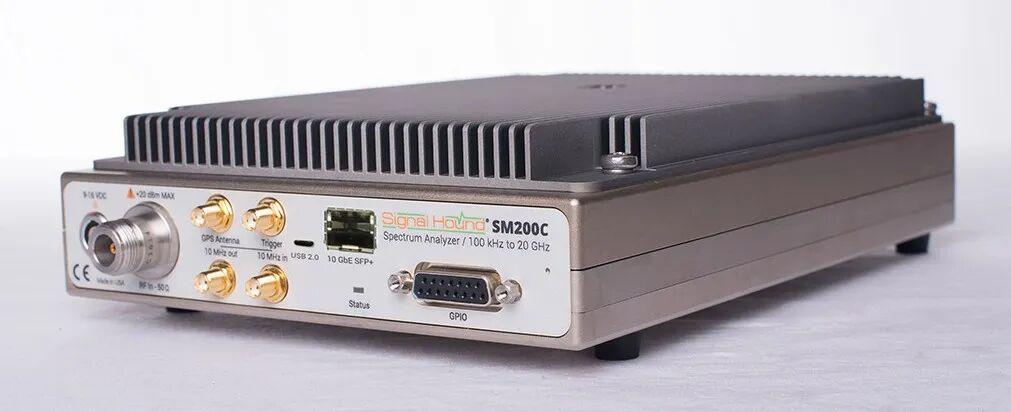
The SM200C changes the interface from USB 3.0 to 10GbE SFP+, enabling 160 MHz continuous I/Q streaming – something the SM200B cannot do. The 10GbE choice means remote deployment and centralized analysis: you can mount the analyzer on an antenna tower and send I/Q back over fiber for real-time processing on a host. That distributed spectrum-monitoring architecture is something a traditional benchtop analyzer cannot achieve. The SM200C also has a sub-octave preselector (same architecture as the SM200A/B) and GPIO ports for antenna switching.
The SM435B is the millimeter-wave flagship of the SM series, jumping to 100 kHz-43.5 GHz and positioned as a “millimeter-wave spectrum analyzer and monitoring receiver.” Core specs: 160 MHz instantaneous bandwidth, 110 dB dynamic range, 1 THz/s scan speed (at 30 kHz RBW or wider), and phase noise low enough to contribute less than 0.1% to EVM measurements. A built-in GPS-disciplined OCXO holds timebase accuracy to +/-5×10^-10 once locked, with I/Q time stamping and GPS positioning. The RF input uses a 2.4 mm connector (50 ohm) with a 20 MHz-43.5 GHz sub-octave preselector to preserve scan-speed performance. The interface is USB 3.0 with 2-second segmented I/Q buffering (the same mechanism as the SM200B). An optional Option-80 configuration replaces the front-panel 10 MHz output with 800 MHz IF bandwidth (24-43.5 GHz selectable, 1.5 GHz center), letting the unit switch between spectrum analysis and millimeter-wave downconversion modes.
The SM435C is the 10GbE version of the SM435B, achieving 160 MHz continuous I/Q streaming through a 10GbE SFP+ port and supporting long-distance fiber communication. Device control and data transfer are done entirely over the SFP+ link with no USB. Apart from the interface, the RF specs match the SM435B: 100 kHz-43.5 GHz, 160 MHz IBW, 110 dB dynamic range, 1 THz/s scan speed, 2.4 mm connector. It likewise offers the Option-80 downconversion mode. The SM435C is positioned as a remotely deployed millimeter-wave monitoring node for 5G mmWave monitoring, 24 GHz ISM band monitoring, and full Ka-band spectrum testing.
VSG Series: Introducing Transmit Capability
The VSG25A is a portable vector signal generator covering 100 MHz-2.5 GHz with PSK, QAM, ASK/FSK, and other modulation formats, weighing only 130 g.
The VSG60A extends the frequency range to 50 MHz-6 GHz with 40 MHz of streaming modulation bandwidth, supporting preprogrammed modulation types including LTE, 802.11a/n/ac/ax, Bluetooth LE, and custom OFDM. Its low-phase-noise agile local oscillator has a 200 us switching time, enabling frequency-hopping spread-spectrum testing.
The TG124B is SignalHound’s tracking generator model, used with a spectrum analyzer for two-port measurements.
SP Series: Portable Real-Time Spectrum Analysis
The SP145 is a portable real-time spectrum analyzer covering 100 kHz-14.5 GHz with scan speeds up to 200 GHz/s, weighing only 500 g, with an optional extended temperature range. The SP145 targets field spectrum monitoring and interference hunting; its lightweight design and wide temperature range point squarely at on-site work.
Positioning Differences and Selection Logic
If you place these three brands on one set of axes, the axis to choose is “who holds control of the signal processing.”
Ettus hands control to the user. FPGA logic is programmable, RF parameters are reconfigurable, and the signal-processing flow can be built from scratch with GNU Radio. The cost is that the user carries the complexity of system integration, solving synchronization, calibration, and real-time guarantees themselves. The Ettus user profile is an R&D team with RF and digital signal processing skills whose goal is to implement a new communication scheme or validate a new waveform design. From the USB-portable B series, to the networked MIMO nodes of the N series, to the RFSoC flagship X series, each Ettus line is a different price point on the axis of freedom. The B310 fills in a low-latency PCIe/Thunderbolt desktop option between USB and 10GbE.
WinRadio pulls control into the receive chain. What the user gets is an optimized receiver system with defined specifications. Algorithms for strong-signal handling and weak-signal extraction are already fixed in hardware and embedded software. The WinRadio user profile is an operator with a monitoring mission whose goal is to reliably intercept and demodulate known signal types rather than invent new ones.
SignalHound concentrates control on the analysis dimension. What the user gets is real-time, high-resolution visibility into the spectrum. The VSG series rounds out transmit capability, but the overall positioning remains “test and monitoring” rather than “communication system development.” The SignalHound user profile is a spectrum manager or interference-hunting engineer whose goal is to understand what is happening in the spectrum and to test RF device performance.
A common misconception is that Ettus is “more advanced” or SignalHound “more professional.” The three serve different task profiles; there is no absolute ranking. Use Ettus for weak-signal monitoring in the HF band and you will be fighting USB bus noise and IP3 limits. Use WinRadio for MIMO waveform validation and it has no transmit capability at all. Use SignalHound to prototype a custom protocol and its architecture will not let you write physical-layer logic.
The right selection question is not “which brand is better” but “which part of my signal chain needs freedom and which part needs determinism.” Where you need freedom, Ettus is a programmable blank canvas. Where you need determinism, WinRadio and SignalHound provide validated answers. Understanding that distinction is more fundamental than comparing any single specification.
Platform Comparison at a Glance
| Dimension | Ettus | WinRadio | SignalHound |
|---|---|---|---|
| Control model | User-programmable (FPGA + host) | Fixed in hardware and firmware | Analysis-centric, PC-hosted |
| Transmit | Yes (TX/RX or RX-only) | No – receive only | Partial (VSG series only) |
| Typical bandwidth | 56 MHz to 1.6 GHz instantaneous | 2 MHz to 32 MHz processing | 27 MHz to 160 MHz instantaneous |
| Frequency reach | Up to 7.2 GHz (RFSoC) / 20 GHz (X420) | 8 kHz to 8 GHz | Up to 43.5 GHz (SM435B/C) |
| Primary strength | Architectural freedom, MIMO scale | Receiver SNR and dynamic range | Real-time bandwidth and scan speed |
| Ideal user | Waveform and PHY R&D teams | Monitoring and interception operators | Spectrum managers and EMI engineers |
Have questions about this article? Feel free to contact us at [email protected] — we’re happy to help!
Frequently Asked Questions
Is Ettus more advanced than SignalHound?
No. They optimize different things. Ettus maximizes architectural freedom and coherent channel scale; SignalHound maximizes real-time bandwidth and scan speed for spectrum analysis. Neither is a superset of the other.
Can WinRadio transmit?
No. WinRadio’s product line is receive-only by design. Its value is an optimized receive chain with high IP3, high dynamic range, and turnkey monitoring software, not transmit capability.
What does 27 MHz of instantaneous bandwidth actually buy?
Probability of intercept. Instead of dwelling on one frequency at a time, the analyzer captures 27 MHz at once, so short bursts such as frequency hops and radar pulses are far more likely to be caught.
Why can the SM200B not stream 160 MHz I/Q in real time?
USB 3.0 throughput is the limit. The SM200B instead uses a 2-second internal buffer with up to 250 triggerable segments. The SM200C solves this by moving to a 10GbE SFP+ interface for continuous streaming.
Which platform should I pick for a custom physical layer?
Ettus. Only a platform with programmable FPGA logic and an open driver stack such as UHD and RFNoC lets you implement and run your own physical-layer algorithms end to end.
About Aomway
Aomway is a technology company specializing in drone and FPV equipment, publishing in-depth analyses of motor control, embedded hardware, and open-source robotics projects. With over 15 years of industry experience, Aomway covers the full spectrum from flight controllers and FPV goggles to thermal imaging cameras and long-range datalinks for the global drone community.