
Key Takeaways
- Underwater laser communication can theoretically reach Gbps data rates, against tens of kbps to Mbps for acoustic links – but the hard problem has shifted from transmit power to beam acquisition.
- A blue-green laser spot only centimeters or millimeters wide has to stay on a target that is drifting, pitching, and turning in currents, waves, and self-motion.
- DenseNet handles the vision half: dense connectivity preserves low-level edges and texture while still fusing high-level semantics, which matters in water that attenuates color and scatters on suspended particles.
- Transformer handles the prediction half: attention over time answers where the target will be in a few seconds, so the beam can be aimed ahead of it rather than corrected after it drifts.
- The likely end state is not a replacement for classical control but a hybrid: AI prediction plus conventional control plus multi-sensor fusion, with the classical loop as the safety net.
For decades, underwater communication has been one of the biggest technical bottlenecks in connecting the ocean world. In air, radio waves cross hundreds of kilometers with ease; in the ocean, electromagnetic waves attenuate quickly and conventional wireless links largely stop working. Submarines, underwater robots, and ocean sensors have therefore long depended on acoustic communication.
Acoustic links cover long distances but carry inherent limits: low bandwidth, high latency, and poor directionality. For future ocean robots, sending simple commands is nowhere near enough. Deep-sea resource exploration, ocean observation networks, unmanned underwater vehicle swarms, and subsea data centers all push robots toward what smart devices on land already do – high-definition video, real-time map sharing, coordinated control, and large-scale data synchronization.
That has opened a new technical path: building high-speed underwater data links with blue-green laser optical communication.
The hardest problem in underwater optical communication is not laser power. It is getting the beam to find another robot that is moving. In air, optical terminals rely on a stable platform and precise position measurement to stay aligned. In the ocean, robots are pushed by currents and waves, change attitude, and move under their own power, so the geometric relationship between two terminals never stops changing. A laser spot only centimeters or millimeters wide has to keep hitting a moving target in a dynamic environment.
This is no longer fundamentally an optics problem. It is becoming a problem of artificial intelligence controlling a beam.

Why Underwater Laser Communication Is Hard: The Core Conflict Moves From Range to Aiming
Underwater optical communication typically uses blue or green wavelengths because seawater absorbs them least, giving relatively longer propagation. Against the tens of kbps to Mbps that acoustic links deliver, underwater optical communication can theoretically reach Gbps or higher.
Behind that high rate sits an engineering problem: the beam must be aimed precisely at the receiver.
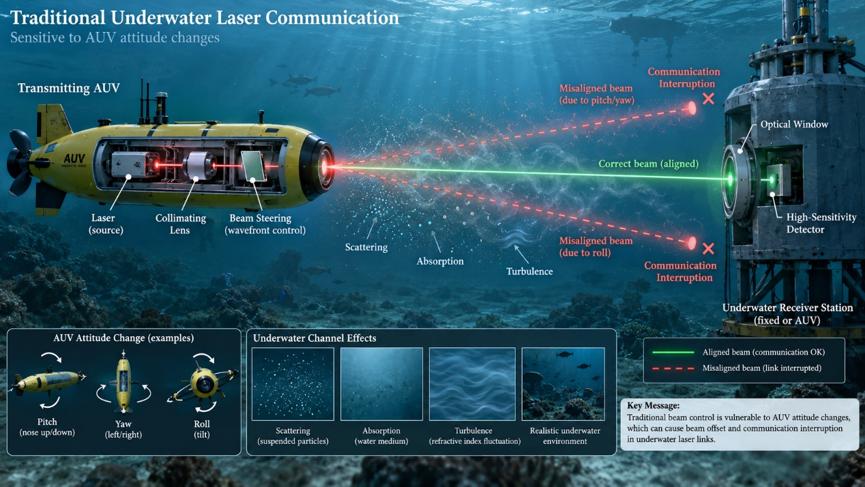
A conventional underwater laser terminal usually contains a laser, beam-expanding and collimating optics, a high-speed detector, and a mechanical or MEMS micro-steering mechanism. Establishing a link normally runs through four stages: target search, beam acquisition, fine tracking, and stable communication.
Acquisition is the hardest of the four. If two robots are hundreds of meters or even kilometers apart, a few degrees of attitude error can send the laser spot entirely off the receiver aperture. Future underwater robots therefore need more than a stronger laser – they need an intelligent vision system that understands the environment, predicts motion, and actively adjusts beam direction.
Why DenseNet Becomes the AI’s Eyes: Letting a Robot Read Underwater Targets
If an underwater robot is to find a communication partner on its own, the first step is not controlling the laser. It is understanding the visual environment. That means the robot has to answer: where might a communication target be? Where is it moving? Which way should the beam be adjusted right now?
This demands strong visual recognition. In recent years deep learning has become a major route in machine vision, and DenseNet (Dense Convolutional Network) is a network structure well suited to vision tasks in complex environments.
Traditional convolutional networks pass information layer by layer – what one layer extracts is handed to the next – and as networks grow deeper, early features are easily lost. DenseNet uses dense connectivity so that every layer can directly access the information from all preceding layers. The benefits are that low-level edge and texture information is preserved, high-level semantic information keeps being fused, and the network uses parameters more efficiently.
For an underwater robot this matters a great deal, because the underwater visual environment is far more complex than on land. Seawater attenuates color, suspended particles scatter light, low illumination reduces signal-to-noise ratio, and the target may occupy only a very small region. What the robot sees is not a clean industrial camera image but a blurred world filtered through seawater.
DenseNet helps the system extract target features from limited visual information: robot outlines, communication lights, laser beacons, reflection signatures, and motion trajectories. It answers the question “what am I seeing?” But if the robot needs to predict where the target is going, a CNN alone is not enough. That is where Transformer comes in.
Why Transformer Changes Underwater Beam Control: Understanding Motion Relationships
Transformer began in natural language processing, and its biggest innovation is the attention mechanism. Put simply, Transformer does not only look at information at the current position – it analyzes relationships between different pieces of information. That capability was later brought into computer vision.
For an underwater communication robot, the target is not a static object. An AUV may be moving forward, turning, rising and descending, and being pushed by currents. The robot has to predict where the target will be a few seconds from now, and where the beam should be pointed in advance. That is a temporal prediction problem.
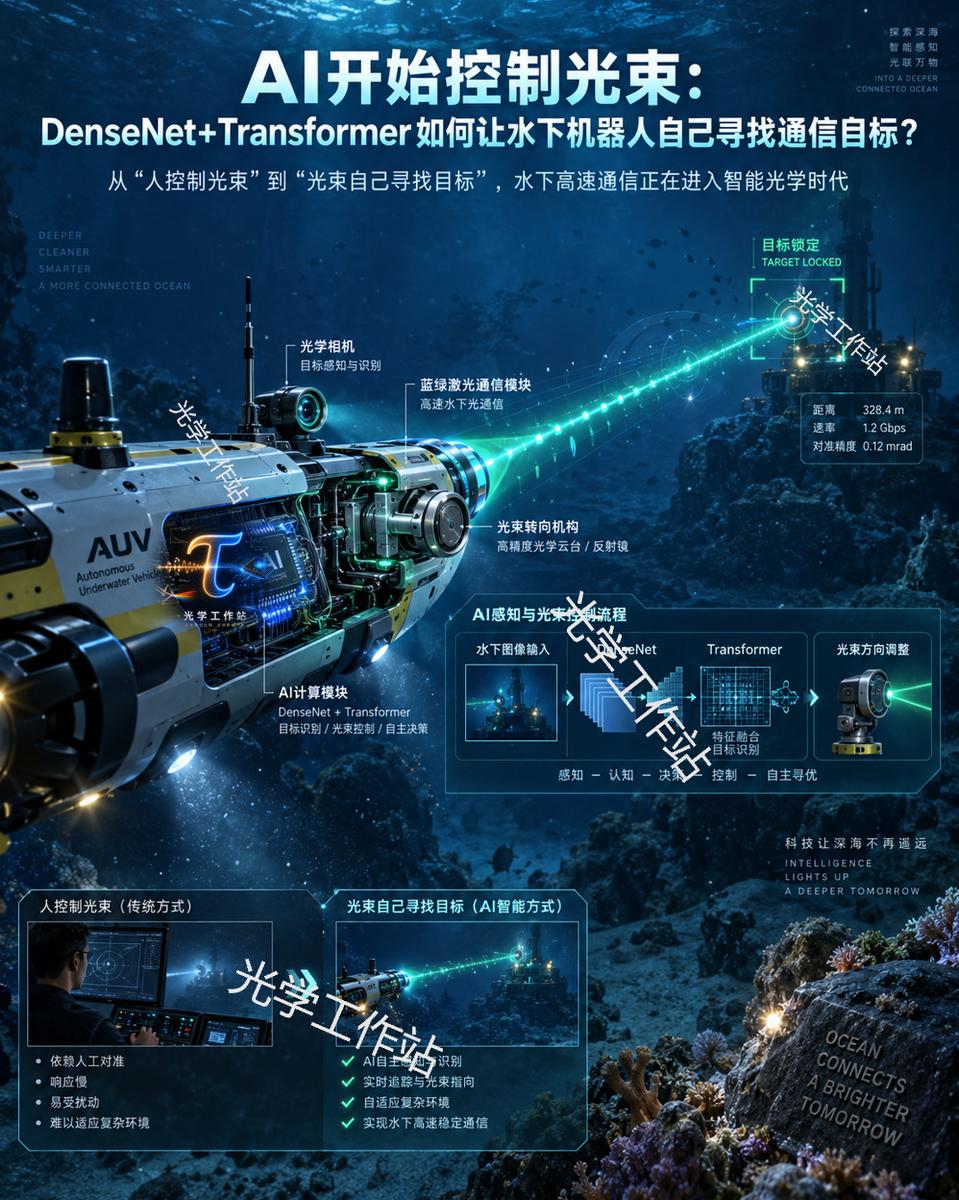
DenseNet extracts visual features, and Transformer understands how those features change over time. Together they form a typical pipeline: DenseNet extracts underwater image features, Transformer builds spatial and temporal relationships, and the control algorithm outputs the beam adjustment strategy.
The result is a closed loop. The camera sees the target, the AI predicts its position, the controller adjusts beam steering, the laser re-acquires the target, and the communication link stays stable. This is underwater optical communication moving from conventional passive alignment to active prediction.
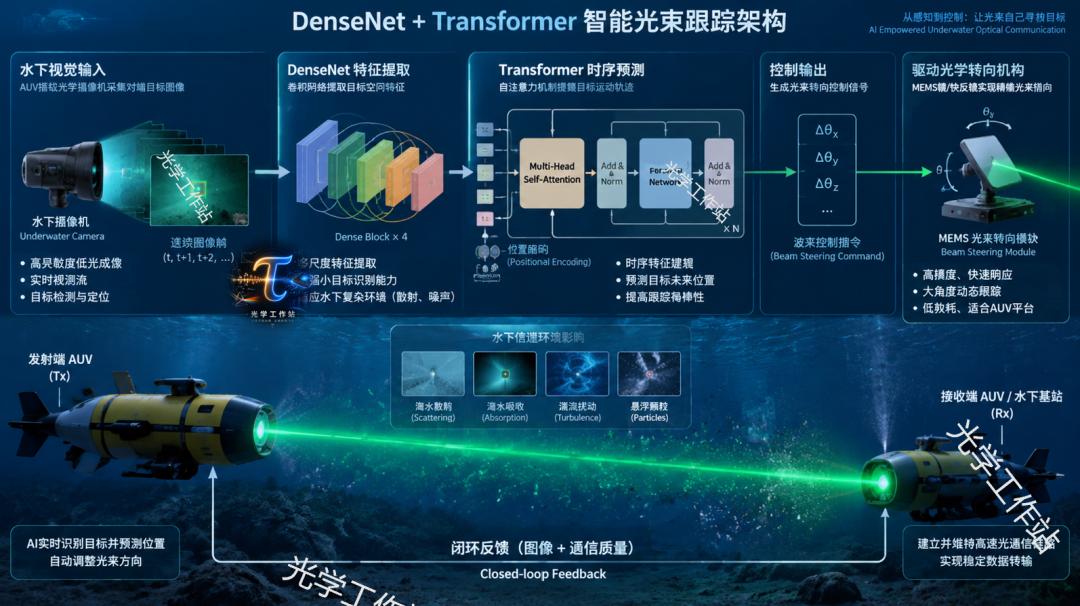
AI Beam Control Means Giving the Robot a Visual Closed Loop
Conventional robot control leans more on pre-planning: know the target position, compute the trajectory, execute the control action. But the real ocean cannot be fully predicted. In the deep sea, currents keep changing, robot attitude carries error, the communication target may move, and the optical environment keeps shifting.
Future underwater robots therefore need a closed loop more like a human eye and brain. The human visual system does not simply see a target – it constantly predicts where the object will be in the next second and how to adjust its own motion. AI beam control works the same way. It does not wait for the laser to drift and then correct it; it predicts the error in advance. That is why predictive models such as Transformer are drawing more attention.
Future underwater communication systems may fuse visual perception, inertial navigation, sonar positioning, laser ranging, and deep learning prediction into a single multi-sensor intelligent optical system.
From Communication to Perception: Toward an Optical Intelligence Era
The significance of AI-controlled underwater laser communication is not just higher speed. The deeper change is that underwater robots are moving from platforms that execute tasks to intelligent nodes with spatial awareness.
Future ocean robots could form large-scale cooperative networks: AUVs exchanging map data at high speed, subsea sensors uploading environmental information in real time, robot swarms conducting autonomous coordinated surveys, and deep-sea equipment undergoing real-time remote maintenance. All of these need stable, high-speed, low-latency data links, and underwater optical communication could become an important part of future ocean digital infrastructure.
At the same time, this pushes a set of new industry directions: highly reliable underwater laser communication modules, MEMS beam steering chips, underwater machine vision algorithms, AI edge computing chips, and integrated optical-mechanical-electrical control systems. The key competition is no longer who can build a stronger laser, but who can make a robot truly understand the ocean environment and let the beam find the target on its own.
Future Challenges: AI Can Solve “Seeing” but Still Has to Solve “Reliability”
Although AI techniques such as DenseNet and Transformer are improving underwater optical communication, large-scale deployment still faces challenges.
The first is data. Land-based vision algorithms have large public datasets, while real deep-sea environmental data is extremely limited. Different sea areas, depths, and turbidity levels all affect model performance.
The second is real-time computation. Underwater robots usually run on limited energy, so AI models must complete high-speed inference on low-power chips.
The third is safety and reliability. A broken link can mean a failed mission, so an AI control system must keep conventional control algorithms as a safety guarantee. The likely direction is not full replacement of classical methods but a new intelligent optical architecture combining AI prediction, conventional control, and multi-sensor fusion.
Acoustic vs Optical Underwater Links
| Parameter | Acoustic | Optical (blue-green laser) |
|---|---|---|
| Data rate | Tens of kbps to Mbps | Theoretically Gbps and above |
| Effective range | Long, kilometers and beyond | Shorter, wavelength and water dependent |
| Latency | High | Low |
| Directionality | Poor | Very high, requires precise aiming |
| Dominant engineering problem | Bandwidth and latency | Beam acquisition and tracking |
| Maturity for robot swarms | Mature, widely deployed | Emerging, active research area |
Conclusion: The Next Generation May Have Smarter Eyes, Not Stronger Thrusters
From acoustic communication to blue-green laser communication and now to AI-driven autonomous beam control, underwater robots are going through an upgrade in how they connect. In the past, humans had to tell the robot where the target was and where the beam should point. In the future, the robot may observe the environment itself, predict motion, and let the beam actively seek the communication partner.
DenseNet helps the robot better understand the visual world, Transformer lets it predict future change, and the intelligent control system finally turns the beam into an AI organ that can adjust its own direction. When AI starts controlling the beam, competition in underwater communication shifts from who has the stronger transmit capability to who has the stronger perception, computation, and autonomous control.
This article is compiled for technical reference. Some images were generated with AI assistance.
Have questions about this article? Feel free to contact us at [email protected] — we’re happy to help!
Frequently Asked Questions
Why is beam acquisition harder than increasing laser power?
A wider or stronger beam does not solve geometry. Because the spot is only millimeters to centimeters wide, a few degrees of attitude error over hundreds of meters sends it off the receiver aperture. The problem is pointing, not power.
What does DenseNet contribute to underwater optical communication?
Dense connectivity lets every layer access all preceding layers, so low-level edge and texture detail survives while high-level semantics keep fusing. In water that attenuates color and scatters on particles, that preserves more usable target features.
Why is Transformer needed on top of a convolutional network?
A CNN answers what is in the image, not where the target will be. Transformer’s attention mechanism models how features change over time, which turns beam control into a prediction problem rather than a correction problem.
What are the main obstacles to deploying this at scale?
Three stand out: scarce real deep-sea training data across varying turbidity and depth, the need for high-speed inference on low-power chips, and the safety requirement that a classical control loop remain as a fallback when the AI path fails.
Will AI fully replace conventional control in underwater robots?
Unlikely in the near term. The more probable architecture combines AI prediction with conventional control and multi-sensor fusion, keeping the deterministic controller as the safety layer while AI handles anticipation and adaptation.
About Aomway
Aomway is a technology company specializing in drone and FPV equipment, publishing in-depth analyses of motor control, embedded hardware, and open-source robotics projects. With over 15 years of industry experience, Aomway covers the full spectrum from flight controllers and FPV goggles to thermal imaging cameras and long-range datalinks for the global drone community.