
Key Takeaways
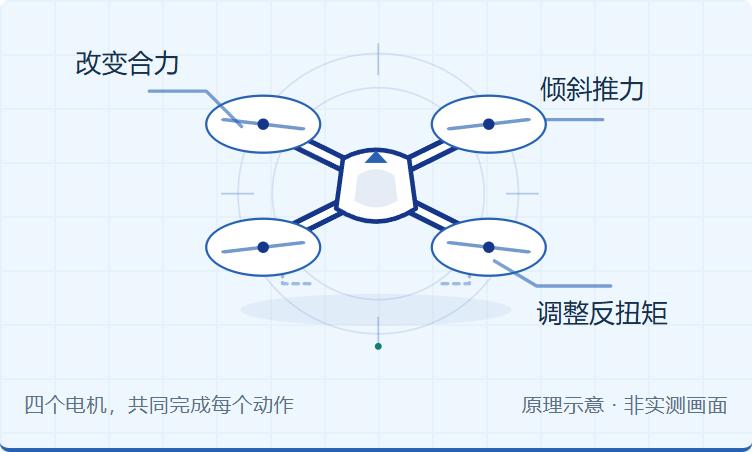
- A quadcopter has no rudder or control surfaces — climb, pitch, roll, and yaw all come from four motor speeds.
- Total thrust above weight accelerates the drone upward; below weight it accelerates it downward.
- Tilting 20 degrees leaves only about 94% of thrust vertical, so holding altitude needs roughly 106% total thrust.
- Yaw comes from unbalancing the two counter-rotating propeller pairs — no motor ever reverses.
- PX4 and ArduPilot call the motor-assignment step “control allocation,” also known as mixing.
How quadcopter propellers work comes down to one idea: with no rudder and no swashplate, every climb, turn, and descent is produced by changing the relative speed of four fixed-pitch rotors. Total thrust sets altitude, differential thrust sets tilt, and torque imbalance sets heading. As of 2026 this is still the control scheme used by ArduPilot and PX4.
No steering wheel, and no control surfaces on the wings. It hands every movement to four motors.
In the previous article in this series we broke hovering down into a continuous process of correction. This time we go one step further: how does the correction coming out of the flight controller actually become a movement of the airframe?
Push the stick and the drone flies forward, climbs, or turns its nose. They look like different actions, but behind them are the same four motors.
Today we start from those four motors and take climb, forward flight, and yaw apart.
What we are explaining
A common X-configuration, fixed-pitch quadcopter: blade pitch and motor mounting direction never change, and thrust is controlled mainly by adjusting each motor’s speed. Front, back, left, and right in the diagrams are relative to the nose; the example rotation directions do not represent the wiring of every airframe.
01 | To climb or descend, change total thrust first
The thrust of the four rotors adds up to the total thrust that holds the drone up. In an ideal hover — no wind, level airframe — it balances gravity.
From that state, if total thrust exceeds gravity the drone accelerates upward; if total thrust is less than gravity it accelerates downward.
A first way to think about it:
- Total thrust greater than gravity: accelerating upward.
- Total thrust equal to gravity: vertical velocity stops changing.
- Total thrust less than gravity: accelerating downward.
This assumes a level airframe and ignores air resistance.
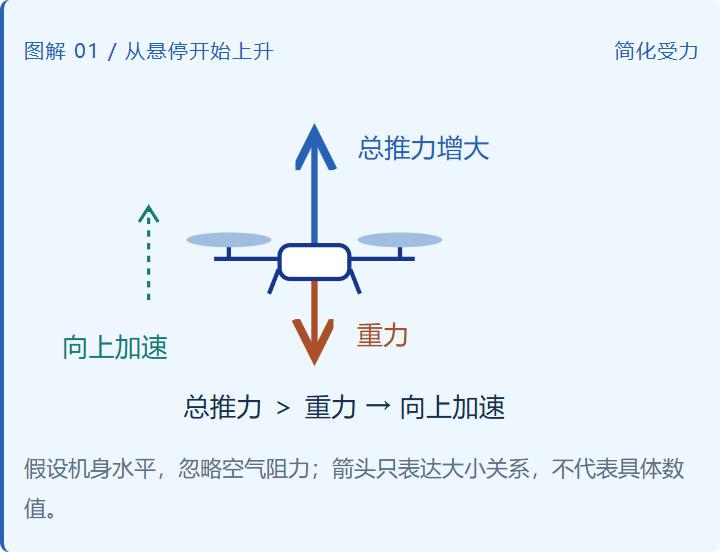
But there is an easy confusion here: climbing does not mean it is still accelerating upward.
Ignoring drag, a drone climbing at a constant speed can still have total thrust balanced with gravity. The difference between thrust and gravity decides “how the velocity changes” — it does not by itself tell us “which way it is flying.”
In real flight the flight controller is also correcting attitude at the same time, and the four motors are not guaranteed to run at exactly the same speed.
02 | To fly forward, tilt the thrust vector
A common quadcopter has no engine pointing forward. It first pitches its nose down: the two rear rotors increase thrust relative to the front pair, producing a moment that pitches the nose down.
This is the differential action at the moment the attitude starts to change. Once the target tilt angle is reached, the flight controller keeps adjusting the motors to hold attitude; it does not keep the same “small front, large rear” split forever and let the nose drop further and further.
As soon as the airframe tilts, the direction of total thrust tilts with it. It has both an upward part and a forward part:
- Vertical component: provides lift.
- Horizontal component: accelerates the drone forward.
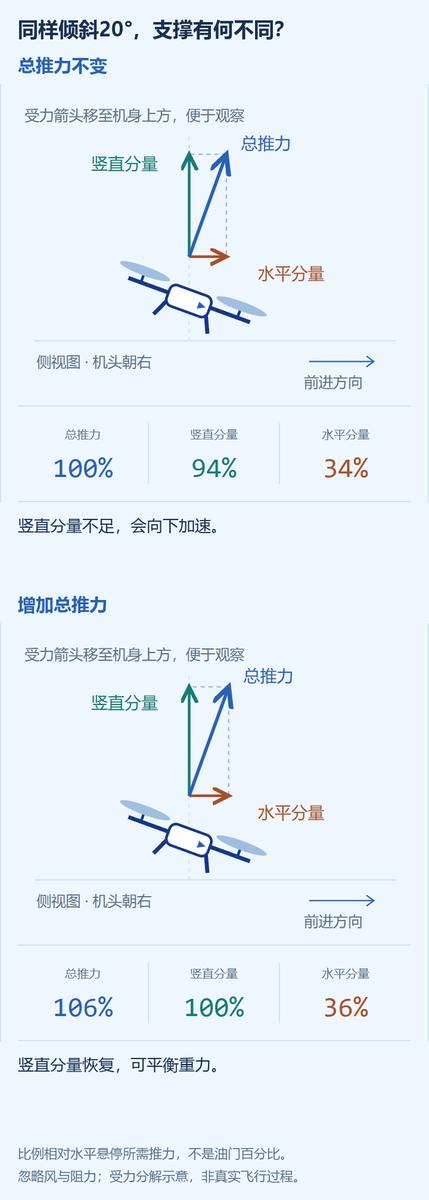
Once it tilts, is the original thrust still enough to hold it up?
Assume the total thrust needed for a level hover is 100%. If the airframe tilts 20 degrees forward and total thrust stays the same, the vertical component is only about 94% and the horizontal component is about 34%.
Under those simplified conditions the vertical component is not enough to balance gravity, and the drone accelerates downward.
To keep altitude while tilted you have to make up the vertical support: raise total thrust to about 106%, the vertical component returns to 100%, and the horizontal component becomes about 36%.
| Condition | Total thrust | Vertical component | Horizontal component |
|---|---|---|---|
| Level hover (reference) | 100% | 100% | 0% |
| Tilted 20 degrees, thrust unchanged | 100% | ~94% | ~34% |
| Tilted 20 degrees, altitude held | ~106% | 100% | ~36% |
How should these percentages be read?
They are all measured against the total thrust needed for a level hover — they are not throttle percentages. The vertical and horizontal components point in different directions, so 94% and 34% cannot simply be added as if they were total thrust.
This assumes thrust is perpendicular to the rotor plane and ignores wind and drag; it only illustrates the force relationship.
Sliding left or right works the same way. To start banking right, for example, the left rotors increase relative to the right, tilting the airframe right and producing a thrust component to the right.
Fore-and-aft tilt is called pitch; left-and-right tilt is called roll. Remember those two names and a lot of flight behaviour becomes readable.
How fast it actually goes also depends on drag and on the control target, so tilt angle alone does not settle it.
03 | Turning the nose uses a different kind of differential
Seen from above, a common quadcopter usually has two rotors spinning clockwise and two counter-clockwise, with the same rotation direction on each diagonal.
Why not have them all spin the same way?
When a motor drives a rotor, the airframe also feels the reaction torque in the opposite direction. Put simply: the rotor turns one way, and the airframe is pushed to turn the other way.
At suitable speeds and loads the two reaction-torque groups cancel each other out, so the airframe does not spin.
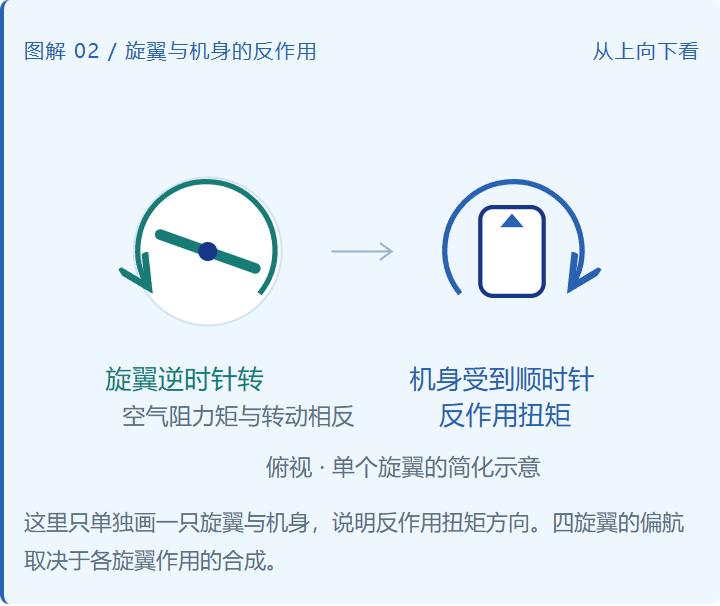
Make the two reaction-torque groups unequal and the airframe starts to rotate about its vertical axis. This change of nose direction is called yaw.
With the rotation directions used in this article’s example, to yaw the nose right you increase the output of the counter-clockwise group and decrease the clockwise group, giving the airframe a net clockwise torque.
What changes here is the speed and effect of the two rotor groups — not a sudden reversal of any single rotor. To stop yawing or hold a steady yaw rate, the flight controller keeps adjusting as well.
But turning the nose and turning the flight path are two different things.
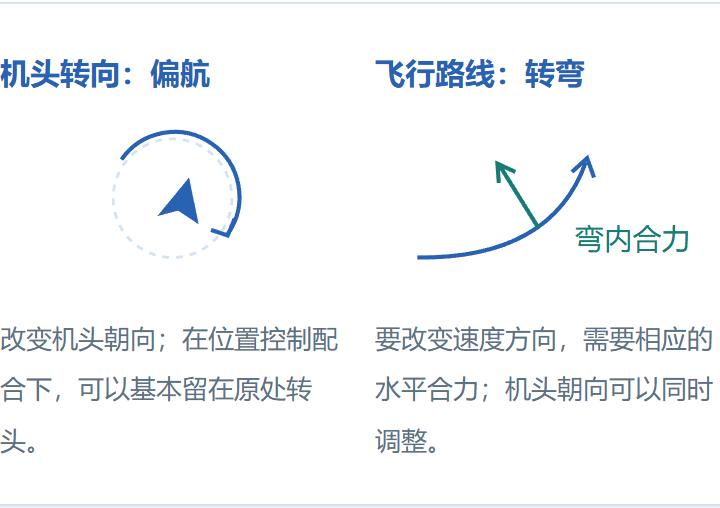
- Turning the nose: changes the drone’s heading. With position control working alongside, it can essentially stay in place and turn.
- Turning the flight path: changes the direction of travel, which needs a corresponding horizontal resultant force; the nose can be adjusted at the same time.
“Which way it looks” and “which way it goes” can be two different directions.
04 | One movement, four motors together
Now let us put the pieces together.
This article uses one clearly stated X-configuration example: viewed from above with the nose pointing up, the front-left and rear-right rotors turn clockwise, and the front-right and rear-left rotors turn counter-clockwise.
1. Hover: keep the resultant force and moment balanced.
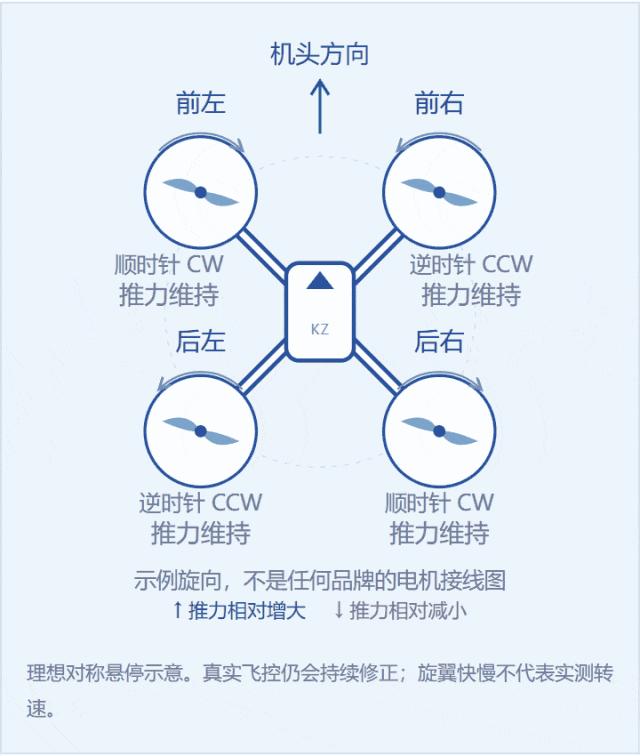
In the ideal symmetric example all four rotors hold their baseline thrust and the two reaction-torque groups balance. In a real hover the flight controller still adjusts every motor continuously.
2. Climb from hover: increase total thrust.
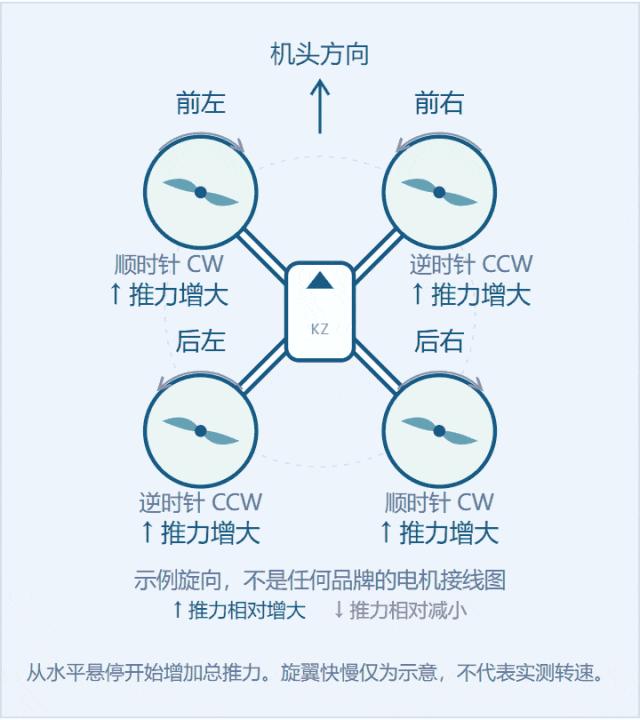
The combined thrust of the four rotors exceeds gravity, producing upward acceleration. At a constant climb rate that difference does not have to be maintained.
3. Start pitching the nose down: rear increases, front decreases.
The rear rises and the nose pitches down. Once the airframe is tilted, total thrust gains a horizontal component pointing toward the nose.
4. Start rolling right: left increases, right decreases.
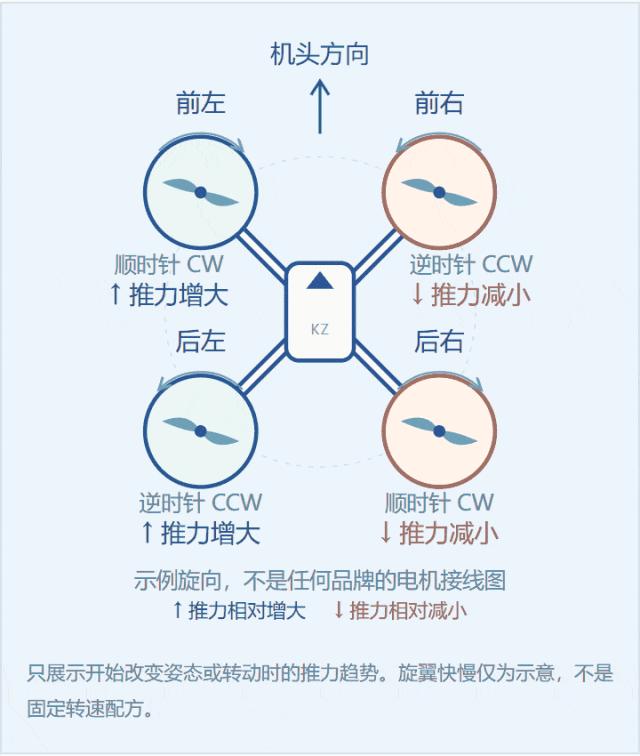
The left side rises and the right side dips, and the airframe begins rolling right. Once tilted, total thrust can produce a component to the right.
5. Start yawing the nose right: strengthen the counter-clockwise rotor group.
In this example the front-right and rear-left rotors increase relative to the front-left and rear-right, creating a net torque that yaws the airframe clockwise.
The “increase” and “decrease” above are all relative changes, not specific throttle values. The nose-down, right-roll, and nose-right-yaw cases show the trend at the moment the attitude or heading starts to change, not a fixed recipe for sustained flight.
The flight controller does not hand “forward” directly to one motor. It first computes the required thrust and moments, then distributes the task across the motors according to frame geometry, rotor position, and rotation direction. This step is called control allocation, often also called “mixing.”
In real flight, climb, tilt, and yaw usually happen at the same time. They are separated here to make each role visible; the actual output has to satisfy attitude, position, and power-margin constraints together.
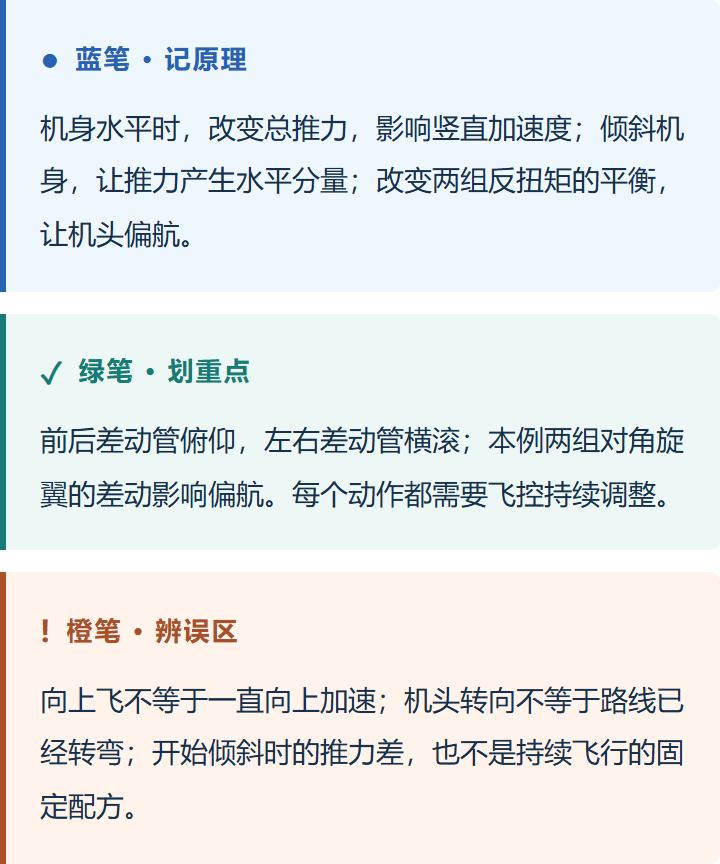
05 | Three-colour notes: remember these three changes
A question to take away
In this article’s ideal example, starting from a level hover and rolling the airframe to the right, which side’s thrust should increase relative to the other?
First work out left and right from the nose direction, then go back to section 4 to check your answer.
Next up: how does a drone know it is tilted? Meet its sense of balance.
References
- ArduPilot: What is a MultiCopter and How Does it Work? (https://ardupilot.org/copter/docs/what-is-a-multicopter-and-how-does-it-work.html) — multirotors achieve climb, pitch, roll, yaw, and horizontal motion through changes in motor speed.
- ArduPilot: Connect ESCs and Motors (https://ardupilot.org/copter/docs/connect-escs-and-motors.html) — motor positions and rotation directions for different frame layouts.
- PX4: Control Allocation (Mixing) (https://docs.px4.io/main/en/concept/control_allocation.html) — converts desired thrust and moments into actuator commands according to frame geometry.
- NASA Glenn: Newton’s Laws of Motion (https://www1.grc.nasa.gov/beginners-guide-to-aeronautics/newtons-laws-of-motion/) — the relationship between resultant force and acceleration, plus action and reaction.
Frame layout and rotation directions are an explicitly stated teaching example and do not represent a specific product configuration; the diagrams and percentages are based on ideal force relationships, not measured data.
Have questions about this article? Feel free to contact us at [email protected] — we’re happy to help!
Frequently Asked Questions
How do quadcopter propellers make a drone climb?
All four propellers speed up together so total thrust exceeds the drone’s weight, which produces upward acceleration. The difference between total thrust and weight decides how fast the climb speed changes, not how high the drone is. At a steady climb rate the two forces can be equal again.
How does a quadcopter move forward without a forward-facing motor?
It pitches its nose down first. The rear rotors increase thrust relative to the front pair, creating a moment that tilts the airframe, and the tilted total thrust then has a forward horizontal component that accelerates the drone. The flight controller keeps adjusting all four motors to hold the target tilt angle.
How does a quadcopter yaw without reversing a motor?
Yaw comes from unbalancing the two counter-rotating propeller pairs. Speeding up the counter-clockwise group and slowing the clockwise group leaves a net reaction torque about the vertical axis, so the airframe rotates. No propeller ever needs to reverse direction, and the flight controller continuously trims the balance to hold a steady yaw rate.
What happens to lift when a quadcopter tilts?
The vertical component of thrust drops as the tilt angle grows. At a 20 degree tilt with unchanged total thrust, only about 94% of thrust still points upward and roughly 34% points forward. To hold altitude at that angle the total thrust has to rise to about 106%.
What is control allocation in a quadcopter flight controller?
Control allocation, also called mixing, is the step that converts the flight controller’s desired thrust and moments into individual motor commands. It uses the frame geometry, rotor positions, and rotation directions to work out how much each motor should contribute. PX4 and ArduPilot both document this as a separate control stage.
About Aomway
Aomway is a technology company specializing in drone and FPV equipment, publishing in-depth analyses of motor control, embedded hardware, and open-source robotics projects. With over 15 years of industry experience, Aomway covers the full spectrum from flight controllers and FPV goggles to thermal imaging cameras and long-range datalinks for the global drone community.